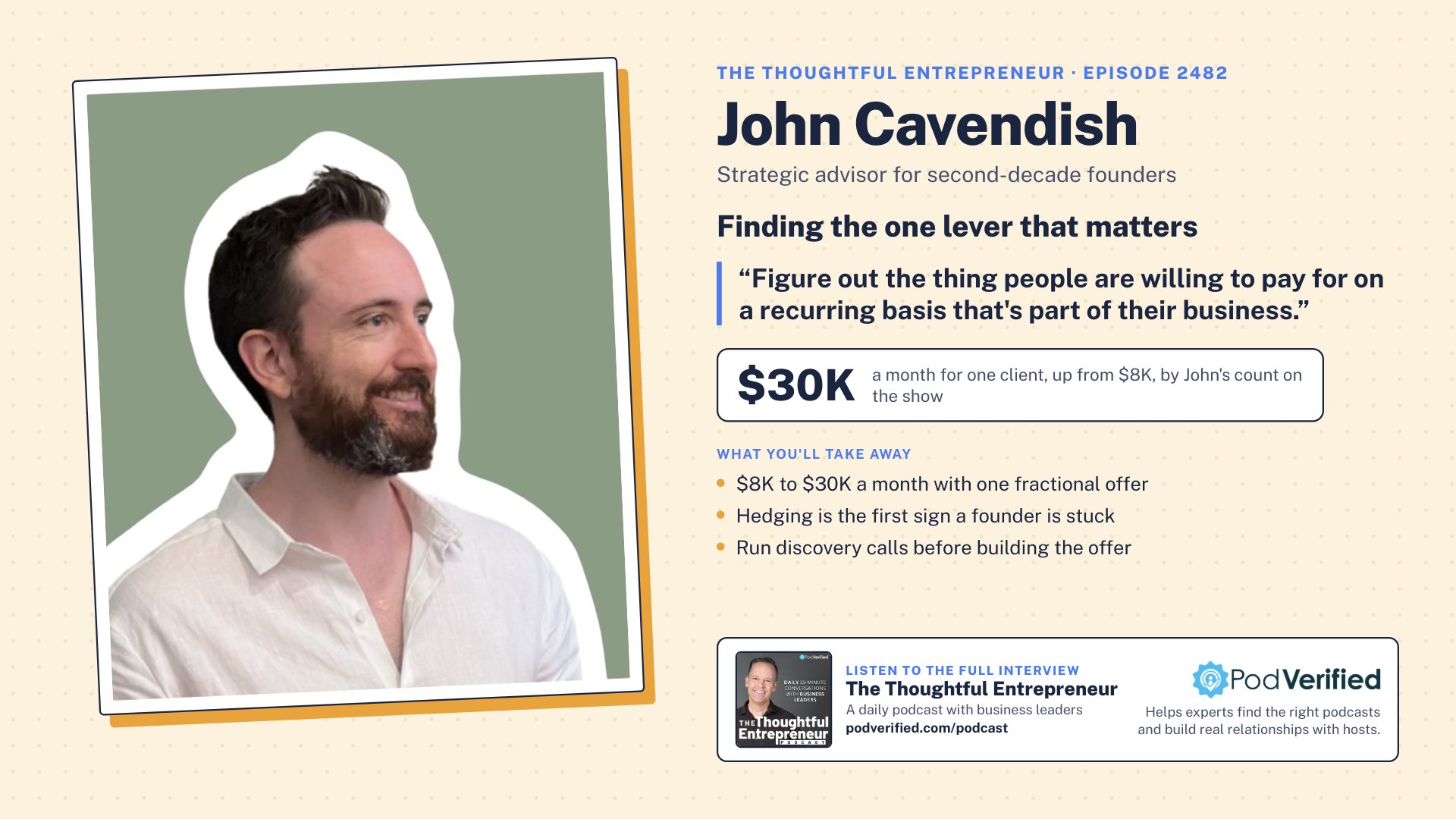
Building Houses and Businesses Without Losing Your Mind with John Cavendish
The Thoughtful Entrepreneur · Episode 2482
The short answer
How can a founder who has been in business for years stop doing too much and grow revenue?
John Cavendish, a strategic advisor for second-decade founders, says founders who feel stuck are usually doing too many things, with several revenue streams each making some money. His fix is one offer and one go-to-market strategy. His rule for that offer: stop selling time, sell something simple and recurring, and make it easy for other people to deliver.
Key takeaways
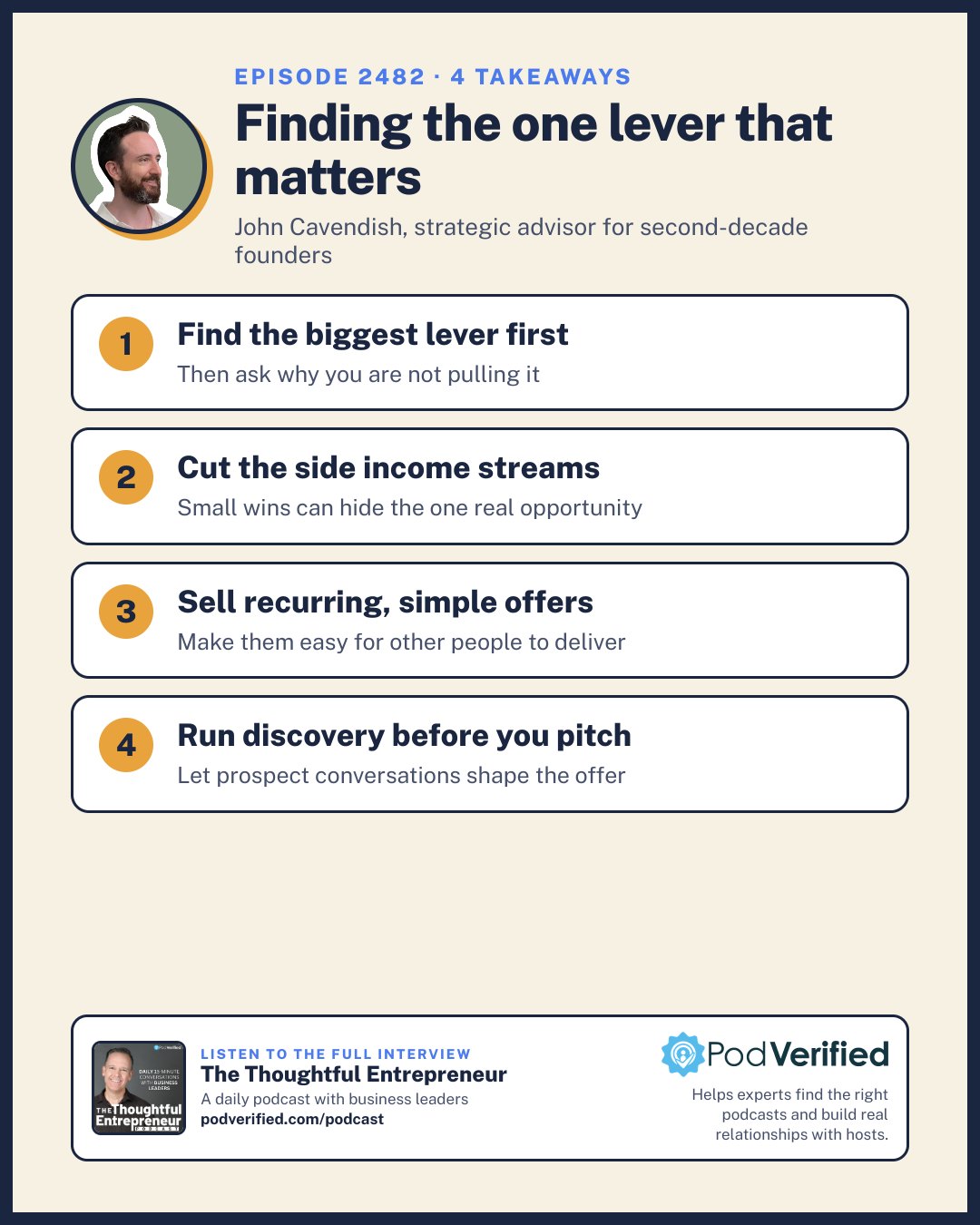
- Long hours can miss the lever. John says founders working 50 or 60 hours a week often spend only one to three of those hours on their biggest lever.
- Hedging keeps revenue flat. Several income streams that each make a little money are the first thing John looks for when a founder is stuck.
- One offer can be enough. John says a service business can scale a single offer, one go-to-market plan, without adding more lines.
- Run discovery before you build the offer. John's approach is to ask prospects about their problems first and shape the offer from what they say.
An AI consultant was billing $100 to $150 an hour and bringing in about $8,000 a month in random invoices. Within a few months, by John Cavendish's account, the same person was at $25,000 a month and then $30,000, selling one month-to-month offer: a fractional AI engineer.
John is a strategic advisor for second-decade founders and a three-time exited founder. On this episode he explains why founders who have been at it a decade usually do too much of everything, and how to find the one lever worth pulling.
🎧 Listen to John's interview
Press play below. About 18 minutes.
Or listen in your favorite app:
Apple Podcasts Spotify YouTube Amazon Music iHeart Audible Pandora Castbox TuneIn
The Thoughtful Entrepreneur is a daily podcast with business leaders. Subscribe so you don't miss one.
How did $8,000 a month turn into $30,000?
The client was a friend of John's. After an e-commerce business blew up, he started a consultancy doing AI work at $100 to $150 an hour, which added up to about $8,000 a month.
John applied the same rules he uses with almost every client: sell recurring models, sell something simple and make it easy for other people to deliver. He says smart founders often find the part clients pay most for is not the part where they spend their brainpower.
Looking at the client's customers, John says they needed someone with a business brain who also understood AI and how to apply it. So they packaged that as a fractional AI engineer. Instead of hiring an AI engineer John put at $20,000 a month, a company could get this client for $3,000 to $6,000 a month, month to month.
By John's count, revenue went to $25,000 a month and then $30,000 within roughly three to four and a half months. He credits getting the offer right for the market at the right time, then pouring gasoline on it.
Straight from the recording
Quotes are lightly edited for readability: filler words and stutters removed, nothing reordered. Times are approximate.
“I work with these people because they were me.”
“Figure out the thing people are willing to pay for on a recurring basis that's part of their business.”
“So to start with, it's all open, and every time we talk to somebody new, we close the loop closer and closer and closer for what offer they might want to offer.”
“I was running away from being poor and I wanted freedom.”
Josh on too many good options
When John said founders do too much of everything, Josh said he could identify with it, and put the problem this way:
“there is an unlimited appetite for activity, for things that you can invest in, for focus.”
Josh added that prioritization is one of the superpowers of a good business owner, including the willingness to skip work you like for the work the business needs.
Questions answered
Why do experienced founders feel stuck?
John says most founders in their second decade know what they should be doing but are not doing it. Usually, by his account, they are doing too much of everything.
What is hedging in a small business?
It is John's word for running several opportunities or income streams at once. He says if you have three revenue streams and aren't above about $80,000 a month, you are doing too many things, and analysis usually shows one or two are the real opportunity.
What is a fractional AI engineer?
It is the offer John helped one client build: a month-to-month role helping a business find and put AI opportunities in place. He said the client charged $3,000 to $6,000 a month, depending on the package.
How do you find an offer the market wants?
John suggests two things. Get an outside view from someone with no stake in your ideas, and run discovery before you pitch an offer, asking prospects about their problems and tightening the offer with each conversation.
How do you work with John Cavendish?
Go to johncavendish.com, read the testimonials and the advisory page, then book a fit call. On the show he described it as a 15-minute call to see if you fit an intensive, which looks for the biggest lever in your business and the block keeping you from pulling it.
Questions to ask your own team this week
Drawn from the examples John gave, not from johncavendish.com.
- Which of our income streams is the real opportunity? John says one or two usually stand out once each is analyzed for growth and sellability.
- How many hours a week go to our biggest lever? John often finds the answer is one to three hours out of a 50-hour week.
- What part of our work do clients pay most for? John says it is often not where the founder spends the most brainpower.
- Could we sell this as a recurring, simple offer someone else delivers? Those are the principles John used with the fractional AI engineer client.
Away from the screen
John lives in Vietnam with his Vietnamese wife and their young son, who had started standing up and walking around at the time of recording. The couple bought a house, then sold it to build one instead.
John says land in a major Vietnamese city can cost New York City prices, because money can't leave the country, so people bank land. A jump in prices pushed his expected cost up by about $100,000, and the build went back to the drawing board. Construction was set to start once rainy season ends, and crews there, he says, work 14 hours a day.
“6 months, they'll build you a 4,000-square-foot solid concrete house.”
Episode details
| Guest | John Cavendish |
|---|---|
| Role | Strategic advisor for second-decade founders |
| Website | johncavendish.com |
| Background | Three-time exited founder and NLP Master Practitioner, per johncavendish.com. Earlier companies include Mayfair Nutrition and Seller Candy, which the site says exited in November 2024. |
| Topics | Founder focus, hedging, single-offer growth, recurring offers, fractional roles, customer discovery, building a house in Vietnam |
| Host | Josh Elledge |
| Episode | 2482, The Thoughtful Entrepreneur |
| John Cavendish on LinkedIn | |
| Listen | Play it on this page, or on Apple Podcasts, Spotify, YouTube or Amazon Music |
We're always looking for great guests
Be our next guest on The Thoughtful Entrepreneur
We publish a new conversation every day, so we're always looking for leaders like John. The guests we love most are generous: real experience, a clear point of view, and something useful to give our listeners. Come ready to teach, and we'll make you look great doing it.
Not ready to apply yet? Get your free PodVerified Score to see how podcast hosts size you up. It takes two minutes.
Full transcript
Filler words and stutters removed. Company and guest names corrected where the automatic transcript misspelled them. Times are approximate.
Read the full transcript
Josh Elledge (00:00): With us right now is John Cavendish. John, you are a, what would you say, a strategic advisor for second-decade founders. You have had 3 exits in your time. You're an NLP master practitioner and you are found on the web at johncavendish.com. John, thank you so much for joining us.
John Cavendish (00:15): Thanks, Josh. Thanks so much for having me and the amazing introduction. And I can be found there. Yes.
Josh Elledge (00:21): So we were talking, I always love to start with a question. I always love kind of finding out what high-level leaders are doing for fun or kind of keeping busy with outside of work. I understand you are in the process, you're currently living in Vietnam and you're building a house there, and that has some steps to it. You shared just a little bit. I mean, it's certainly been keeping you occupied. And I think you've also, you mentioned that you've learned a few things. Tell us what this process is like. And by the way, you're doing this while you have a newish baby.
John Cavendish (00:55): Newish baby. Yes. He's just started kind of just standing up and walking around. So yeah, so we're like settling down and me and my wife, who's Vietnamese, we were like, oh, let's build a house. Let's buy a house. We bought a house. We're like, oh no, screw that. Sell that one. Let's build a house. So we bought a piece of land and Vietnam's crazy. So Vietnam, if you're or anywhere in the world has the craziest real estate market, kind of a bit like China, because it's a closed system. So it's a closed communist system. You can't take money out of the country. So people invest in gold or land? So it's like land banking. It's like an asset. So land is super expensive here, way more than the US, like talking about like New York City prices if you're in a major city here. And we bought some land, we'd got an architect, we started building. Well, we started planning to build. Then Trump invaded the Middle East and all the prices went up for everything in the world. Like, it was costing me an extra, supposed to be costing me an extra $100,000. How much is it costing everybody else in the world? Anyway, so everything's delayed. We're going back to the drawing board. Building in a few months once rainy season finishes. And I'm super excited, but it's definitely a journey. We've been through several crazy things so far in the last 6 months trying to build this thing.
Josh Elledge (02:10): Gosh. Oh my gosh. Well, when are you hoping to have that process done?
John Cavendish (02:18): Well, if we start building the end of rainy season, they throw houses up here. It's like solid, like concrete. So they're like literally building 14 hours a day, every day. 6 months, they'll build you a 4,000-square-foot solid concrete house. Concrete floors and brick walls.
Josh Elledge (02:34): Yeah. Well, congratulations on the endeavor. You know, I know it's, you know, you've had some fits and starts, so we'll just say it that way. You know, John, thank you. I really would love to learn a bit more about your work. I love the title that you have, and I think that this resonates with a lot of founders, particularly if they've been at it a little bit of time. You know, perhaps they expected a little bit different trajectory or experience at this point, but they're here, and you know your opening line is you built this for freedom, so why do you still feel stuck? What is your experience of you know working with the kinds of clients that you do? Obviously, you've been through some exits. You've been through this process. Explain this dynamic.
John Cavendish (03:30): Yeah, thanks for asking. I mean, I work with these people because they were me. You know, I was doing the same thing. I was building, building, building. And I wasn't experiencing the freedom that I thought I would experience on the other side. You know, a lot of I think a lot of us go if we get to here, then I will feel like this. If we do this, then I will feel like that. And I was holding it over myself like a hammer, you know, as they say, like push motivation. I was running away from scarcity, away from lack of money, being poor. Or not having freedom rather than towards some amazing vision. I heard all these entrepreneurs and all these coaches talking about you need this cool vision that you're running towards, but I didn't have it. I was running away from being poor and I wanted freedom. So I got super into, you know, Tony Robbins several years ago. I credit that for like my ability to connect with people, meet my wife. It changed me a lot. And then once I sold the last company and I had the baby, like perfect timing, after some time off, I got really deep into becoming an NLP master practitioner and applying all the stuff that I've learned over the last decade in business and also through all the Tony Robbins stuff to helping others and really figuring out why they're stuck. Because most people in their second decade, they know what they should be doing, or they have a good idea, but they're just not doing it. So the figuring out is what's the biggest lever in their business and how can we figure out why you're not pulling it and make things easier. Usually it's not that they're not doing enough, it's that they're doing too much of everything. And I can talk you through if you want that a little bit.
Josh Elledge (05:06): Yeah. All right, let's just continue on in this journey. Doing too much of everything, I can identify with that. No, I think a lot of people can because, you know, John, there is an unlimited appetite for activity, for things that you can invest in, for focus. And that's overwhelming. So a lot of times it's, you know, I think it's just really just a question of where it's really. And I think, you know, one of the superpowers of being a great business owner is just, you know, where do you prioritize? It's all about prioritization and just having that wisdom and also drive to do the things that really matter when there are a lot of other things that we might opt into because we're like, well, maybe that's not as challenging. I like doing this better, but maybe that's not the thing that my business needs, but I'm not willing to engage in that conversation in my head. I don't know if this is a dynamic that you see or how you would describe it.
John Cavendish (06:05): Exactly. Yeah. So you talk to someone, they're like, I'm working 40 hours a week, 50 hours a week, 60 hours a week. But then once we've had a conversation, we figure out what the biggest lever is in their business. Well, how many hours a week are you working on that? We get down to, oh, 1, 2, 3. Say the biggest thing is lead generation or going on podcasts, and they're going on 1 podcast every 2 weeks. You're like, oh, okay. Okay, well, what brings you clients? Well, podcasts have been my main lead generation form so far for clients. Well, how many podcasts does Josh do every 2 weeks or every month? Maybe more than 2. So the 3 biggest things that I see, like the 3 biggest things that people get stuck on and the reason they're not moving forward. Tip from Josh, 3 biggest things are, well, the first one's hedging. So I talk to a lot of people, I ask, what are you doing? And they usually say, I've got this opportunity, that opportunity, I'm doing this business, that thing, I've got these 3 income streams for my business. And then I ask how much revenue you're doing. And if you're not doing more than, I don't know, $80K a month when you've got all that going on, you're doing too much. You're doing too many different things. And all of them are doing something. Like usually I talk to entrepreneurs in their second decade. And all of their revenue streams are making some money and they don't wanna kill the thing making $2,000, $4,000, $8,000 a month. But when we get down and deep and we analyze each of the opportunities and we figure out, okay, well, which one is the real opportunity, both in terms of growth and also in terms of like a sellable business? Usually it becomes pretty clear that either one or 2 are the thing. And that level of clarity means that we can just start chopping off all this other stuff. Because really, you wanna make $1 million, you only need, I mean, only, you only need to be having, you know, ideally one offer, one go-to-market strategy. And, you know, whatever your business model is, it's just one thing. You know, you should be able to scale one offer to $1 million, whether it's helping people with podcasts, whether it's scaling you know, an offer that you're selling as a service business, you know, it's only 8 clients at $5K a month. That's 40. It's only 12 clients at $5K a month and you'll get your million dollars. It's not crazy, crazy. It's just what's the plan to get from here to there?
Josh Elledge (08:18): So who would be some examples of folks that you have worked with? And I mean, you're right. I mean, that sounds like an incredibly simple formula. I feel like a lot of founders would then look at that and go, yes, on paper that sounds incredibly simple. But the, you know, the reality is it's kind of almost like building a house in Vietnam. I mean, it's, you know, there are just things that are gonna come up and, you know, I wish I could get to 8 $5,000 clients, but again, there's all this and all that and this and that. And, you know, so where do we go from there?
John Cavendish (09:00): Good question. So I'll use an example and I'll explain how we applied it to this client. This is one of my clients. So when he came to me, he was making, say, $8,000 a month. He's a friend of mine. He'd done a few businesses. This was a new one he'd started because he had an e-com business and then everything literally blew up, caught fire. So he started a new consultancy business. And he was like, okay, John, how do I scale this up? So we applied my kind of principles of almost everyone I work with. If they are working on a new offer or a new way to sell their offer, which is stack the bricks in your favor, stack the odds in your favor, sell recurring models, sell something simple, and make it easy for other people to deliver. Because too often people, well, clients, and I know we all are as well, we're experts in the business we get into, so we think we have to be super smart in what we do. Like, we need to apply our brainpower in order to move things forward. And most people I work with are super smart people, and they don't, you know, then they quickly realize that the bit the client wants the most and pays the most for isn't necessarily the bit they're applying their brainpower. It's this bit of their process. So if we can take a step back and stop selling time. Of course, as everyone always says, don't sell time for money, but stop selling time. Figure out the thing people are willing to pay for on a recurring basis that's part of their business. Then we go back to market, we figure out, okay, how do we apply that? So for this guy, he was doing AI. It's very trendy, but he was doing AI consulting for $100, $150 an hour. We took a step back and realized that what all his clients needed was somebody with a business brain who also understood the AI and how to apply it. So we said, okay, what is that? Well, fractional is super hot and important right now. Fractional is a super hot topic right now. So we came up with the idea of a fractional AI engineer. So we went out to market saying like, we will be the fractional guy in your business. So rather than hiring a real AI engineer who'd cost you $20,000 a month, you can have me, which is him, for depending on the package, $3,000 to $6,000 a month. I'll be there. Figuring out opportunities, implementing them with you, and getting things moving forward. And it's just month to month. And that was the offer we went to market with. And very quickly, he went from $8K of randomly invoiced revenue to $25K a month and then $30K a month within 3 months. 4 and a half months because we got the offer right for the market at the right time and then just poured gasoline on it.
Josh Elledge (11:31): Yeah. Well, how did you get that figured out? So I know that, you know, as I've talked with founders and I've been through this, right, where, you know, you kind of put something out to the market and it's like, it's not quite there yet. You know, and so you have to iterate and you have to iterate and it can be frustrating to get to that point. But ultimately, hopefully you find it, right? You get it. How do you get to that part as quickly as possible?
John Cavendish (11:59): Good question. So I think there's 2 approaches. First one is most people, most of us, if we've been in business for a decade, have been doing what we do for too long, and we have lots of pre, you know, pre-misconceptions, pre-thoughts about what the market wants and doesn't want. So I think having somebody to bounce ideas off who hasn't got any oar in the game is useful, whether that's me or whether that's just another business friend or business adult who can be there and sit with you and go, does that make sense? What about that? What about this. The other, because we're working on a new offer now with one of my clients, I think is don't go in with the offer. So build the hand-raising outbound. So whatever that is, like this is the problem outbound to people. Like, do you have this problem? Do you have that problem? Do you have the other problem? I'm building this, which I've worked with on a different client. Would you like to talk about it? So we just run discovery. So we get in there, we have a really well-formatted discovery script. If you want my discovery script, you can just reach out to me on my website. But just run discovery. And just be totally open to ideas. So run a well-framed discovery call, lots of questions, and then come back like, okay, I'm going to put something together that how we might be able to work together. So to start with, it's all open, and every time we talk to somebody new, we close the loop closer and closer and closer for what offer they might want to offer. Does that make sense? I know I'm trying to speak in generalities, but people that people understand.
Josh Elledge (13:26): No, absolutely. Your website, johncavendish.com. Can you share just a little bit about, you know, how you engage with folks, what that looks like?
John Cavendish (13:35): Sure. So the way I work with people is I only work with people who've, you know, been in business for a while. It might be a decade, it might be 5 years, but they've got over the initial hump. Like, they've proved that, you know, it may have gone up, may have gone down, but they've continued to push forward. You know, that's what you said about business adults. I think business adults are people that have put their oar in and just continued. Sometimes it's amazing and you're making hundreds of thousands of dollars, and sometimes it's a bit shit. So it's not, it's not great. And you lost 50 grand, you lost 100 grand, but you're still moving forward and on the way up. So, you know, if you're interested, you check out my website, you book a fit call with me. It's a 15-minute call for us to jump on and see if you're a good fit for an intensive. And on that intensive, we see if you're a good fit to do longer work. But the goal of an intensive is figuring out the biggest lever that we just talked about, the biggest lever in your business, the thing that if you put gasoline on it will make you a bunch of money, and the block, like the thing that, the reason you haven't pulled the lever yet so that you can become obvious, you know, obvious, it can become open. And half the time you know, we solve things just because we're aware of them, aren't we? Because when we're not aware of something, then it's just there in the background. Once we're aware of both of these things, naturally you'll start to figure out solutions because we all do, you know, we're all smart people. Like coaching, which is kind of what I'm doing, strategic advisory and coaching, is a want, not a need. You know, you have to want it and you have to want the results. And if you want it, I'm there to help my clients who want me to be on their side of the table, being their, you know, co-CEO, co-director and figuring stuff out together. You know, no judgment. We all go through good stuff, bad stuff, and I'm there to be with them.
Josh Elledge (15:16): Excellent. johncavendish.com is the website. When folks go there, what do they click on? What would you recommend their next steps be?
John Cavendish (15:24): Oh, very detailed. I click around, look at the testimonials, look at other stuff, then book a fit call. Click on the book a fit call and jump on with me for 15 minutes. But yeah, first thing to do is go to the website, check out the client testimonials, check out the advisory page, and if you resonate with the advisory page, then you should book a fit call. That's the main thing. The advisory page is the best page that best articulates exactly what I do.
Josh Elledge (15:50): John Cavendish, again, you are strategic advisor for second decade founders. I like that. 3-time successful exit. John, it's been great. Thank you so much for the conversation.
John Cavendish (16:00): Thank you, Josh.