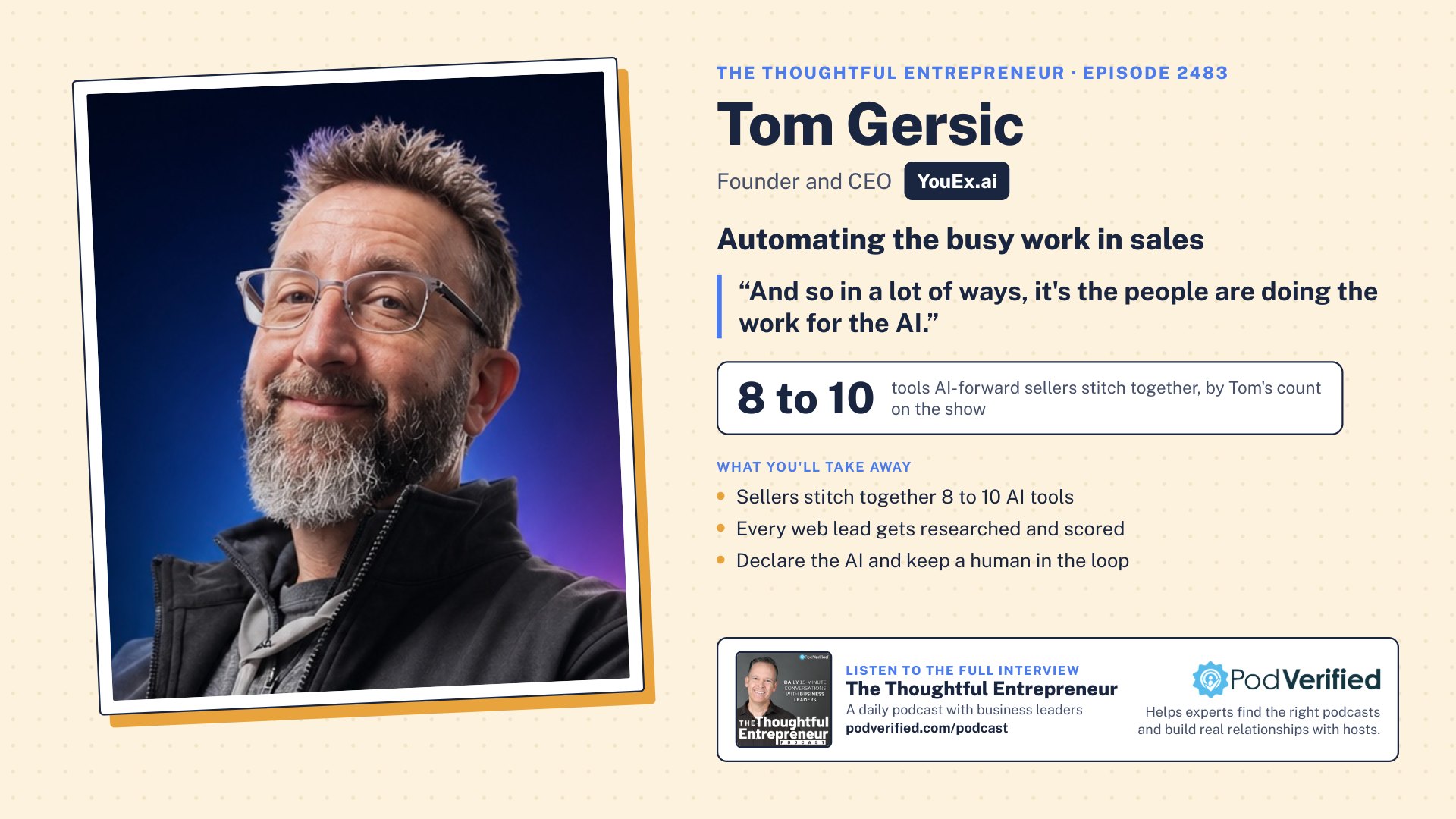
Automate the Busy Work, Amplify the Human Touch with YouEx.ai's Tom Gersic
The Thoughtful Entrepreneur · Episode 2483
The short answer
How should sales teams use AI without juggling a pile of separate tools?
Tom Gersic, founder and CEO of YouEx.ai, says sellers on the cutting edge of AI are stitching together eight to 10 tools and copying data between them, so people end up doing the work for the AI. His answer: one AI workflow that starts at the website lead, says it is AI and makes the handoff to a person clear.
Key takeaways
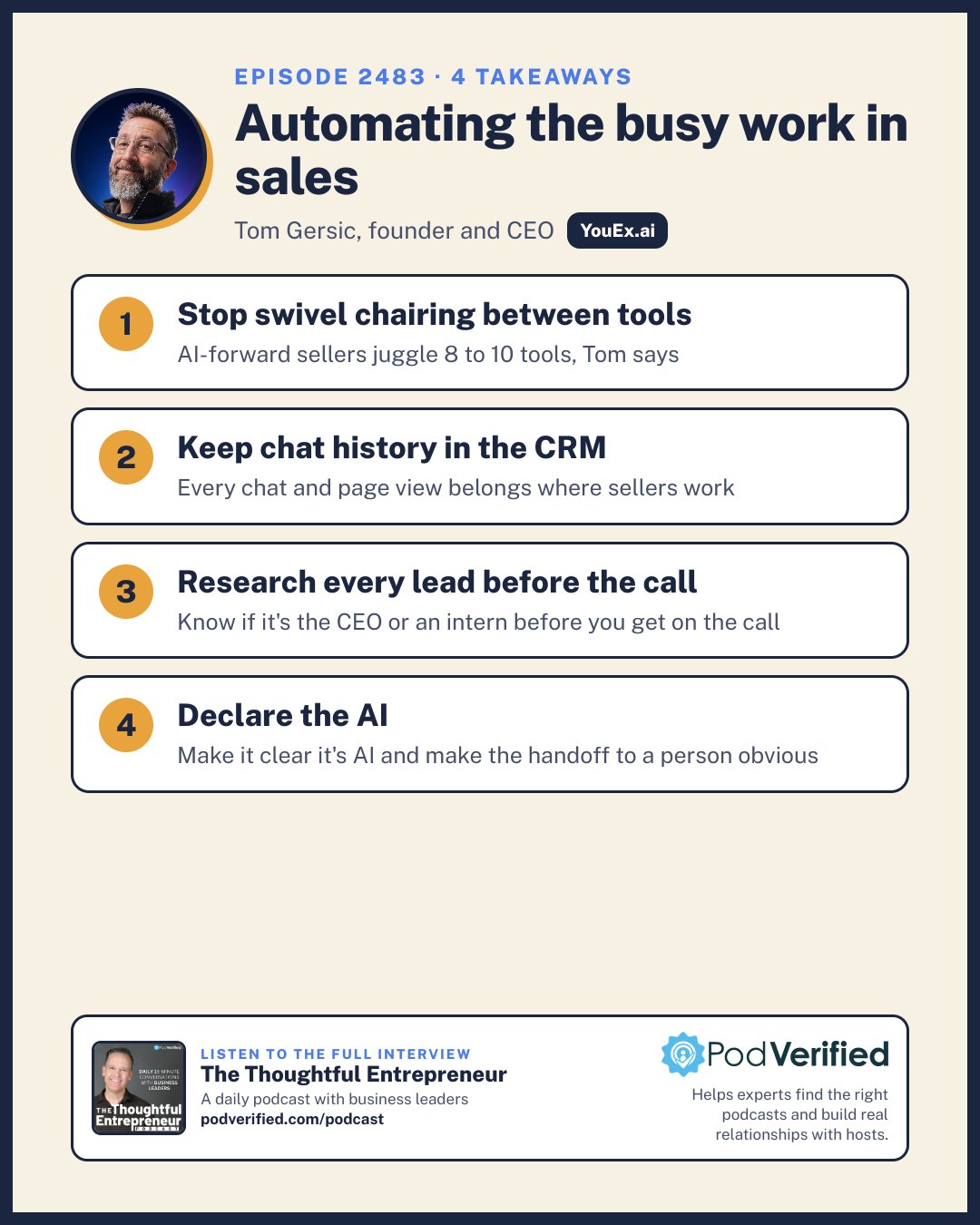
- Sellers are swivel chairing between tools. Tom says the people pushing hardest on AI in sales stitch together 8 to 10 tools and copy data between them.
- Engineers are ahead of sales. Tom points to coding, where AI runs through code review and the code repository, as the model sales hasn't caught up to.
- Say it's AI. Tom says a website chatbot should be clearly AI, and that rules like the EU AI Act are moving that way.
- Every lead gets researched. By Tom's description, YouEx.ai checks LinkedIn, Google and the lead's employer's website to judge buying authority, then routes the lead.
Sales teams trying to stay ahead with AI are often running 8 to 10 tools at once, Tom Gersic says. ChatGPT, Claude or Gemini, tools to find email addresses, tools to send email, spreadsheets. Then people copy data from one to the next by hand. In Tom's view, the people end up doing the work for the AI.
Tom is the founder and CEO of YouEx.ai, a software platform that takes a lead from a website chat to a booked meeting. On this episode he tells Josh Elledge where sellers lose time, why AI should announce itself, and what happens to a lead before a salesperson ever sees it.
🎧 Listen to Tom's interview
Press play below. About 18 minutes.
Or listen in your favorite app:
Apple Podcasts Spotify YouTube Amazon Music iHeart Audible Pandora Castbox TuneIn
The Thoughtful Entrepreneur is a daily podcast with business leaders. Subscribe so you don't miss one.
What happens to a lead before a salesperson sees it?
Tom walked Josh through it step by step. It starts when someone lands on a company's website and talks to the AI agent there. YouEx.ai logs the full chat history, including every return visit and every chat, plus each page the visitor scrolled or clicked. That record sits in the CRM, not in Google Analytics or a separate marketing tool, and the system writes a summary of what the person cared about.
Next comes research. Tom says every lead gets a multi-phase check of LinkedIn data, Google data and the visitor's employer's website. The goal is to know before the call whether you're talking to the CEO, an executive with purchasing authority, or an intern doing research for someone else.
Agents then score the lead, hot or cold, high intent or not, and send it to the right person. Teams can use plain round robin. Tom described a second option: each salesperson writes down what they're good at, technical work or a legal background, for example, and the AI matches leads to them. If a company's CTO is interested, the lead goes to the technical rep.
From there, Tom says, the job belongs to the seller. Once the meeting is booked, it's on the salesperson to build trust and make the sale.
Straight from the recording
Quotes are lightly edited for readability: filler words and stutters removed, nothing reordered. Times are approximate.

“And so in a lot of ways, it's the people are doing the work for the AI.”
“And then once you have the meeting, it's on you to sell, right?”
“It created jobs. It created more effort and more work. And AI will do the same thing.”
“I can set up time with Josh. You know, are you available tomorrow at 3 PM? Because he is.”
Josh's worry about bots
Before asking for best practices, Josh asked Tom for the worst ones. His concern was personal:
“my fear would be, you know, that sales impersonates me poorly.”
Tom's answer: declare AI when it's AI, keep a human in the loop to review drafts, and make the handoff to a real person clear. He also listed the tells that give AI writing away, including em dashes and the same stock phrases repeated again and again.
Questions answered
What is swivel chairing in sales?
Tom uses it to describe copying data from one tool to another by hand. He says sellers pushing hardest on AI often stitch together 8 to 10 tools, so the people end up doing the work for the AI.
Should AI sales tools pretend to be a person?
Tom says no. He wants AI declared as AI, or a human reviewing drafts before they go out, and he points to the EU AI Act as a sign that disclosure is becoming a regulatory requirement.
Will AI replace salespeople?
Tom says companies that replaced people with AI have backtracked and rehired. He compares AI to the computer, which he says broadened the economy and created jobs, and expects companies hiring sellers who use AI to get ahead faster.
How does AI lead routing work?
Beyond round robin, Tom says each salesperson can describe their strengths and the AI matches leads to them. A CTO showing interest, for example, gets paired with the technical rep.
How do you get started with YouEx.ai?
Tom suggests starting with the videos page at youex.ai, including a walkthrough of setting up the web agent. You can book a demo through the AI agent on the site, start a 2-week free trial that Tom says has no limits, or get in touch with Tom directly.
Questions to ask your own team this week
Drawn from the examples Tom gave, not from YouEx.ai's marketing.
- How many tools does a lead pass through before a rep calls? Tom's count for AI-forward sellers is 8 to 10, with data copied between them.
- Where does our website chat history end up? Tom wants it in the CRM, not hidden away in Google Analytics.
- Do we know a lead's buying authority before the first call? Tom's example: is this the CEO, or an intern researching for someone else?
- Would a prospect know when they're talking to AI? Tom says it should be obvious, with a clear handoff to a real person.
Away from the screen
Tom spent two weeks in Croatia this summer with his family. His last name is Croatian and his grandparents immigrated to this country, but he had never been. They stayed in Dubrovnik, whose old city walls appear in Game of Thrones, then went to the island of Brač and to Split.
Tom says you can walk along the top of the walls, used for defense for more than 1,000 years, and stop for a drink at the restaurants up there. Josh hoped none of them was a McDonald's. Tom says the food is authentic Croatian, and his family never had to wait for a table.
“Such a beautiful place. I can't recommend it enough.”
Episode details
| Guest | Tom Gersic |
|---|---|
| Role | Founder and CEO, YouEx.ai |
| Website | youex.ai |
| Background | Tom spent more than a decade at Salesforce following the Model Metrics acquisition, then led AI and Data go-to-market at Altimetrik before founding YouEx.ai in 2026. |
| Topics | AI in sales, CRM data entry, website chat agents, lead research and scoring, AI lead routing, AI disclosure and the EU AI Act, travel in Croatia |
| Host | Josh Elledge |
| Episode | 2483, The Thoughtful Entrepreneur |
| Tom Gersic on LinkedIn | |
| Listen | Play it on this page, or on Apple Podcasts, Spotify, YouTube or Amazon Music |
We're always looking for great guests
Be our next guest on The Thoughtful Entrepreneur
We publish a new conversation every day, so we're always looking for leaders like Tom. The guests we love most are generous: real experience, a clear point of view, and something useful to give our listeners. Come ready to teach, and we'll make you look great doing it.
Not ready to apply yet? Get your free PodVerified Score to see how podcast hosts size you up. It takes two minutes.
Full transcript
Filler words and stutters removed. Company and guest names corrected where the automatic transcript misspelled them. Times are approximate.
Read the full transcript
Josh Elledge (00:00): With us right now, it's Tom Gersic. Tom, you are the founder and CEO of YouEx. You're found on the web at youex.ai, and that's Y-O-U-E-X dot A-I. Tom, it's great to have you.
Tom Gersic (00:15): Oh, thanks so much for having me on, Josh. I'm really excited for the conversation today.
Josh Elledge (00:18): Yeah, absolutely. And you know, before we get talking about the work you're doing, and by the way, if you are interested, to our friend that's listening, if you're curious in keeping up to date with what is happening at the intersection of AI and sales, please stay tuned because that's what we're going to get into. But Tom, before we do, I understand you recently had a vacation to Croatia. Tell me about that.
Tom Gersic (00:45): It was amazing. I've always wanted to go. My last name, Gersic, is Croatian, but I'd never been. My grandparents immigrated here. And, you know, so I've heard my whole life about how beautiful the country is. And really, this was the, you know, the summer we finally got to go. Such a beautiful place. I can't recommend it enough. Beautiful beaches. It's mostly beaches. Like, it's beaches all along the coast. It's right across the Adriatic from Italy. And just, we stayed in Dubrovnik, which is where a lot of Game of Thrones is filmed, like all the giant walls and all of that in Dubrovnik. And then we went to the island of Brač and then a little bit in Split, and we spent 2 weeks there and just had an amazing time with the family. So I can't recommend it enough.
Josh Elledge (01:24): It's such a beautiful location. Yeah. Did you happen to see some sites and they're like, yeah, this is in Game of Thrones?
Tom Gersic (01:30): Yeah, 100%. Walled city of Dubrovnik is this place called Old Town, and it's actually a walled city. There's walls all around. It's been used for defense over like 1,000 years. You know, as a... it's a medieval city, and it's all built out of like stone, this like beautiful white marble that's from the island. And so like the streets are paved in marble, the buildings are white. It's just an amazing city with all around the walls. And you can go for a walk around the walls, and it's the actual... it is the walls that are in Game of Thrones. And it goes all the way, and you can walk along the top of it, and there's like restaurants on top, and there's all sorts of... you could stop for a drink and take a look out over the sea. And it's... yeah, so you absolutely do see the gates and the walls and different sites from the show.
Josh Elledge (02:11): Yeah, it's pretty amazing. They don't keep the restaurants kind of like authentic to the age, right? They don't have a... hopefully they don't have a McDonald's up there, but they, you know
Tom Gersic (02:21): No McDonald's is not authentic to the medieval times, but authentic to Croatian cuisine for sure. And a lot of restaurants, like, we never had to wait. And there's a lot of tourism there because of Game of Thrones and all that, but like there are so many restaurants. You could... you walk right in and, you know, you'd always find a place because there are so many restaurants throughout that area.
Josh Elledge (02:40): Just amazing. Amazing food too. So yeah, everything. Excellent. All right, thank you so much for sharing that. I am inspired. I'm definitely... you want to hit up some Google Images and take a look at, or unless you shared some photos on your social media or whatever, I could go look at that. But that sounds awesome. Hey Tom, let's talk about your superpower. And I'm hoping maybe you can just kind of start with a kind of a quick 101 or kind of a state of the union of where we are right now with AI-enabled tools and sales. There's a lot of sales that is just very labor-intensive, it's very time-consuming, and then there are things that, you know, just kind of maybe a little bit more high-touch and also time-consuming. So where are we today?
Tom Gersic (03:31): Great question. I'll just say, I'll start with saying like our goal is really to help salespeople do more of what they're really good at and what people are really good at and salespeople are really good at building relationships, building trust, meeting with people, talking with people. The thing that just takes a ton of time is all the busywork. You know, people don't like updating a CRM. People don't like all the data entry. They don't like all of that kind of a thing. And so what we're really trying to do is to automate a lot of that. And if you think about AI right now for sales, I would say there's kind of 2 perspectives on it that I would say. One is that there's a million tools out there and the people who are really kind of trying to be on the cutting edge of AI and sales as they're selling are typically stitching together 8 to 10 different tools. They've got probably ChatGPT and/or Claude and/or Gemini, probably a little bit of all 3. They're using a variety of different tools to get email addresses and to send emails. And spreadsheets and they're copying data from place to place. And so in a lot of ways, it's the people are doing the work for the AI. They're copying data from place to place, they're swivel chairing, and they're not getting the full value out of deeply embedding AI into workflows. And if you look at where people are getting a lot of value out of deeply embedding AI into a workflow, the people that are way ahead of the game are engineers, right? So when you really think about like coding and, you know, the people who are using Claude Code and Codex and Cursor, and all of these tools for vibe coding, those are the, that's the kind of industry right now, or, you know, the group of, you know, people, roles that are getting that deeply embedded, like what does it look like when you're really getting deeply embedded into your workflow? And that means that it's not just the tools that people are using to generate the code, it's also the code review. It's also as they push code into, you know, a source code repository, it's running additional things off of there. Agents are going and improving the code. And all of these things are really deeply embedded. Deeply embedding into workflow. That's what's missing right now in sales. Right now you have a bunch of point solutions people are stitching together. They're coming up with their own workflows and it's not really getting that value that you would have out of a deeply embedded workflow for sales. That's what we're trying to solve for. And what we're, our thesis to say, rather than yet another sales point solution, have an AI workflow that starts from the very beginning from a lead and say, okay, you could have a lead from a website. What's the best way to make a website less like just a brochure and more interactive, more conversational, really help people to understand what you're offering and is, you know, start to use AI for that. And then also have AI review your email, have AI do all these types of things so that you're not spending time updating CRM, you're getting that much more value out of a CRM by having it already have all the information you need and then giving you information back. Giving you analysis, telling you, okay, this is what you should be following up on. These are the leads that you haven't followed up on. Do you want me to send an email? Things like that are the things that AI can do. And then once you have the meeting, it's on you to sell, right? Like, you know, you have a meeting with somebody, that's what you're really trying to do is to get on a call and really try to, you know, build trust, build a relationship and have that ultimately that sale. So that's the goal. And that's what we're really trying to do is to embed AI deeply into a sales workflow by making sellers that much better at what they do. And I think what the industry is missing right now is this notion around, oh, is AI replacing sellers? Is AI replacing engineers? Is AI... and in some cases it is, and it's always a mistake. You know, and the companies that have gone and done that have backtracked and they've rehired people. And because ultimately AI is a technology like any technology. You know, when we had the launch of the computer, people had the same concerns, like, oh, it's gonna put people out of work. And ultimately, when you look at it, kind of the broad strokes and macroeconomic effect of computers, it didn't put people out of work. It, you know, it broadened the economy. It created jobs. It created more effort and more work. And AI will do the same thing. It's a technology. The more people are using it, the more value they get out of it, the faster they are getting that sort of use and value out of workflow with AI. The quicker we get, you know, that much more done. And ultimately, the companies that are hiring sellers that use AI are the ones that are going to be getting ahead that much faster. And that's what we're trying to enable.
Josh Elledge (07:59): So Tom, I'd love to get your take on maybe a couple of other best practices for leveraging AI effectively if you are responsible for sales for your organization, particularly if you're a founder that's doing that work. But before we do, I'm hoping maybe you can give us a couple of worst practices. Because I think that there are some ways that I, you know, I've been seeing some, especially on the marketing side, you know, I've just been seeing some, you know, lazy AI-enabled marketing, and it's pretty off-putting. And I have to tell you that then when we get to sales, which is, you know, particularly for those of us who are a little bit higher touch in that effort, you know, my fear would be, you know, that sales impersonates me poorly. And then damages a relationship where I would feel kind of like, ew, why, man, you know, it's like, Tom, I thought we had something here. And now it's just all your bots trying to impersonate you. That's obviously not you. Like, that would be my fear, like, that that would happen.
Tom Gersic (09:14): I think it's important when you're using AI in sales to declare that it's AI and to make it, or to have a human in the loop so that it's not. If you're generating a draft and then you're reviewing it and sending it, then that's different, right? But I think especially as we start to think globally, one, it's a best practice, but two, it's a regulatory requirement as you start to look at things like the EU AI Act that does start to require AI-based generated materials, whether it be, you know, email or text or, you know, video or, you know, audio or any, really any media, we're starting to see a regulatory framework, especially coming out of the EU, around requiring some sort of declaration that this is AI, you know, or it has to be obvious that it is. So I think impersonation is not really what the gold standard should be. It should be an ability to say, okay, we have a chatbot on the website. It's clearly not a person, you know, and we're not trying to claim that it's a person. It's clearly an AI, but it's based around enabling somebody to get that much more information out of what they're trying to research or how they're trying to engage. And then make it clear where there's a handoff, you know, if you want to have a handoff be a scheduled meeting, have the AI be able to say, I can set up time with Josh. You know, are you available tomorrow at 3 PM? Because he is. That kind of a thing is something that then you have a clear handoff to a real person. And then the other thing, you know, as you're generating, you know, an email or whatever, a lot of it is like, there's so many tells, right? Like if you see an em dash in an email or, you know, or a whole bunch of em dashes, or you see like just the whole like compare this with that, or, you know, a lot of talk about like, oh, these are the people that will win, you know, like that AI keeps says these like same phrases. Again and again and again. But I think also, like, one of the things we've really built in is to say, you know, we can generate an email, we can have it ready to send, you should review it. And at some point you can have it automate, but we, you know, we'd like to be truthful and trustworthy about what we're sending and not have it try to impersonate a person, but have it ultimately be something that is, you know, compliant with regulatory frameworks, but is also clear with people what they're getting.
Josh Elledge (11:32): So the high-level features for YouEx.ai is where does that... help me understand. Or give me maybe just like a case study of like, you know, where this fits in, what it's going to be doing for us. Because I know also too, of course, you know, this integrates with Zapier's MCP integration. Which basically means it's going to integrate with about everything else in our systems. But outside of that, can you help us just understand where this fits in? And I should say, you know, looking at your pricing on your website. I mean, this is just... it's a SaaS platform. It's priced as a SaaS. It's very accessible right now. Okay, so the workflow.
Tom Gersic (12:14): Workflow starts from a lead coming into a system. Our goal is to say we want to bring web leads more directly into a sales process. I think there's a lot currently over the history of websites, it's been this sort of like marketing function and then you have like a sales function handoff to say, okay, we can actually bring that directly into a sales platform by using AI, make it that much faster to get a web lead. Then you have, if you have a person who's engaged with your website, who set up a meeting with you via your website, via an agent, you have a lot of things. You have, first off, the information that they asked about in the chat. We're logging the entire chat history that they asked. And that's not just that one visit, but if they've come back multiple times to your website and had multiple chats with that agent, you know every single one of those in our CRM. We also know every single page you've scrolled on, clicked on, everything like that also logged. So you have information in rich detail directly in the CRM, not hidden away in Google Analytics or some other marketing platform. It's right in your CRM. All of the data is there, but we also summarize it so we can make it easy to just look, okay, this person's interested in this. We also have... once it's logged in the CRM, every single lead gets researched. That's a multi-phase research. It goes out and searches LinkedIn data, Google data. It searches your employer's website to see, are you the CEO? Are you an executive who has purchasing authority? Or are you just an intern who's doing research for somebody else? Like, what is the level that you're, you know, interacting with when you jump on a call so that you know. And then we have agents that will then score that lead, make it clear, you know, what that kind of overall scoring is. Is it a hot lead? Is it a cold lead? Is it an important, you know, high-intent, high, you know, purchasing authority buyer? And then send that to the right person. So we have an AI-based routing system that doesn't just... we can do round robin where it just assigns like a normal workflow, but we also have an AI-based routing system where each individual salesperson on your team can describe what they're good at. If you have one person who's more technical and you have one person who maybe has a legal background and you have another person who has, you know, whatever, they can put that in there and then the AI can look and say, okay, this is somebody who needs more tech. You know, the CTO at this company is interested. Let's pair them up with this technical resource. And then they can have a better conversation. So it's a, our goal is to say, okay, we have lead to opportunity. We're trying to be a really, really efficient CRM that allows people to get leads converted to opportunities and to track their opportunities and move that into revenue and ultimately use AI along the way.
Josh Elledge (14:55): And so for our friend that's been listening here, your website, Y-O-U-E-X.ai. And when they go to the website, what would you recommend they do?
Tom Gersic (15:06): I would say, you know, we just published a really great video that kind of gives a walkthrough of how to set up the web agent. I would take a look at the videos page and start to look through, you know, a little bit of that. We're gonna start posting more videos now that we've, you know, sort of started to do a little bit of that video. Also, you know, just take a look at the book a demo link because you can interact with the agent right there. It will connect you, you know, to us to set up a demo and we can walk you through how it works. There's a free trial as well. So if you are interested in doing a free trial, that's an unlimited free trial. You can start a 2-week trial, put it on your website, see how you like it. It works just as if you had a paid agent. If you're paying it, we're not limiting it in any way. So you can use the free trial as well. And then set up a demo or get in touch with me and I'm more than happy to discuss it as well.
Josh Elledge (15:57): Tom Gersic, founder and CEO of YouEx.ai, found on the web at youex.ai. Tom, it's been a great conversation. Thank you for joining us.
Tom Gersic (16:07): Yeah, thanks so much, Josh. Really enjoyed it.