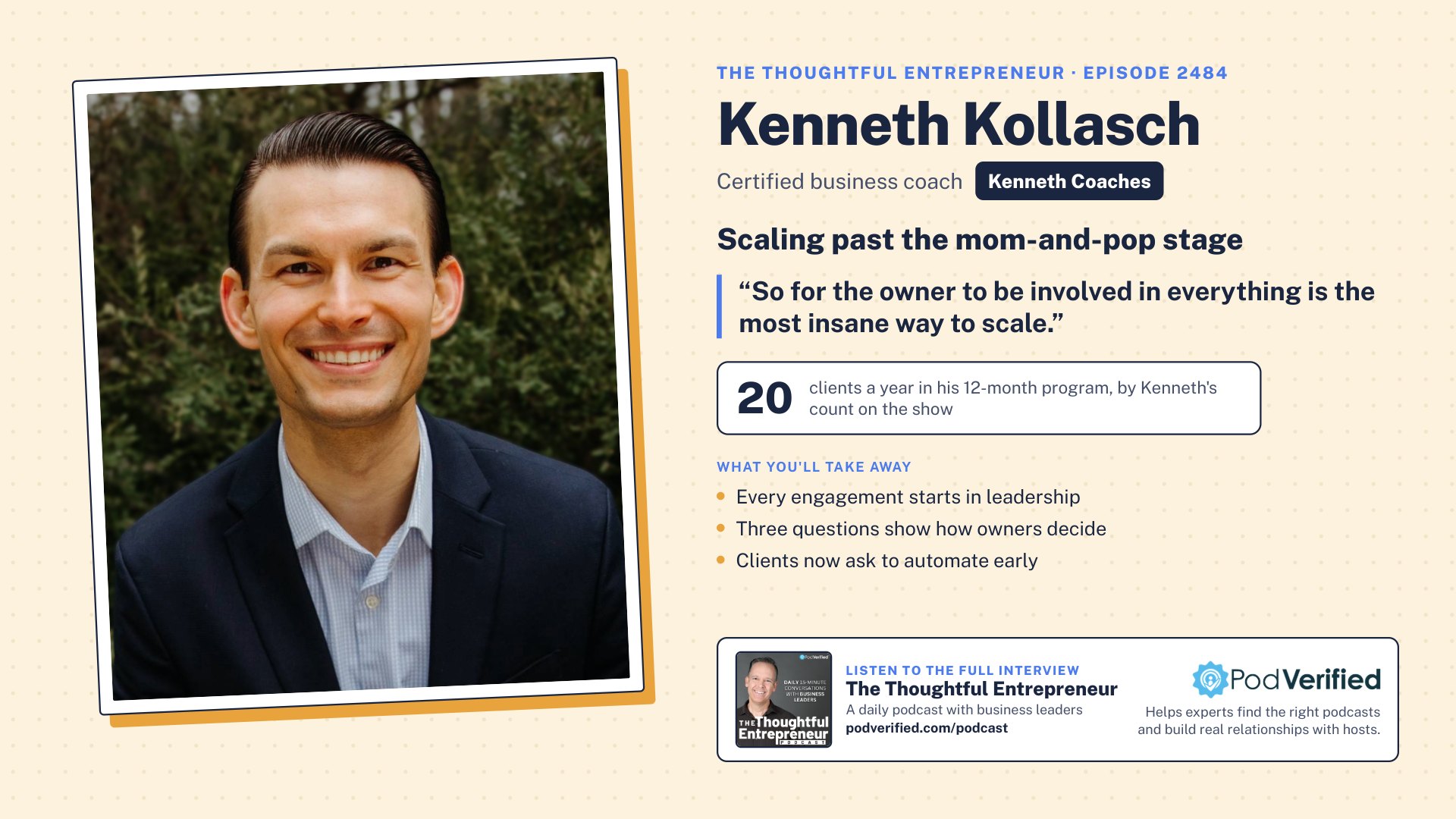
Coaching Small Business Owners Through Leadership Challenges and AI Automation Trends with Kenneth Kollasch
The Thoughtful Entrepreneur · Episode 2484
The short answer
How does a small business owner scale past the mom-and-pop stage?
Kenneth Kollasch, a certified business coach who runs Kenneth Coaches, says a business is still mom-and-pop when all the decisions funnel through the owner, and he calls the owner being involved in everything the most insane way to scale. His Small Business Flight Plan starts with leadership: how the owner makes decisions, why then, and who else could make them.
Key takeaways
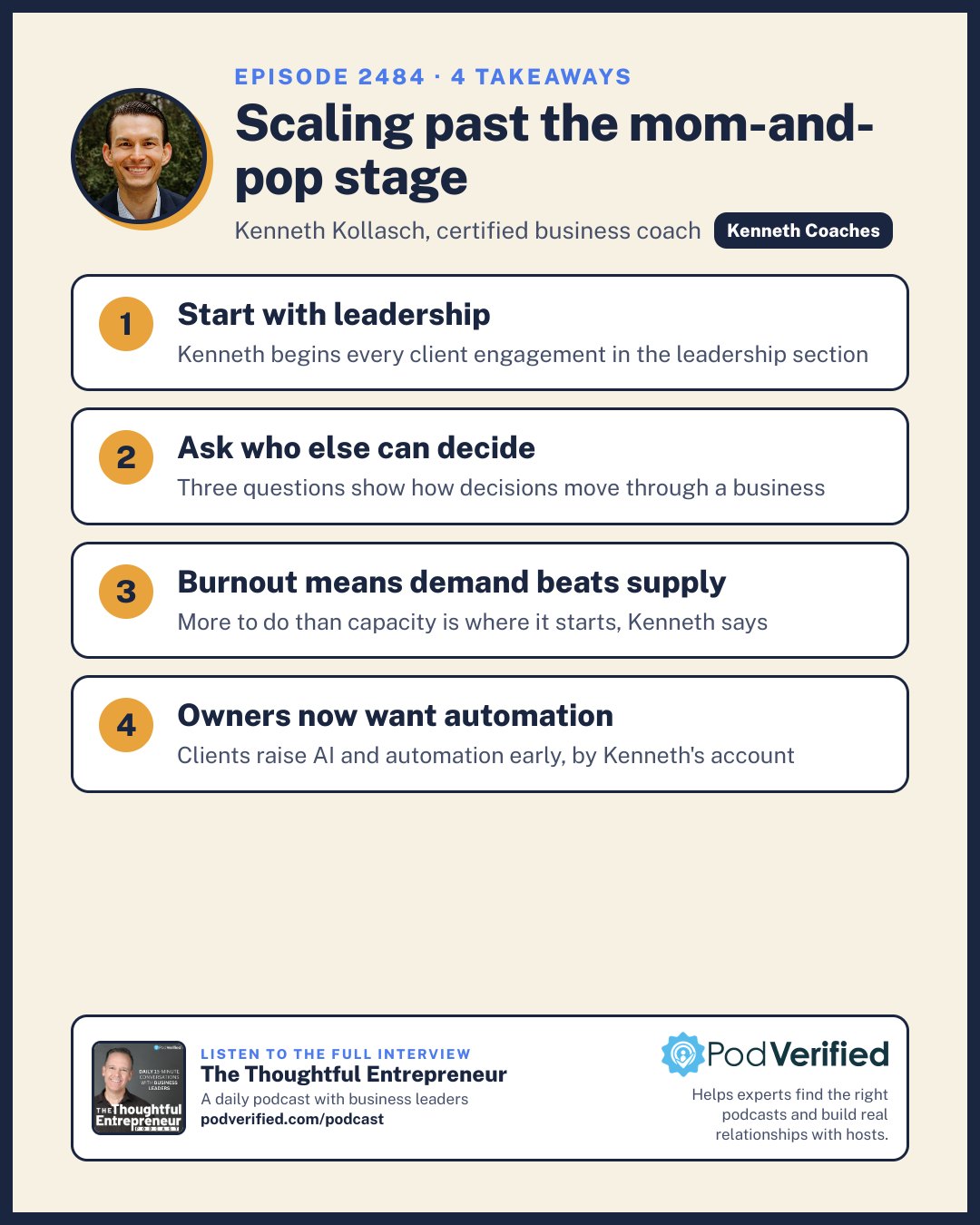
- Leadership comes first. Kenneth says his 12-month Small Business Flight Plan starts every client in leadership, before sales or marketing.
- Three questions show how a business decides. How you make decisions, why you make them when you do, and who else could make them.
- Burnout is a demand problem. Kenneth says it comes from having more to do than you have the capacity to supply.
- Owners now ask to automate. By Kenneth's account, clients raise automation and AI in a very early conversation.
A plane can have a comfy cabin, good wings and full tanks and still land in Atlanta when you meant to fly to Dallas. Kenneth Kollasch uses that picture to explain why he starts every client with leadership, not sales or marketing.
Kenneth is a certified business coach who runs Kenneth Coaches. On this episode he tells Josh how to spot a mom-and-pop business, where founder burnout comes from, and why owners now ask him about automation almost from the first conversation.
🎧 Listen to Kenneth's interview
Press play below. About 19 minutes.
Or listen in your favorite app:
Apple Podcasts Spotify YouTube Amazon Music iHeart Audible Pandora Castbox TuneIn
The Thoughtful Entrepreneur is a daily podcast with business leaders. Subscribe so you don't miss one.
Why does every engagement start with leadership?
Kenneth's Small Business Flight Plan runs six steps across the whole business, and he says it starts with leadership every time. The cabin can be comfy, the wings great and the tanks full. If the plane lands in the wrong city, nobody is happy.
The first move is a diagnostic. Kenneth asks three questions. How are you making decisions? Why are you making them at the time you make them? And who else has the capacity to make the same kind of decisions?
The goal, he says, is decision-making that can trickle through the company as managers and a sales team come on, with results as if the owner were in the room. Owners who reach $1 million or $5 million are good at their craft, Kenneth says, but haven't yet learned how to build or scale a business. That's the fork in the road. Some stay stuck, get fed up and sell. Others learn to hand off what they do by instinct.
Most clients come to him, Kenneth says, after they've already tried more sales, more marketing and a better offer. His answer is to install one full system, so the company doesn't end up a Frankenstein business of good parts that hold each other back.
Straight from the recording
Quotes are lightly edited for readability: filler words and stutters removed, nothing reordered. Times are approximate.
“So I help them come in and in that program we professionalize their business and double their revenue in 12 to 24 months without them going insane.”
“And who else has the capacity to make the same kind of decisions?”
“Burnout can come from a lot of areas and it typically comes from not knowing how to manage the problem of I have more demand than I have the ability to fulfill or supply.”
“So for the owner to be involved in everything is the most insane way to scale.”
Falling behind on AI?
Asked about trends, Josh admitted something a lot of founders feel, even though he spends much of his own time experimenting with AI:
“And yet, as up to date as I think that I am, it still feels like I am so far behind sometimes.”
Kenneth sees the shift in his clients. He says he comes from a 114-year-old franchise background and grew up a third-generation entrepreneur. Owners who started in the '80s, '90s or early 2000s, he says, treat the relational touch as king. Newer entrepreneurs see automation as good. For at least the last year and a half, Kenneth says, clients bring it up themselves: automate the social media, the emails, and an AI voice agent that answers the phone on a weekend, books appointments and sends invoices and estimates.
Questions answered
What is a mom-and-pop business?
Kenneth's test is whether the owner still touches everything every day: pulling the strings, putting out the fires, with every decision running through them. Age and size don't decide it. He has seen it in franchises that have been around for decades, and Josh adds that online agencies and consultancies can stay stuck there too.
What is the Small Business Flight Plan?
It's Kenneth's 12-month, one-on-one coaching program for owners about five years in. It covers six steps across the whole business, starting with leadership. Kenneth says he works with 20 clients a year and aims to professionalize the business and double revenue in 12 to 24 months.
Where does founder burnout come from?
Kenneth says it comes from every direction, but the root is having more demand than you can supply. He's on his fifth business and says he has been there, with a thousand decisions and an hour to make them. His fix is to set up daily leadership habits that get ahead of burnout instead of getting good at coping with it.
Why do owners get stuck after their first million?
Kenneth says most owners are very good at the work they sell, which is how they reached $1 million or $5 million. Building and scaling a business is a different skill. The ones who grow learn to transfer how they make decisions to other people in the company.
How do I reach Kenneth Kollasch?
Go to kennethcoaches.com/free, where Kenneth says there are over a dozen resources that are free forever, for owners and for their teams. If you don't know where to start, he says you can book a call with him at kennethcoaches.com.
Questions to ask your own team this week
Drawn from the examples Kenneth gave, not from Kenneth Coaches' marketing.
- Who else here can make the decisions I make? It's the third of Kenneth's three leadership questions.
- Why do we make decisions when we make them? Kenneth asks it to see how a leadership team operates day to day.
- What happens here when I'm not involved? If the answer is nothing, Kenneth would call that a mom-and-pop business.
- Do our systems work together? Kenneth warns about a Frankenstein business, where good parts limit each other.
Away from the screen
Kenneth got into tennis in the last three or four years. At the time of recording, he was entered in a local Northwest Indiana tournament, in singles and doubles, hosted by friends who coach high school tennis. He'd been playing regularly with the guys he'd face. His goal was to come out in one piece.
As for pickleball, Kenneth says the players are taking over the courts. He's happy everybody's getting into it, but it stings a little to look across and see them there again.
“Well, I'm always attracted to the deep end of the pool, so sometimes I jump in there a little too early”
Episode details
| Guest | Kenneth Kollasch |
|---|---|
| Role | Certified business coach, Kenneth Coaches |
| Website | kennethcoaches.com |
| Background | Third-generation entrepreneur who said on the show that he comes from a 114-year-old franchise background and is on his fifth business. His About page says he and his wife became international champions in competitive ballroom dance. |
| Topics | Leadership, decision-making, scaling a small business, founder burnout, mom-and-pop businesses, automation and AI, business coaching |
| Host | Josh Elledge |
| Episode | 2484, The Thoughtful Entrepreneur |
| Kenneth Kollasch on LinkedIn | |
| Listen | Play it on this page, or on Apple Podcasts, Spotify, YouTube or Amazon Music |
We're always looking for great guests
Be our next guest on The Thoughtful Entrepreneur
We publish a new conversation every day, so we're always looking for leaders like Kenneth. The guests we love most are generous: real experience, a clear point of view, and something useful to give our listeners. Come ready to teach, and we'll make you look great doing it.
Not ready to apply yet? Get your free PodVerified Score to see how podcast hosts size you up. It takes two minutes.
Full transcript
Filler words and stutters removed. Company and guest names corrected where the automatic transcript misspelled them. Times are approximate.
Read the full transcript
Josh Elledge (00:00): With us right now, it's Kenneth Kollasch. Kenneth, you are a certified business coach and you are found on the web at kennethcoaches.com. Kenneth, it's great to have you.
Kenneth Kollasch (00:08): Yeah, we're gonna have a great episode, Josh.
Josh Elledge (00:11): Well, I hope so. I can tell already by our kind of our pre-interview chitchat, you know, you're quite passionate about what you do. And you always love to begin these conversations, you know, hearing what high-level leaders do for fun when they're not at work. And I understand, and tell me about your background in tennis, but you're competing in tournaments.
Kenneth Kollasch (00:40): Yeah. Imagine that we have a life outside of our business. Who knew? Yes, I love tennis. I've gotten into it in the last 3 or 4 years. And so I'm in a tournament this weekend and hopefully I'm hoping that I come out in one piece. That's my goal.
Josh Elledge (00:56): This weekend. Yeah. And who are you playing against? And like, how did you get, I mean, go from just kind of learning tennis and now you're, you know, competing or, you know, kind of, you know.
Kenneth Kollasch (01:09): Well, I'm always attracted to the deep end of the pool, so sometimes I jump in there a little too early, but I submitted. It's a local tournament by us and a couple of my friends. They host it that are high school coaches here in the area. And I've lived here my whole life. So the Northwest Indiana area hosts a tennis tournament. I applied to be in the singles and the doubles division. And so we'll be off to the races. I've been playing regularly with the guys I'm gonna be competing against and the partner that I have for doubles. So it'll be fun. At the very least, it'll be fun.
Josh Elledge (01:37): Yeah, no question. Do the pickleball players, are they annoying to deal with as a tennis player?
Kenneth Kollasch (01:45): Oh my gosh, they're taking over all of our courts and I'm so happy. I'm happy that, you know, everybody's getting into pickleball, but it is a slight on us when we look over from the other side of the courts like, ah, you're here again, the pickleballers.
Josh Elledge (01:59): Well, very cool. Kenneth, tell me about the work that you do. So as a business coach, who are you typically working with? And I guess, you know, you're not a one-size-fits-all coach. So, you know, if you could kind of go into the weeds on your specialty, that would be great.
Kenneth Kollasch (02:18): For sure. Yeah. Well, I run what's called a Small Business Flight Plan. It is a 12-month program one-on-one with me where I take small business owners. Typically they are beyond those first few years in their business. They're 5 years in and they're maybe still pulling all the strings, putting out all the fires, cleaning up all the messes. So they are the typical small business owner in that mom-and-pop stage where they're looking to scale, but it's either scary or if they doubled their business, they would probably go insane. So I help them come in and in that program we professionalize their business and double their revenue in 12 to 24 months without them going insane. So that is what I do. I work with 20 clients a year and it's been a blast.
Josh Elledge (03:00): When you work, I mean, obviously that's a bold claim. And so some folks might hear that and, you know, again, sounds a little bit like a Hormozi offer, but that's fair. Take me through the typical places that you start to build that scaffolding to help them get to that outcome, particularly in light of the fact that why haven't they figured that out themselves?
Kenneth Kollasch (03:28): Yeah, well, the way the program works is we go through 6 steps. It's really their entire business, but it starts with leadership, which like any great business, I compare it a lot of times to an airplane where even if the cabin is comfy and the wings are great and there's enough fuel in the tanks, but if you literally end up in Atlanta instead of Dallas, you're still upset at the end. And so naturally we start out in their leadership suite of who are they as a business, how are they functioning, how do they make decisions? What is the how behind why they're in business and what they're actually doing day to day? So that's typically where we start. And the reason that I come into play is because they've typically exhausted all the options of trying to just do more sales and do more marketing and get better with their product offering. And they've tried all the things, but for whatever reason, it has not come into fruition, with staff turnover or client turnover or whatever problem they're running into. We come in and we actually install a full system. So it's not a Frankenstein business where there's a bunch of random parts that may be good on their own, but if it's not actually cohesive and working together, you have parts of their business that are actually limiting the other parts of their business at the same time. So yeah, it's great to come in and have really my hands in their entire business for a whole year. And it's very intense. It is not for the faint of heart, but for those that are actually in the growth stage and the scale stage, it is a really powerful system. And we do typically start every time in their leadership section of their business.
Josh Elledge (04:55): When you say leadership part of their business, and what I'm hoping is that our friend that's listening to us right now could probably get some ideas on where they could be a little bit more introspective about their own operations. So what's kind of the first step that you go through with people? And again, if you could kind of do it in a little bit of a workshop fashion here, that would be great.
Kenneth Kollasch (05:17): All right, let's do it. So the first thing that we typically do, like anything, is we get a good diagnostic of how are you currently operating? Which in the leadership section is how are you making decisions? Why are you making the decisions at the time you're making them? And who else has the capacity to make the same kind of decisions? And those 3 questions give us a really good insight into how you're operating as a leadership team or as the leader, the solo leader at the top of the spearhead of the business, or the pyramid, so to speak. And the reason we do that is because what we're trying to get at in the leadership section is not just something that's going to be great for you as the business owner, or maybe as your leadership team, but it's something that's going to be scalable when you actually start bringing on managers, project managers, depending on your business model and the company that you own, actually you're getting into your sales team. We're wanting to duplicate successful principles in duplication and decision-making that can actually trickle through the organization in a way that is actually going to yield results like as if the owner were making the decisions or as if the owner were there in the sales process, or in the management, you know, team meeting, whatever it is. That is a difficult thing for an entrepreneur and a business owner to do because typically they're really good at what they do, and that's why they've built a successful business. That's why they've gotten to $1 million or $5 million or wherever they're at, but they've not yet actually learned how to build a business or scale a business. They're just good at the task or the offer of the service that they have. And so this is like the fork in the road where business owners either stay stuck and frustrated and eventually sell their business because they're just fed up with it, or they figure this out sometimes with the help of a coach, and they learn how to duplicate and transfer those same types of things that they intrinsically do and learn how to actually transfer that to other people in their business. And that's what separates those that do really well and accomplish the dreams of, you know, time, money, and freedom versus the ones that just get burnt out and eventually just sell their business.
Josh Elledge (07:16): Yeah, well, we don't want that to happen. Can you talk a little bit more about burnout? Where does burnout come for a lot of the founders that you work with?
Kenneth Kollasch (07:25): It comes from every direction. It feels like for me, I'm on my 5th business now. So just for you, our friend listening, I have been there in every situation where the marketing's not going well, or the sales system is, you know, the conversion rates are horrible, or, you know, I just got 1,000 decisions and only, you know, an hour to make 'em. And so I've been in all these places where it's typically, I have a lot more demand than I have supply. In other words, I have way more to do than I have the capacity to actually do myself. And that is where burnout comes, whether it's in your marketing or you've got all these staff that you are contractors or you have this team now, all of a sudden they're very demanding and they're needy from what I hear from a lot of founders. Burnout can come from a lot of areas and it typically comes from not knowing how to manage the problem of I have more demand than I have the ability to fulfill or supply. And that is a, it's a tricky situation to figure out, but it's also another aspect that we do in the leadership section of, again, how do we operate on a daily basis as a leader in a way that prevents burnout and gets in a way proactive before we even get to that stage versus just getting really good at dealing with it when it arrives.
Josh Elledge (08:39): What trends are you seeing this year compared to maybe in years previously? I don't know if, you know, economic factors that you've been seeing, if there are, obviously AI is, you know, impacting operations, the market, you know, what we can do. But, you know, I obviously, I think that AI also represents just one more thing that maybe founders feel like they're falling behind on. I know that, you know, I'm pretty fairly adept. I don't wanna say obsessive, but you know, that's a lot of the, you know, the content and stuff I kind of do outside of normal working hours, is, you know, a lot of experimenting with AI, and, you know, even during working hours, you know, just setting up cool stuff. And yet, as up to date as I think that I am, it still feels like I am so far behind sometimes. And I think that that's just simply because, you know, we're in an era right now where there is, you know, a little bit of a maybe Moore's Law kind of, you know, we're kind of shooting up there and in the tools that we have available to us.
Kenneth Kollasch (09:48): Yeah, I would say so. My experience, just so everybody knows, I come from a 114-year-old franchise background. So I grew up as a third-generation entrepreneur in this world where the business owners, the franchisees, the consultants had a lot of things figured out. There's a lot of systems that have been tried, proven, and have been installed for literally decades. And so I think the trend that I've noticed the most, especially with clients that are in that, they're baby boomer clients or they're people that are at the end of their business journey. They've been in business 20+ years. Is the trend that I'm seeing, the difference between them and some of these new generations of entrepreneurs is the perspective that automation is good. Like to automate things is actually a good thing to the newer generation, and it's something that they're voraciously trying to figure out and install with AI, with finally getting into these, you know, all these different SaaS products, software products that are helping them automate different sections of their business versus the more traditional entrepreneur that maybe started their business in the '90s or in the '80s or in the early 2000s, they come from a generation where the relational touch is king. And the relational one-to-one, sometimes even like one-to-few is more preferred than the automated. So I would say the trend is actually moving now, whether for good or for bad, it is the trend of how can I automate this, Kenneth? How can I automate the social media? Automate my emails, automate the, with the AI voice agent, with people calling in on a weekend when I'm not available, or even during the day if I don't wanna hire a VA, can I have AI voice agents, you know, answer the phone and book appointments and send invoices and estimates. And so I think this trend of people preferring the relational models to now preferring an automated system, that has been the trend, I think, for at least the last year and a half or so that I've noticed is a very early conversation I have with almost every client, and they're the ones bringing it up.
Josh Elledge (11:53): You talk about working with mom-and-pop businesses, and I think a lot of times we think, well, that's just like the crafting store in downtown Valparaiso, Indiana, right? Whereas, you know, mom-and-pop, you know, for even for an online business, you know, let's say you're an agency owner or a consultant, I think from what I can see, I mean, those can all stay stuck at that mom-and-pop phase. You mind maybe just sharing a little bit about that thinking?
Kenneth Kollasch (12:24): Of course. So mom-and-pop, you're right, it's so traditionally thought of as it's the restaurant down the street that there's only one of one. You know, it's the taco stand.
Josh Elledge (12:33): It's the food truck.
Kenneth Kollasch (12:34): It's the yarn store at the end of the street corner. You know, it's that one-of-one store. And to me, the mom-and-pop, I've experienced this even with franchisees in the dance world that I came from, where again, the franchise was many, many years old. And I've worked with other companies that are kind of in the same place where the business itself is not new, but the owner themselves is still kind of in a place where, again, they're the ones pulling all the strings, putting out all the fires, all the decisions funnel through them, and nothing happens unless the owner gets involved. That's kind of my mantra for you. And you'll know you're in a mom-and-pop business model if the buck stops here is still the way of doing business, as the owner has their hands in all the cookie jars of the business. So for the owner to be involved in everything is the most insane way to scale. If you had a $10 million or $100 million business that you still had to have all your hands in the cookie jars of every spot in the business, you would literally go nuts. So the mom-and-pop business is still, to me, that caricature of the owner touches everything every day. And if you're in that stage, whether you have a franchise that's been around forever, or you've got, again, the local, you know, one-of-one stores, street corner store down in local Valparaiso, then either way, it's kind of like the operating system of a mom-and-pop business owner looks like that. And that's what I kind of consider as the mom-and-pop.
Josh Elledge (14:08): Your website, kennethcoaches.com, you have a lot of free resources here. Do you mind sharing for our friend that's listening, maybe some things that you'd recommend? And by the way, can I just say, you know, I've interviewed over 2,500 folks. I teach media training and skills. I love the fact when guests come and they've got a lot of resources to offer. You do. Unfortunately, a lot of guests are like, well, you can book a call with me or you join my newsletter. And I'm like, anyway, you've got a lot here. Do you mind maybe highlighting a few of these things that folks can find?
Kenneth Kollasch (14:47): Yeah. Absolutely. And the reason that there's a lot is because there's a different starting point for everybody. So if you go to kennethcoaches.com/free, what Josh is talking about is there's over a dozen resources on there that are free, free forever. They're not, you know, the bait and switch. Hey, it's free until you log in and then boom, gotcha. It's free, free forever. And the idea is there's things on there that are for you as the owner to assist you in becoming a better owner. In other words, it's building you up as the owner to be more productive, more organized, make better decisions, you know, sooner rather than later. And then there's also resources on there that go into actually helping you work on your business. Cuz working on yourself is great and becoming a better owner is always amazing. But then there's also 4 or 5 resources on there that are designed to actually come into your business and help you install a meeting system that gets proactive instead of reactive, or there's a productivity system that is on there for your staff and learning how to professionally develop your staff into leaders and managers and supervisors, et cetera. So there's a bunch of resources. There's for every person that goes on there, find the one that is the best fit for you to start with. And of course, I guess I will throw out the book a call if you have questions and you don't know where to start, you know, you can always talk to me. But yeah, if you go to kennethcoaches.com/free, there's over a dozen on there and they're there on purpose as a marketing tool for you to start wherever you need to start.
Josh Elledge (16:10): Kenneth Kollasch, your website is kennethcoaches.com. If you go to kennethcoaches.com/free, you get all the free stuff, assessments, workbooks, templates, checklists, software courses, books, PDFs, all kinds of good stuff. Kenneth, it's been a great conversation. Thank you so much for joining us.
Kenneth Kollasch (16:22): My pleasure, Josh.