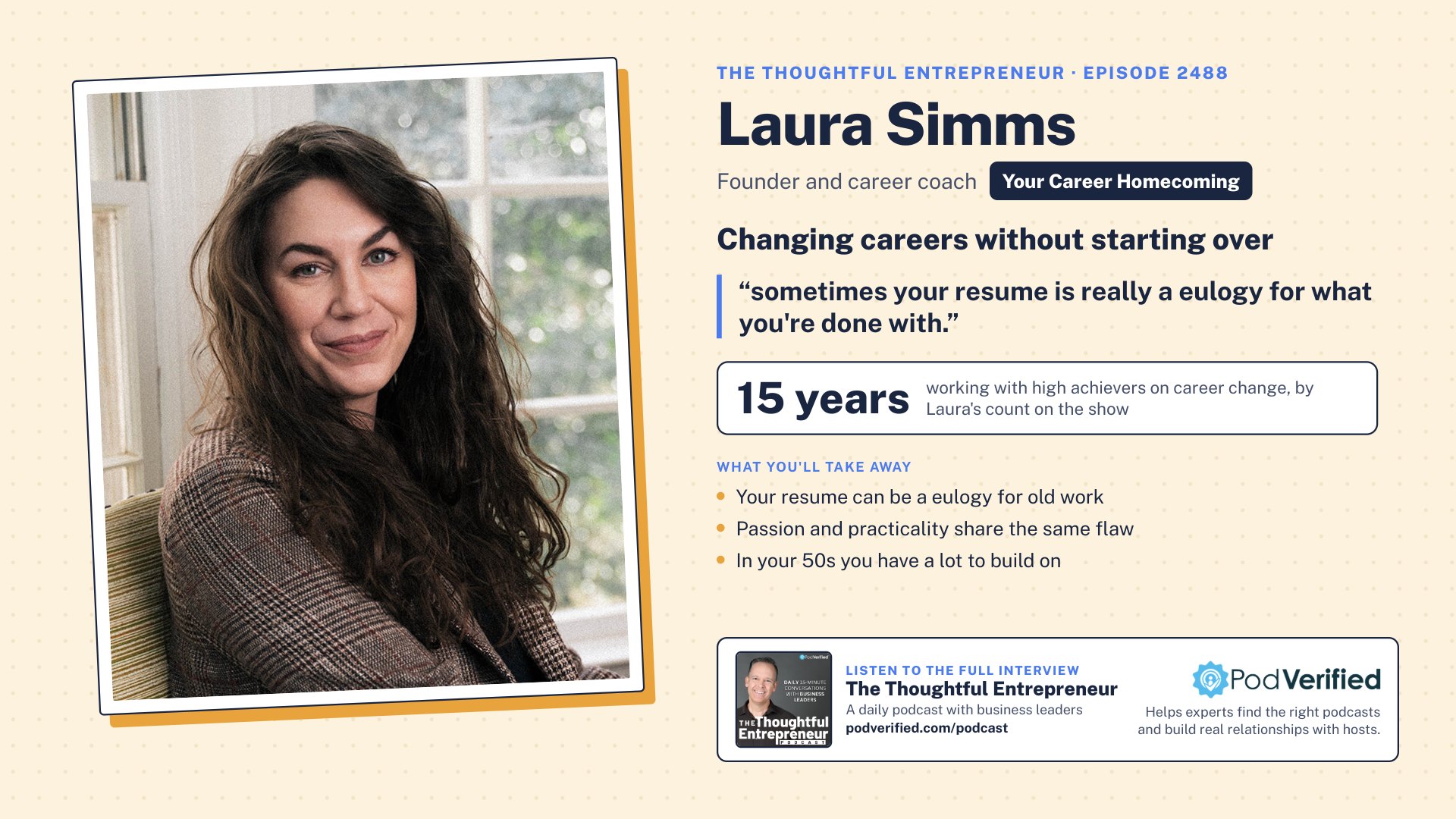
Finding Financial Security and Joy Without a Total Reset with Your Career Homecoming's Laura Simms
The Thoughtful Entrepreneur · Episode 2488
The short answer
How do you change careers in midlife without starting over?
Laura Simms, founder and career coach at Your Career Homecoming, says a midlife career change is often less dramatic than people think. She builds options from the whole person, not the resume, which she calls a eulogy for what you're done with. Her aim is a middle ground that makes you feel alive and is financially viable.
Key takeaways
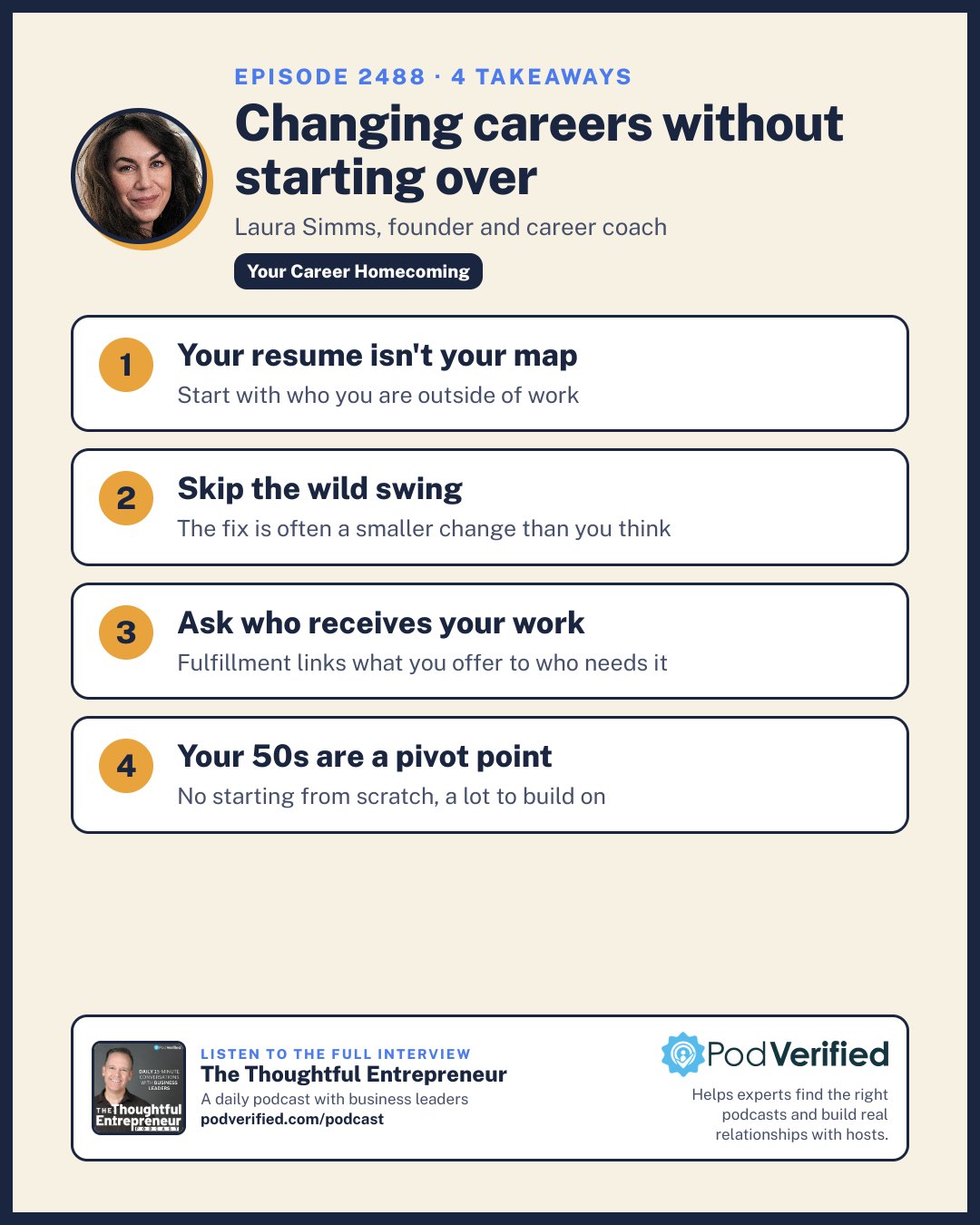
- Success on paper can still feel empty. Laura says many of her clients hit a midlife "is this all there is?" moment after doing everything right.
- Look past the resume first. Her process starts with who you are outside of work, then builds a list of options from that raw material.
- Passion and practicality share a flaw. Laura says both leave out the question of who receives what you have to offer.
- Your 50s are a starting point. By then there's no starting from scratch, Laura says, because you have a lot to build on.
Laura Simms tells her clients to stop reading their resumes for answers. On this episode she put it plainly: "sometimes your resume is really a eulogy for what you're done with."
Laura is the founder and career coach at Your Career Homecoming, where she says her team has spent 15 years working with high achievers who hit the goals on paper and still feel empty. She told Josh why the fix is usually smaller than a wild swing, and why your 50s are a good place to start.
🎧 Listen to Laura's interview
Press play below. About 16 minutes.
Or listen in your favorite app:
Apple Podcasts Spotify YouTube Amazon Music iHeart Audible Pandora Castbox TuneIn
The Thoughtful Entrepreneur is a daily podcast with business leaders. Subscribe so you don't miss one.
Why do successful people feel stuck?
Laura's clients are go-getters. When they know what they want, she says, they find a way to get it, even with some delayed gratification. The trouble is they don't know what the better option would be.
Many of them followed a traditional path and did what they were supposed to do to win at life. So Laura's first step is to look at how they make choices, and to set aside habits inherited from parents or school.
Next comes what she calls the homecoming: looking at the person outside of work. What do you care about? What do you connect to? How do you show up in a room? Only after collecting that raw material does she help clients generate options and weigh which one fits.
The same pattern shows up on both sides of the payroll, Laura says. Employees assume the fix is running their own business. Business owners assume the fix is the safety of a job. Often neither is the real issue, so she starts with diagnostic work on where the dissatisfaction comes from.
Straight from the recording
Quotes are lightly edited for readability: filler words and stutters removed, nothing reordered. Times are approximate.
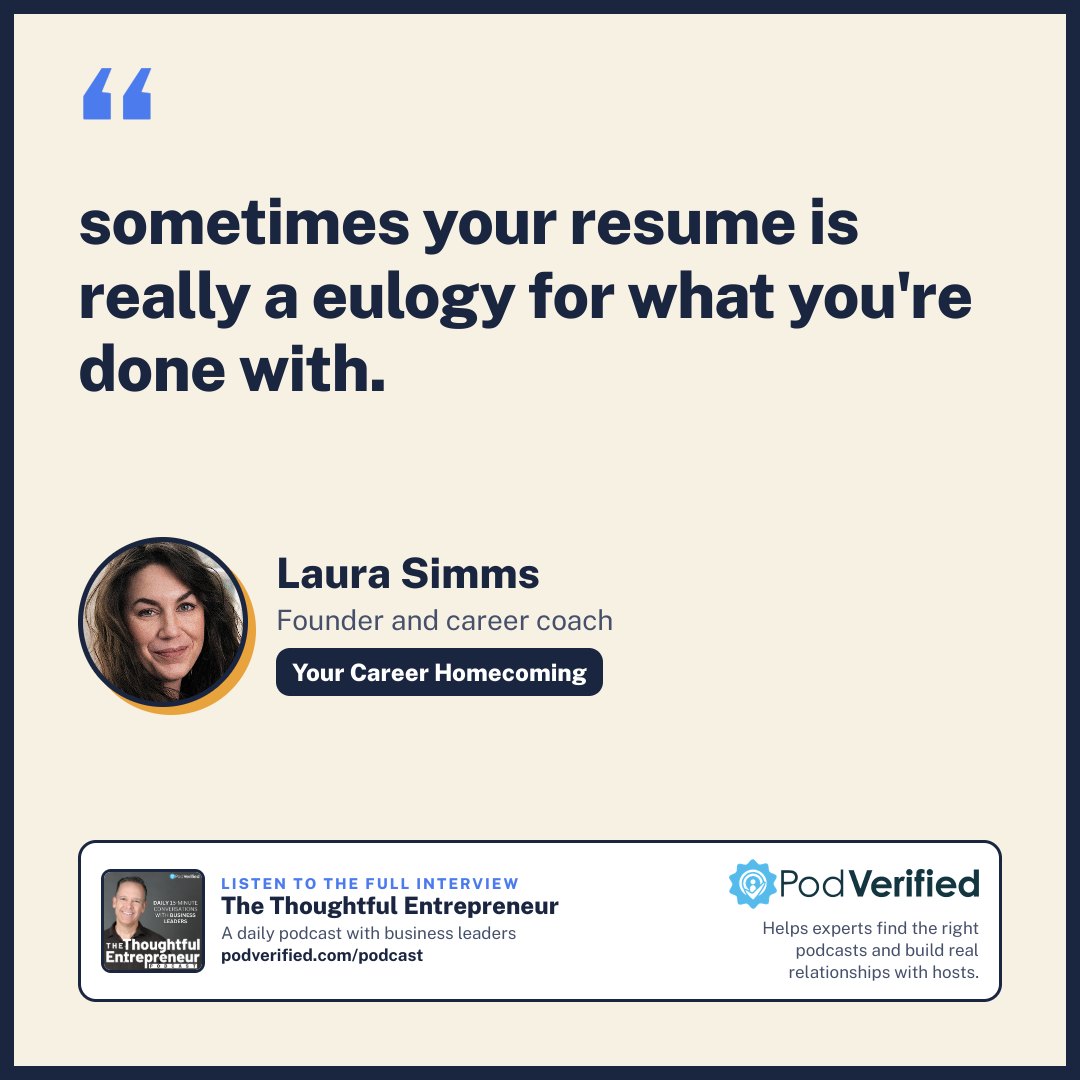
“sometimes your resume is really a eulogy for what you're done with.”
“I think doing the practical prescriptive thing and follow your passion are really two sides of the same coin.”
“it's often the solution is not as dramatic a change as people think it has to be”
“by the time you're in your 50s, there's no starting from scratch. Like, you're a fully formed human being. You have a lot to build on.”
Josh's case for keeping your experience
Josh said he often hears people who are unhappy at work talk about a food truck, a franchise or selling paintings. His skepticism is about what they leave behind:
“Whereas, you know, very few people on the planet have your amount of experience. And that might be more valuable.”
Laura agreed and went further. She says the answer is to drop the choice between practical and passion, and get back in relationship with what you have to offer and who needs it. Sometimes that does mean selling quilts. Often it's a middle ground that feels alive and pays the bills.
Questions answered
Is it too late to change careers in your 50s?
No, Laura says. You need to plan better than you did in your 20s, but by your 50s there's no starting from scratch. She calls it a great pivot point because you have a lot to build on.
Why do high achievers feel unfulfilled at work?
Laura says many of them have done everything they were supposed to do, accomplished what they wanted on paper, and still feel empty. She describes it as a midlife "is this all there is?" moment.
Should I quit my job to follow my passion?
Laura sees passion and the practical route as two sides of the same coin. Both leave out who will receive what you offer. She says the answer is often less dramatic than a wild swing.
How can I start figuring out what I want from work?
Start outside of work. Laura says many clients over-identify with their jobs and struggle to say what they like in their personal lives. She suggests asking what you'd care about if you never worked another day, and what value you bring to your relationships.
How do I get started with Your Career Homecoming?
Go to yourcareerhomecoming.com and click Learn the WHOLE Method in the upper corner to watch the free masterclass. Laura says it walks through the exact strategy her team uses with each client.
Questions to ask your own team this week
Drawn from the examples Laura gave, not from Your Career Homecoming's marketing.
- Is anyone here stuck in a role they no longer want? Josh described founders burnt out on founder-led sales who would rather speak or design.
- Do we know what the better option would be? Laura says go-getters stall when they can't name what they'd rather be doing.
- What problem would this change solve? Laura asks that before anyone blows up the org chart.
- Who receives what each of us does best? Laura says fulfilling work comes from the link between what you offer and who needs it.
Away from the screen
Laura has been rewatching The Four Seasons on Netflix, the Tina Fey show with an ensemble cast that includes Colman Domingo. Drawing on her acting background, she watches once for the story and again to study how each script is built, what happens in each scene and how the wardrobe changes as a character moves through an arc. Josh's wife has been watching it too.
“So I have just been soaking it up on repeat.”
Episode details
| Guest | Laura Simms |
|---|---|
| Role | Founder and career coach, Your Career Homecoming |
| Website | yourcareerhomecoming.com |
| Background | Former actor who trained in an MFA program and worked in Los Angeles before turning to career coaching, per her site. Based in Atlanta. |
| Topics | Midlife career change, career fulfillment, founder burnout, follow your passion, decision-making, career change in your 50s |
| Host | Josh Elledge |
| Episode | 2488, The Thoughtful Entrepreneur |
| Laura Simms on LinkedIn | |
| Listen | Play it on this page, or on Apple Podcasts, Spotify, YouTube or Amazon Music |

We're always looking for great guests
Be our next guest on The Thoughtful Entrepreneur
We publish a new conversation every day, so we're always looking for leaders like Laura. The guests we love most are generous: real experience, a clear point of view, and something useful to give our listeners. Come ready to teach, and we'll make you look great doing it.
Not ready to apply yet? Get your free PodVerified Score to see how podcast hosts size you up. It takes two minutes.
Full transcript
Filler words and stutters removed. Company and guest names corrected where the automatic transcript misspelled them. Times are approximate.
Read the full transcript
Josh Elledge (00:00): With us right now, it's Laura Simms. Laura, you are the founder and career coach with Your Career Homecoming. You're found on the web at yourcareerhomecoming.com. Laura, it's great to have you.
Laura Simms (00:13): Thank you so much. Glad to be here.
Josh Elledge (00:15): Just up the road from me in Atlanta. And what a... I absolutely love going to the Four Seasons. Going to Atlanta. But also you've done, like, in your background, you've done a lot of acting, a lot of stage stuff, a lot of TV shows that we would know. I'm sure we could search you out on YouTube and find some clips where you've been there, but maybe we'll talk about that in just a minute. You know, I always love starting off with, you know, high-level leaders asking what they're doing, kind of geeking out on what they're doing for fun outside of work. I understand you're binge-watching something right now.
Laura Simms (00:58): I am. Well, speaking of my acting background, so I have been loving The Four Seasons on Netflix, which is a Tina Fey-driven show. It's a great ensemble cast, and I've... It's got 2 seasons of it now. I've watched both of them multiple times because I like to, you know, watch it once for story and to enjoy, and then I like to watch it again. And I'm listening to how was this script constructed and what happened in the scene and what was happening with the wardrobe changes as this character goes through a story arc. So I have just been soaking it up on repeat. It's such good writing and such really great performances from the cast.
Josh Elledge (01:30): Yeah, my wife, I know, just finished season... I think she just finished season 2, or she, I know she was watching it. And, you know, just anything that Tina Fey does, she's just so clever. I love her sense of humor. It's so relevant. And yeah, a lot of fun. So yeah, in fact, there was one scene, I'm not gonna try, I'll save that for another conversation. It seemed like the writing was really clever. I love great writing.
Laura Simms (02:02): Yeah, I mean, you can't go wrong with Colman Domingo either, so I'll just eat it up.
Josh Elledge (02:07): Nice. Well, thank you for the TV recommendation. Laura, tell us about the work you do with Your Career Homecoming.
Laura Simms (02:13): Yeah, so for 15 years we've been working with high achievers who have, you know, on paper they have accomplished what they want to in their career, but it is feeling empty and they are kind of hit with often a midlife, is this all there is? I want to do something that feels more fulfilling. I want to do something that really uses my true gifts. And we're helping them figure out what is the career that's going to bring together the meaning, money, and joy at a stage in their life where they don't want to blow it all up and start from scratch.
Josh Elledge (02:43): Yeah, so what do they do?
Laura Simms (02:48): So we really work with folks to take a really holistic approach to this. You know, a lot of times it's not as simple as I need a new list of options. There is this behavior set that is running the choices in the background. You know, a lot of these folks have gone a very traditional path. They have always done what they were supposed to do in order to, you know, win at life. And so some of it is looking at how they make choices, you know, deprogramming some of this stuff that was inherited from parents or from school and learning to make decisions that are actually gonna align with the kind of life they wanna have, the kind of person that they wanna be. And then it is about, you know, how do we get a good list of options in front of you, not based on your resume, because sometimes your resume is really a eulogy for what you're done with. So I want to get back in touch with the whole person. The homecoming of it is, let's look at you as a person outside of work. What do you care about? What do you connect to? How are you naturally showing up in the room anyway? Kind of collecting that raw material before we are generating options and evaluating which one is gonna be the best fit.
Josh Elledge (03:53): What we're talking about isn't just... So I know obviously you're working with a lot of folks that might be, you know, still kind of, you know, working a corporate job, you know, working a job and they're dissatisfied. This same thing happens for people that might be self-employed or might be working as an independent contractor. They might be a consultant or a coach, you know, and kind of, you know, subbing out their talents, and Laura, they might be equally or even more so unhappy about the business that they're in. I talk to business owners frequently that are like, you know, when you finally get them to be very honest in a very quiet room, they're like, I wish I just had a regular job. This sucks. So a lot of, I think, you know, the work that you do is relevant to... folks are just maybe dissatisfied with where they are currently in life. Does this sound right?
Laura Simms (04:48): Yeah, for sure. We work with business owners and, you know, freelancers as well. And I think that first step is really understanding. Let's do the diagnostic work of understanding where's the dissatisfaction coming from, because it's easy when you're an employee to think, well, the fix is just, if I had a business, as I was in charge of everything and I called all the shots, and it's easy to think if you're a business owner, like, well, the fix is just for me to go get under the safety of some organization, and that's not always the big issue. So we want to figure out what's not working. What do you actually need in order to be obviously financially safe, but also fulfilled and feel like this is worth your time. So that's the first step.
Josh Elledge (05:28): All right, well, to our friend that's listening right now, and maybe they just want to kind of have a little bit of a homecoming with themselves, what might be a good way to start that introspection or self-conversation? That sort of thing.
Laura Simms (05:49): Yeah, something that I see with a lot of our clients is there has been a real, I would call it, an erosion of self over the years, and folks really over-identify with work. They think about themselves in a work context, and it's really hard for them to even say what they like and don't like in their personal life. So I think, you know, letting yourself be a human being again and really get in touch with outside of work. What do I care about if I could never work another day in my life, what value do I bring to the relationships that I have? Really decommodifying yourself and thinking of yourself as a full human being again before we figure out how do we express what you have to offer through your work.
Josh Elledge (06:34): One thing I commonly see among some who are dissatisfied with their job is, you know, they think about, well, I just want to be self-employed, like, or I want to start my own business. And then they start looking at like maybe like a franchise or just something. I'm going to open a food truck, or I'm going to start selling paintings or something like that, because they love it so much. And I would, from my perspective, say, well, you know, I feel like you have decades of experience in this industry, in this space. I would hate... I mean, again, this is just me, and you know, obviously this is their own conversation, but my suspicion or my skepticism is why would you throw all of that away. I mean, I get it if you hate your industry, but it's like, man, if you want to start over and start selling quilts, you're competing with anybody, you know, who can do that. And it may not be a super high bar to do that. Whereas, you know, very few people on the planet have your amount of experience. And that might be more valuable. Would you know what I'm talking about here? And help us navigate this.
Laura Simms (07:48): Yeah. So here's what I think you're observing. A lot of people who are miserable in their jobs, because they've done the right thing. They think that the only solution is to make a wild swing, and because they've been very practical and, you know, gone the traditional route, they think the only solution is to do this wild swing and do something out there or follow your passion. I think doing the practical prescriptive thing and follow your passion are really two sides of the same coin. They don't solve the problem because what is being left out of the conversation of all of this is, look, if you want fulfilling work, it's about this relationship between what do I have to offer and who's going to receive it. And when you go the prescriptive route, you know, sometimes you're banking on a thing you're good at. That doesn't mean that's the best at what you have to offer. It might really drain you to do this thing you can excel at. And when we're following your passion, that's usually about your excitement about quilts or an engagement with an activity that you really love. And where's... who's buying it? Who is it serving? Who's the receiver on the other end? And so I want to do is just get rid of this binary altogether and say, let's get back in relationship with what you have to offer and who needs what you have in return. And then that time, I mean, maybe it is, we're doing a wild swing towards selling quilts, but it's often the solution is not as dramatic a change as people think it has to be, and there is something in this middle ground that is going to make you feel alive that is going to be financially viable. I think there's a... people are seeking novelty. And sometimes they swing too far because they don't know what else to do.
Josh Elledge (09:35): And maybe novelty is just the thing that they are not getting in their current work. You know, I've talked with founders that are just burnt out because they're doing founder-led sales, and they're just like, look, what I really love doing is speaking or designing things, but yet I'm kind of stuck. And so this can happen both for, you know, business leaders and founders and, you know, again, as well as, you know, folks that are working in a sales role, you know, in a regular job, so they might be successful, but yet they're miserable. And so, but I wonder if it's... you know, what do you see that's usually preventing them from changing things up? Now I could tell you practically for a lot of business owners, it can be really tough to make those changes structurally, you know, within your organization if you just haven't found a way to, you know, kind of get out of a role, because I think most of us business founders start off doing all of the jobs, and then slowly, you know, we start putting people in to kind of replace the jobs that we hate or already, you know, we know we're not good at, definitely not in our zone of genius, and hopefully we keep kind of pulling back, you know, so we can be in that zone of genius. But any observations on that?
Laura Simms (10:58): Yeah, I think at least for the people I work with, look, they're go-getters, and when they know what they want, they're gonna find a way to get it, even if it is a little bit of delayed gratification. So the problem my folks are facing is they're not even sure what would be the better option. You know, I'm stuck doing this function, but if you ask me what I'd rather be doing, I mean, I'll take some guesses, but I'm not sure that that's gonna solve my issue. And so understanding what is the change that needs to be made? What is that actually going to solve for? What is that going to get you instead? Let's do that before we blow up your whole org chart or before we make some, you know, big life adjustment, is let's figure out what is actually going to solve the problem that you're experiencing now.
Josh Elledge (11:42): Laura, tell me about how you actually engage with folks. Are you just... you grab coaching calls with people?
Laura Simms (11:50): Yeah, so we've got a structured program, so we've got a curriculum that we work folks through. But, you know, it's not as simple as like, here's some worksheets in a book and figure it out. So we've got a combination of small group coaching sessions so people can come, ask their questions, kind of learn from others as they have their hot seat. And then we also do one-on-ones as well because there's just some parts of this that really require more dedicated time. So between the curriculum, small group calls, one-on-ones, we, you know, we do homework reviews for folks that are in the program so we can make sure that they are getting that, you know, oversight and feedback throughout their time with us, because so many of our clients have accumulated a lot of self-knowledge that hasn't gone anywhere, and I want to make sure that we are somewhere that they can actually make change, get the answers they need, get the confidence they need to go make the change for real.
Josh Elledge (12:41): Yeah. Laura, final question. Say someone's in their 50s, is it too late for them to make a career change?
Laura Simms (12:48): No, no. I mean, you got to plan better than you did in your 20s. It's not too late, right? And to your point, by the time you're in your 50s, there's no starting from scratch. Like, you're a fully formed human being. You have a lot to build on. So it is saying, what can we build on rather than pretend we got to throw it all away and start over. It's a great starting point to be at. Like, they call it a pivot, right? It's a great pivot point in your 50s.
Josh Elledge (13:16): [unclear] website, yourcareerhomecoming.com, to our friends that are listening. I know you've got some resources here. What would you recommend they do from here?
Laura Simms (13:23): I say the highest level thing you can do is go check out the free masterclass because it is going to take you through the exact strategy we use with each and every client. It's called the WHOLE Method, and if you're sitting at the cusp of saying, I know something has to change, but I don't know what it is or how to do it, this is going to show you exactly what that transition looks like.
Josh Elledge (13:42): So when I go to your website, what do I click on?
Laura Simms (13:47): Yeah, in that upper corner, there's a little thing that says Learn the WHOLE Method.
Josh Elledge (13:50): Learn the WHOLE Method. You can go there.
Laura Simms (13:52): That's probably the easiest spot.
Josh Elledge (13:54): Yeah, cool. Then just click Get the Training. Start watching. Nice. Got it. Awesome. Well, again, Laura, your website here is yourcareerhomecoming.com. Laura Simms, of which you are the owner and career coach. Great. Thank you so much for sharing all your insights. It's been great having you.
Laura Simms (14:08): Thank you so much.