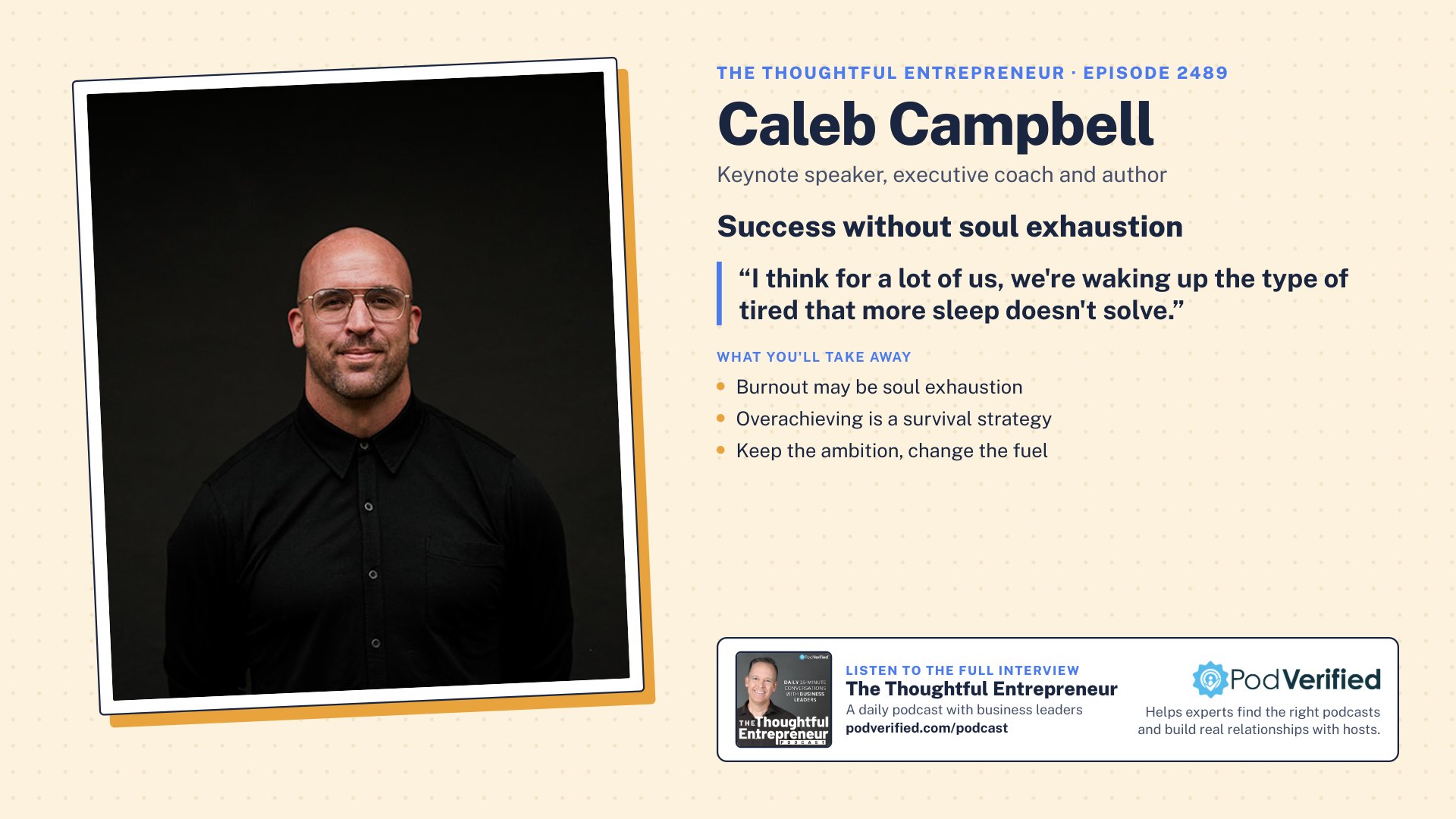
Redefining Success Through Balance, Purpose, and Self-Acceptance with Caleb Campbell
The Thoughtful Entrepreneur · Episode 2489
The short answer
Why do high achievers feel burned out even when they are successful?
Caleb Campbell, a keynote speaker, executive coach and author, says many leaders aren't dealing with burnout but with something deeper he calls soul exhaustion: the type of tired more sleep doesn't solve. He says overachieving is the language of the survival self, and the next level of success comes through deeper internal growth, not more external pursuits.
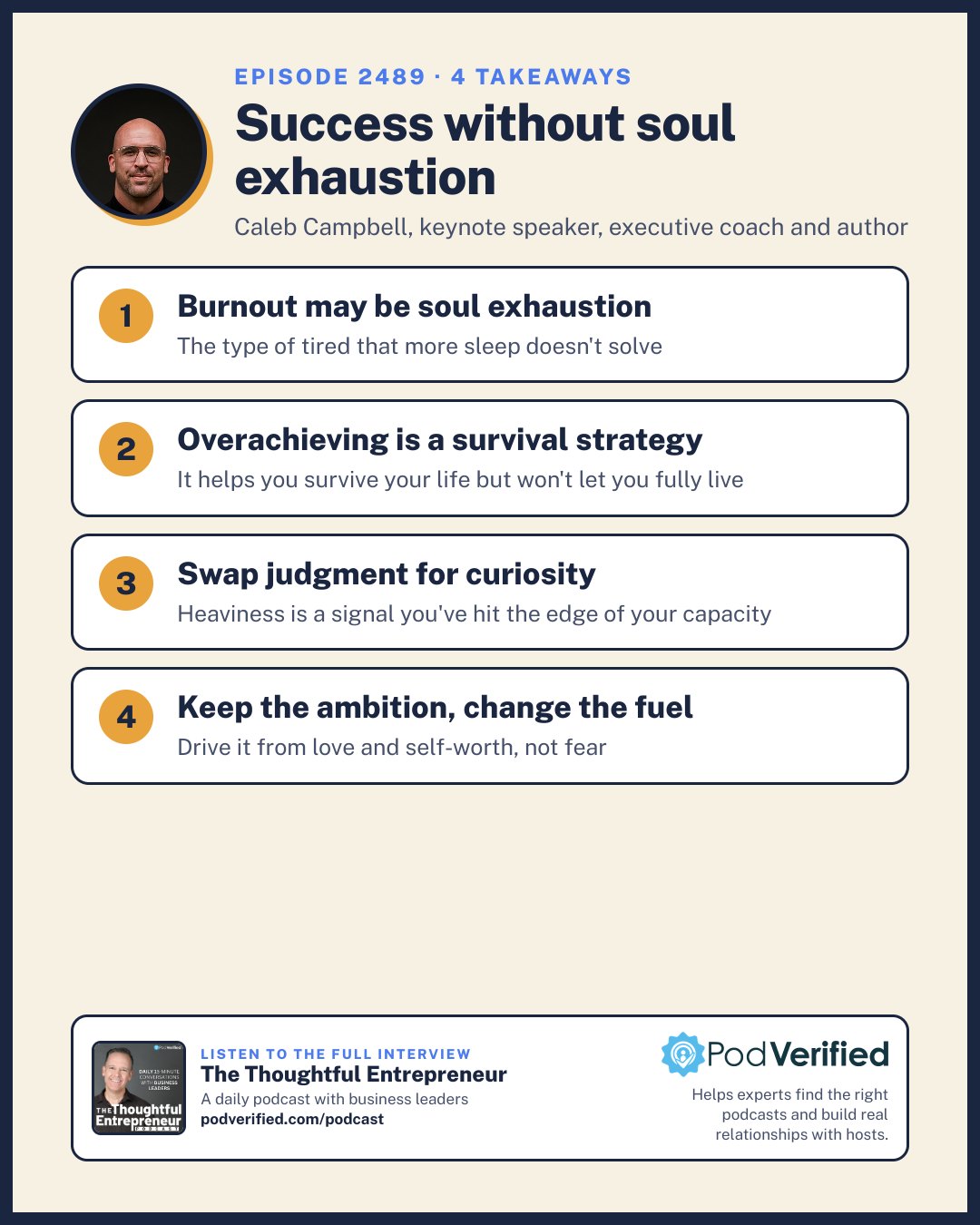
Key takeaways
- Overachieving starts early. Caleb says praise for performance taught him, at 7, that his stats defined his worth.
- Burnout may be the wrong word. Caleb calls it soul exhaustion, a tiredness that more sleep doesn't fix.
- Curiosity comes before fixes. His first step for a stuck leader is to drop the self-judgment and get curious about what's happening.
- Ambition can stay. Caleb says unstriving doesn't make you less ambitious. It changes the fuel from fear to love.
Caleb Campbell was 7 years old when he scored the game-winning touchdown in a community all-star championship game in Texas. He ran to the sideline, found his mother, and heard her say how proud she was. He says that moment taught him his performance decided whether he was accepted.
Caleb is a West Point graduate, former Army officer, former NFL linebacker, keynote speaker and executive coach. On this episode he tells Josh why he thinks many leaders aren't dealing with burnout at all, and what his new book, Unstriving: 12 Lessons on Authentic Success from a Recovering Overachiever, asks them to do instead.
🎧 Listen to Caleb's interview
Press play below. About 21 minutes.
Or listen in your favorite app:
Apple Podcasts Spotify YouTube Amazon Music iHeart Audible Pandora Castbox TuneIn
The Thoughtful Entrepreneur is a daily podcast with business leaders. Subscribe so you don't miss one.
What did a touchdown at age 7 teach him?
Caleb grew up in Texas, where youth football was a big deal. Even at 7, he says, he worked like an overachiever: first to practice, last to leave.
After he scored the game-winning touchdown in the all-star championship, he looked for his biggest fan. It was his mother. She smiled and told him she was proud of him, loved him, and that he'd scored the winning touchdown. Caleb stresses she said it in the most innocent way.
The lesson he took from it was different. From then on, he says, his stats stopped being numbers on paper and became a measure of his worth. Overachieving became the way to protect that worth.
Caleb calls this the survival self. It helps you survive your life, he says, but it won't let you fully live. The question he asks leaders is what sits behind their need to overachieve, and whether they can meet that need themselves.
Straight from the recording
Quotes are lightly edited for readability: filler words and stutters removed, nothing reordered. Times are approximate.

“I was 7 years old when I was taught to believe that my performance in life determines my measure of acceptance in this world.”
“I think for a lot of us, we're waking up the type of tired that more sleep doesn't solve.”
“Something that I want to be very clear on, Josh, is that unstriving and what I'm communicating, it doesn't make you less ambitious.”
“My pursuit of success was always about the avoidance of stillness.”
Josh's case for guarding his downtime
Josh admitted he agrees with Caleb in his head while his body still believes the old formula. Then he put the business case plainly:
“My clients, my team, my audience deserves the best of me. And if I'm cranking out 12 hours a day, they don't get that. So I am ripping them off.”
Caleb's answer was the goal of his book: a version of success where ambition and wholeness can coexist.
Questions answered
What is soul exhaustion?
It's Caleb's name for what many people call burnout. He describes it as waking up with a tired soul, not only tired eyes, the type of tired that more sleep doesn't solve. He says working harder or longer won't outlast it.
What should a burned-out founder do first?
Caleb says to sideline the judgment and get curious. He suggests a reframe: feeling heavy isn't proof you're inadequate. It's a signal you've reached the edge of your capacity and are being invited to grow.
Why do so many high achievers end up exhausted?
Caleb says many learned early that performance earned acceptance, so overachieving became part of their survival self. Those strategies help people survive, he says, but they eventually outgrow them.
Does unstriving mean giving up on ambition?
No, Caleb says. He wants people to look at the fear and pain that fuel their ambition and change it, so it's driven by love and a sense of their own worth instead of insecurity.
How can I reach Caleb Campbell or get his book?
Visit calebcampbell.me to learn about his keynotes and coaching. His book, Unstriving: 12 Lessons on Authentic Success from a Recovering Overachiever, is available on Amazon and other booksellers, as Josh noted on the episode.
Questions to ask your own team this week
Drawn from the examples Caleb gave, not from his marketing.
- What do we praise here, effort or results? Caleb traces his overachieving to praise he got for one touchdown at age 7.
- Who is tired in a way sleep won't fix? That's how Caleb describes soul exhaustion.
- Do we judge ourselves when we fall short, or get curious? Caleb says judgment kept him stuck in a cycle for years.
- What does each of us do to step away from work? Caleb crochets and Josh plays cozy games, and both guard that time.
Away from the screen
For the past two months, Caleb has taken private crochet lessons from a coach, and he's been knitting too. His grandmother taught him as a kid. He says it brings him into the present, lets him work with his hands, and has done wonders for his mental health.
Josh liked the contrast: West Point graduate, Army officer, NFL linebacker, crocheter. His own version is cozy games while he watches a show with his wife, downtime he guards.
“I can feel my jaw unclench, my hands loosen up, my chest exhales, and there's an immediate sense of gratitude.”
Episode details
| Guest | Caleb Campbell |
|---|---|
| Role | Keynote speaker, executive coach and author |
| Website | calebcampbell.me |
| Background | West Point graduate, former Army officer and former NFL linebacker. Keynote speaker and executive coach, and author of Unstriving: 12 Lessons on Authentic Success from a Recovering Overachiever. |
| Topics | Burnout, soul exhaustion, overachieving, identity, self-acceptance, ambition, leadership well-being |
| Host | Josh Elledge |
| Episode | 2489, The Thoughtful Entrepreneur |
| Caleb Campbell on LinkedIn | |
| Listen | Play it on this page, or on Apple Podcasts, Spotify, YouTube or Amazon Music |

We're always looking for great guests
Be our next guest on The Thoughtful Entrepreneur
We publish a new conversation every day, so we're always looking for leaders like Caleb. The guests we love most are generous: real experience, a clear point of view, and something useful to give our listeners. Come ready to teach, and we'll make you look great doing it.
Not ready to apply yet? Get your free PodVerified Score to see how podcast hosts size you up. It takes two minutes.
Full transcript
Filler words and stutters removed. Company and guest names corrected where the automatic transcript misspelled them. Times are approximate.
Read the full transcript
Josh Elledge (00:00): With us right now, it's Caleb Campbell. Caleb, you are found on the web at calebcampbell.me. You are a former NFL, you're a West Point graduate, former Army officer. You're now an executive coach and a keynote speaker, and you have been making the rounds, my friend Caleb. Your new book is, this is exciting. And listen, I am so grateful that you are bringing this message to the world. It's called Unstriving. It's just gone live as of around September 22nd or thereabouts. It's Unstriving: 12 Lessons on Authentic Success from a Retired NFL Player, Recovering Overachiever. And I gotta tell you, Caleb, my suspicion is that you have just pegged probably 80, 90% of this audience, who I think initially, we'll get into it. I don't want to, oh, I'm so excited to talk about this. Before we do, I always love finding out what high-level leaders are kind of doing for fun outside of work. And man, you got a great one. What have you been into lately?
Caleb Campbell (01:17): I genuinely mean it when I say that I, for the past 2 months, I hired a coach. There's a coach for everything these days, but I hired a coach to give me a private crochet lesson. And so I have been spending a lot of time learning how to crochet and also doing some knitting as well. And it's done wonders for my mental health. Mental and emotional well-being.
Josh Elledge (01:41): Now, I appreciate the juxtaposition here. West Point graduate, Army officer, NFL linebacker, crocheter. So help us understand what you personally get out of crocheting.
Caleb Campbell (01:54): Yeah, I think, you know, it's something that I did as a kid. I remember my grandmother teaching me when I was really young. And honestly, I think there's so much of my journey has been learning how to reconnect to the little boy inside of me. I think at some point life, it becomes so demanding and so serious that we kind of have a death grip on life. And so much of my work has been actively learning how to kind of release that grip and shift from surviving life to learning really how to participate with life. And there is just something so genuine and also satisfying and fulfilling about crocheting. And it's simply, I think, for me, just dropping down into the present. You know, I spend so much of my time, especially as a recovering overachiever, out there in the lands of what could be, or back there in the lands of what was. And so, you know, finding a tool that allows me to drop down into the present, to work with my hands, and also to create at the same time has been such a gift.
Josh Elledge (02:50): So another juxtaposition, Caleb. I love it. I absolutely love it. And I'm truly inspired. You know, for me, it's, you know, what you get out of it is just, so emotionally, mentally, what is that experience for you?
Caleb Campbell (03:04): [unclear] I think it's just allowing me to get back into my body, which allows me almost to take, the best way that I can explain it, Josh, is sometimes I feel like, and I think this is also with a lot of leaders that I work with, we move through our life in a way that looks and feels a lot like we're holding our breath. We're tight, we're tense, we're on edge all the time. We're reactive. We have little capacity. And what ends up happening is when I feel like I drop into the present and I just create, there's almost like this exhale that happens, and almost immediately I feel a spaciousness, an inner spaciousness open back up. I can feel my jaw unclench, my hands loosen up, my chest exhales, and there's an immediate sense of gratitude. And a reconnection to joy that, in my opinion, are the very things that really makes life worth living.
Josh Elledge (03:55): Hmm, I'm gonna look into this. You know what, I, you know, kind of a similar thing. I play a lot of cozy games, you know, while I'm maybe watching YouTube videos or watching a show with my wife or whatever. But that's my downtime that I jealously guard. You know, where I'm, again, just not thinking about work. That is not the time for it. And let's talk about this concept because I think a lot of us maybe initially might look at, you know, being an overachiever is, oh my gosh, you could not possibly make your parents any more proud. If you are an overachiever, your teachers, all of your mentors, and you are going to get so much praise. When you are young and you are showing yourself to be an overachiever. So Caleb, what's wrong with that formula?
Caleb Campbell (04:48): It's not that there's nothing necessarily something wrong with the overachieving, but I do think that, like you said, you get a lot of praise because of your ambition, because of your overachieving. And for me, you know, I was 7 years old, Josh, when I scored the game-winning touchdown in the community-wide all-star championship football game. Now you need to understand, I grew up in Texas, so this was a big deal. And I remember I worked even at that age like an overachiever. I was first at practice. I was last to leave. I was putting in a lot of effort. And I remember after I scored that touchdown, I looked to the sideline trying to find my biggest fan. You can probably guess who it was. Guess who that was? It was my mother. And I remember when my eyes caught my mom's eyes, I just ran to her as fast as I could. And she looked at me with this big, beautiful smile on her face. And she said in the most innocent way, she says, son, I'm so proud of you. I love you so much. You scored the game-winning touchdown. And the reason why I'm telling you that story, Josh, is because I was 7 years old when I was taught to believe that my performance in life determines my measure of acceptance in this world. And what ends up happening is my stats are no longer numbers on a piece of paper. My stats are now a definition of my worth. And overachieving is the way that I make sure that I do not ever compromise that worth. And eventually what ends up happening is, for me, overachieving is the language of our survival self. For so many of us, we learn how to survive in our lives. We learn how to find acceptance and belonging through overachieving. And so that overachievement is a part of our survival self. And the problem with the survival self, Josh, and overachieving is while it will allow you to survive your life, it's never going to allow you to fully live. And at some point, we have to stop and ask ourselves, what's behind the need for overachievement? And can we learn how to meet that need ourselves?
Josh Elledge (06:32): Wow. Okay, so how can we? Because I think a lot of us, and I'll just share, you know, very frank with you, Caleb, like this is something that I know that I've really struggled with in my life. And, you know, I've worked my ass off on this topic because, you know, I think for me, the way that this shows up is intellectually, cognitively, 100% believe, you know, agree with you. Like, right? It's like, I don't think that I need to demonstrate, you know, being an overachiever in order to feel worthy, but yet my body and my kind of my shadow self, or, you know, like the emotions do believe that. Yeah. So there's this conflict of like logically I'm like, no, that's ridiculous. But unfortunately, that's the way we show up sometimes in very subtle ways, right? And so something happens, it's outside our control. And then we feel bad about it. And for me, you know, I was like, well, why do I feel bad about that? I don't have any control over that. And it's like, well, a successful overachiever wouldn't have that problem, right? Which is just complete BS. But yet in my mind, I'm still worried that someone's going to think, you know, exactly. You know, I'm just not, you know, not worth it. You know, I don't deserve the title or, you know, it's just so weird, right? These formative years that just shape us so hard.
Caleb Campbell (08:04): And that's what I'm really getting at, especially inside of my book, is a lot of the beliefs and the characteristics and the strengths, strategies that we relied heavily on the early part of our lives that allowed us to really survive our lives, eventually we outgrow them. And we come to this point, for me, where I was finding myself, you know, a lot of people call it burnout. I don't think we're dealing with burnout today. I think we're dealing with something much deeper. I call it soul exhaustion. I think for a lot of us, we're waking up the type of tired that more sleep doesn't solve. And the early formative years of our lives taught us that, oh, if we can just start to, or if we can just continue to endlessly strive, we can outwork, or we can outperform, or we can simply outlast this deep internal unrest or soul exhaustion that we're carrying in our lives. And it's just not true. It took me a long time, Josh, to really understand that when we hit the edge of our capacity, when we have come to that point in our lives that all of our overachieving tendencies, all of our, you know, endless striving characteristics. When we reach that level of we have nothing left to give, that means we have come to the end of our current identity. When we reach the edge of our capacity, we have simply hit the end of our current identity. And the next evolution of success in our lives, and this is what I lead people through the unstriving journey, that next evolution of success isn't going to be found on that familiar path of do more, be more, achieve more, work harder, work longer mentality. That next evolution of success is only going to come through the byproduct of a deeper internal growth that is the catalyst to an internal evolution that helps us evolve at an identity level. And it's through this internal evolution, this deeper inner growth that we begin to almost, we begin to become somebody new on the other side and we expand in the process. We cannot continue to add weight to our lives in every level of success comes with greater weight. We cannot continue to add more weight to our lives without increasing our inner capacity to carry that weight.
Josh Elledge (10:09): Yeah. So specifically, I know you keynote on several topics and one of them is burnout. Can you talk about, I mean, I know you have already to some extent, but specifically if someone is showing up to work, particularly, like, it could be their own company. Yeah. And, you know, they built it, it's theirs. But they might feel trapped. They might feel burnt out. Well, like, how can, what are some things that they might be able to do to help them find a path through and, you know, to a more sustainable level of that, you know, extension of energy?
Caleb Campbell (10:47): I think the first thing that we do is we have to begin to deploy some curiosity and not judgment. We have to sideline the judgment and deploy some curiosity, especially when we find ourselves in this place when I'm feeling burnt out, especially when you're looking at your life and you're saying, oh my gosh, look how far we've come. I got a beautiful life. I make good money. I've got a beautiful family. I've got every reason to be grateful in my life. But I cannot shake this reality that there is something intrinsically missing in my life. It just feels like a void that can't ever be filled, and I am constantly doing and going, trying to wake up in a world where I've done enough so that it feels like it's finally enough. But that internal experience, it constantly eludes us for so many of us, and this was my reality, Josh, for so long, I lived in that place of constantly judging myself, and I was constantly saying, well, clearly I'm not working hard enough. Clearly I'm not doing something right. Clearly I'm missing something, or worst off, clearly something is just intrinsically broken in me. And that kept me trapped in this never-ending cycle of just judgment, trying to fix the problem, and just staying trapped in the problem. And I think what we have to do, Josh, is we in this moment have to just deploy some curiosity and really begin to implement a reframe. And the reframe that we have to begin to implement in our lives is when you do find yourself in that place where it feels like you're not just waking up with tired eyes, but a tired soul, or life feels heavy. That is not a reflection of your inadequacy. That is simply a signal of life letting you know that you have reached the edge of your capacity and you're being invited to expand. But that next level of expansion, again, is not going to be discovered through more external pursuits, only uncovered through deeper internal growth.
Josh Elledge (12:32): Yeah, so this seems a little contrary to like the whole David Goggins thing. David would, I don't think would like that.
Caleb Campbell (12:41): I have nothing but respect for the man. Obviously, he's done a lot of great things. I just think right now people are really tired and we're doing everything that we are supposed to do. We're doing everything that we are expected to do, and it's not actually closing the gap between where we are and where we want to be. Doing more and trying harder is only kind of creating more of an issue. And so I think really people are in this place of really trying to figure out how do we do it a little bit differently? Something that I want to be very clear on, Josh, is that unstriving and what I'm communicating, it doesn't make you less ambitious. I'm not saying that we are now succumbing to the status quo. It was a really big reality check for me when I realized that my pursuit of success was never about the success as much as I thought it was. My pursuit of success was always about the avoidance of stillness. Because in the stillness, I would have come to come face to face with a lot of the fear and a lot of the pain that was driving my ambition. And so I'm saying, like, for a lot of people, a lot of us, we are burning dirty fuel. And now what's happened when we reach the edge of our capacity and we've got nothing left to give, it's time to go look at the source of our fuel, look at the fear, look at the pain, look at the early childhood experiences that shaped your pursuit of ambition and your pursuit of success, and really begin to alchemize that so that it's driven not from fear, but from love, not from an insecurity, but from a knowing of who you are and what you're worth in life. That's the work that we're being invited to do.
Josh Elledge (14:16): Amazing. Caleb, your book, again, which has just hit Amazon and everywhere else. It's called Unstriving: 12 Lessons on Authentic Success from a Recovering Overachiever. What do you hope would be the transformation for the reader when they begin this journey? And I cannot wait to read it. I feel like I'm a perfect candidate. Because I'm just so into this right now and letting go of that identity or what that looks like. But I agree with you because I think ultimately it's the leader who is not overburdened that knows their limit and, you know, when they need to be on, they're on at 100%. And then they jealously guard their crocheting habit, right? Because that allows them to serve their shareholders, serve their clients, serve their teams so much more effectively. My clients, my team, my audience deserves the best of me. And if I'm cranking out 12 hours a day, they don't get that. So I am ripping them off. So that's kind of like intellectually, you know, kind of, you know, how I do that. I don't know if that's, but I'm so excited to read your book. So please tell us about the journey.
Caleb Campbell (15:35): Yeah. You know, for me through this book, what I'm trying to do is in my own way and through my own journey, redefine success in a way where ambition and wholeness can coexist. Because right now, the way that we have been doing things, ambition usually comes at the expense of our wholeness. And sure, we're showing up, we're meeting demands, we're surpassing expectations, but we're showing up at [unclear]. After a long, hard day at work, and we have no capacity left to give the people that we love the most. We're living inside of fragment and broken relationships. Success is costing us. It's coming at the expense of us. And I don't think it has to be that way. And, you know, that was my experience. I get to the height of my journey in the NFL. I reached this version of reality where I was so convinced that if I could just get there, then I'll find everything that I'm looking for. But I got there and I was waking up and I no longer recognized the man in the mirror. I left and lost some essential part of me. And so that was really the beginning of my unstriving journey. And I think a lot of people are in this place, Josh, a lot of high achievers, a lot of entrepreneurs, a lot of professionals, are in this place where they know they have more to give. I know that I was made for something more. I can intuitively feel that. I know there is something that I am being asked to step into. But I also know this old way of doing things, this endless striving, this overachieving, this working harder, working longer, and never turning it off, it just is no longer efficient for me. It is beginning to cost me. And when you are in that place of, I know I have something more to give, but the old way of doing things no longer is aligned, Unstriving is where I plan on meeting you and showing you the new way forward.
Josh Elledge (17:14): All right, so the website is calebcampbell.me. You are a keynote speaker. You have spoken for the world's biggest companies. Google, US Bank, USAA. I love that brand. Also one of my personal favorite brands, La-Z-Boy, because that
Caleb Campbell (17:27): My love language right there, Josh. I'm telling you, man, I was driving to the finest [unclear].
Josh Elledge (17:31): Yeah, no, La-Z-Boy, like, I bought one for last year Christmas. And I was like, oh man, am I really that age? But I tell you what, like, for my sleep hygiene, it's next to my bed. I do all my reading and stuff over there. Bed, that's for the other activities. So, but definitely no devices and that sort of thing. So anyway, Caleb, thank you so much again. The book which is now out, it's Unstriving: 12 Lessons on Authentic Success from a Recovering Overachiever. And I hope to join you as a fellow former overachiever. Caleb, thank you so much for the conversation.
Caleb Campbell (18:15): Thanks for having me, Josh.