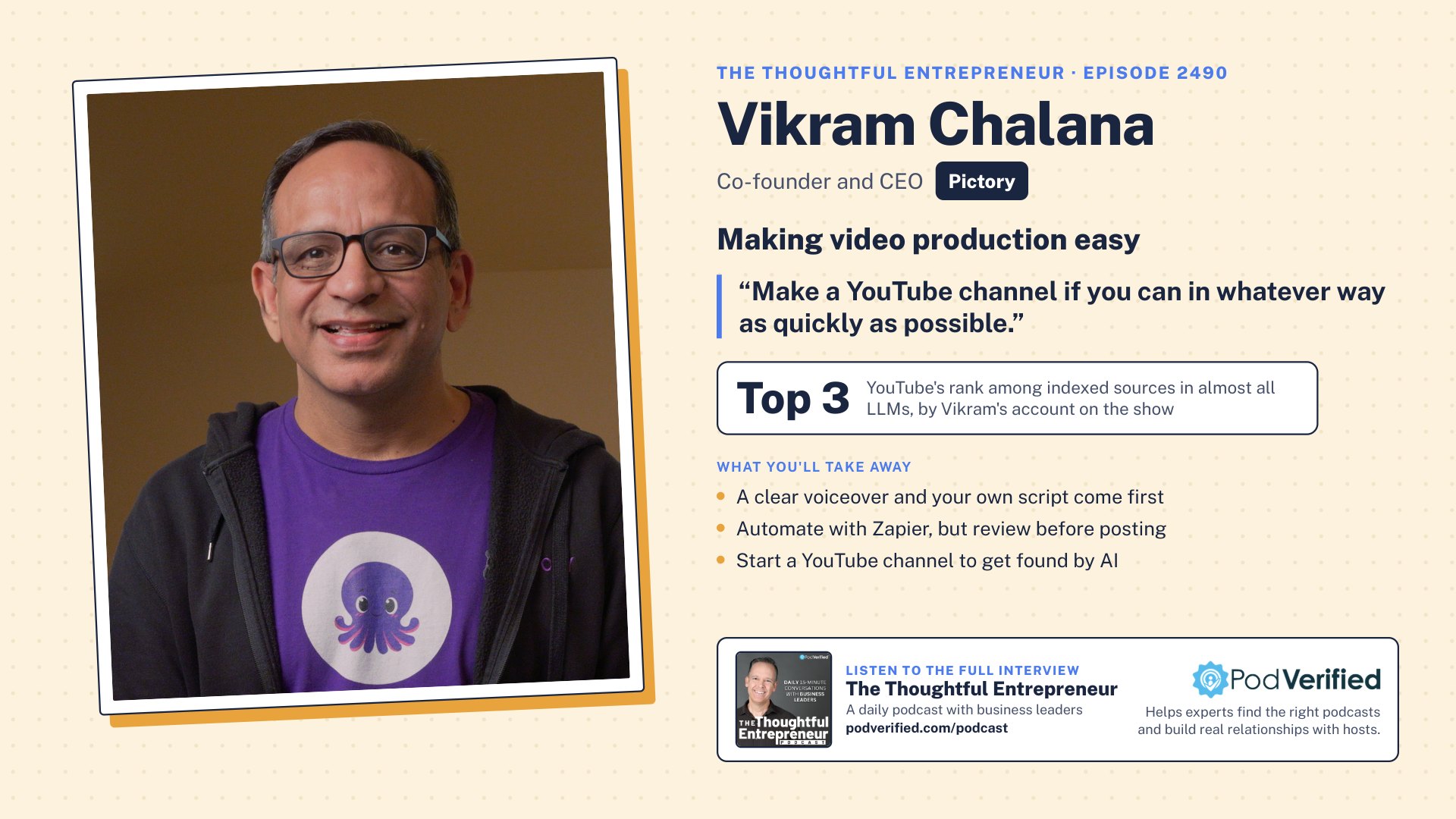
Combining Human Creativity and AI to Make Video Production Easy with Pictory AI's Vikram Chalana
The Thoughtful Entrepreneur · Episode 2490
The short answer
How do you make AI videos that don't look like AI slop?
Vikram Chalana, co-founder and CEO of Pictory, says the script is the most important part of an AI video, because that is where the slop risk is highest. His advice is to add your own story or business narrative, use a clear voiceover and consistent visuals, and keep a human in the loop rather than automate everything.
Key takeaways
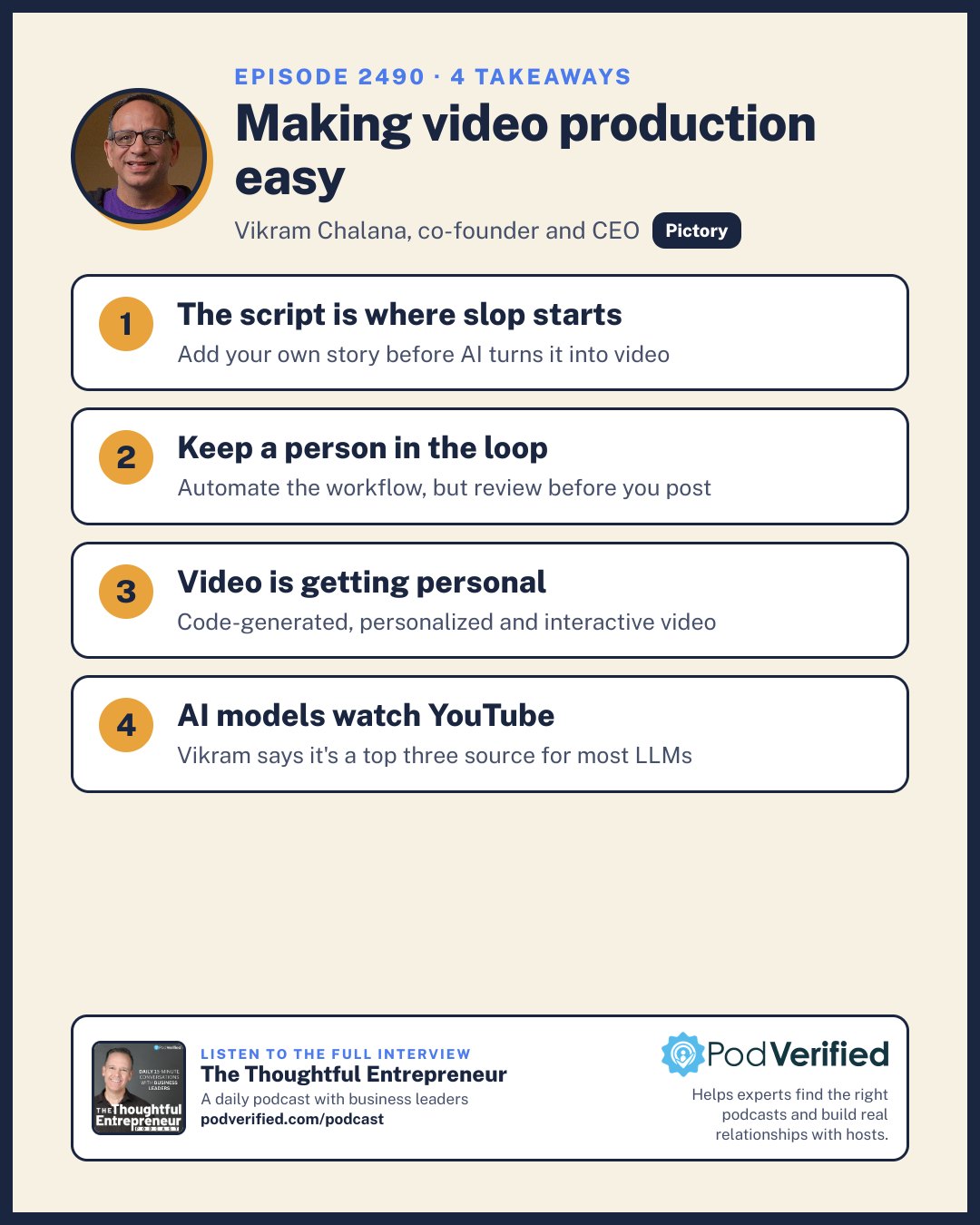
- The script matters most. Vikram says the script is where AI slop creeps in, so add your own story before you turn it into a video.
- Keep a person in the loop. Even with a Zapier workflow from blog post to YouTube, Vikram wants someone to review each video before it posts.
- Code is the next video engine. Vikram says models such as Claude now write HTML that renders as video, and Pictory is testing it.
- Get on YouTube. By Vikram's account, AI models lean on YouTube as source material, so a channel helps you get found.
YouTube is the second biggest search engine. That part didn't surprise Vikram Chalana. What did, he says, is that YouTube is one of the top three indexed sources in almost all large language models, from ChatGPT to Claude to Perplexity. His advice to listeners: start a YouTube channel as fast as you can.
Vikram is the co-founder and CEO of Pictory, an AI tool that turns blogs, white papers, slide decks and scripts into finished videos. On this episode he tells Josh how to keep AI video from reading as slop, what Pictory bundles in, and the three changes he sees coming to video.
🎧 Listen to Vikram's interview
Press play below. About 21 minutes.
Or listen in your favorite app:
Apple Podcasts Spotify YouTube Amazon Music iHeart Audible Pandora Castbox TuneIn
The Thoughtful Entrepreneur is a daily podcast with business leaders. Subscribe so you don't miss one.
How do you make AI video that doesn't look like slop?
Josh asked the question plainly. He doesn't want to put out slop, and he thinks audiences push back when creators get lazy and the result looks over-the-top AI.
Vikram started with the audio. Most Pictory videos are training and education videos, he says, and in those the voiceover may be the most important piece, because people listen as much as they watch. So use a clear voiceover. Keep the visuals consistent with the story, and swap them out when the AI's picks are out of whack. Use motion graphics to point at what you want people to notice.
Then the script. Vikram says it ends up being the most important part, because that's where the risk of AI slop is highest. Asking ChatGPT for a script and turning it straight into a video skips the part only you can add: your personal story or your business narrative.
The same rule applies when you automate. Pictory connects to Zapier, and Vikram's example was a workflow that turns every new blog post into a video. He'd still have someone review each one before it goes up on YouTube.
Straight from the recording
Quotes are lightly edited for readability: filler words and stutters removed, nothing reordered. Times are approximate.
“you have to add your story there. That's where your personal story becomes really important”
“So the whole workflow can be automated with Zapier, but just make sure you have somebody reviewing it in the middle.”
“So showing them a single learning video is gonna be passé.”
“But the bigger surprise I found was that it is one of the top three indexed sources in almost all LLMs.”
Why Josh cares about the education piece
Vikram got into video through education and training, and his third prediction, interactive video that plays more like a game, is an education idea too. Josh connected it to students who don't have the same resources as better funded schools.
“And now if everybody can have access to the world's greatest tutors, I think that really helps, especially if we can make it engaging and fun.”
Vikram's picture of where it goes: a video that asks you questions and takes you down a different path based on your answers, instead of one lesson that every learner watches the same way.
Questions answered
What is Pictory?
Vikram describes Pictory as AI for video creation. You bring a blog, white paper, recorded video, PowerPoint or script, and it builds a video with a voiceover, music, transitions and either stock footage or generative AI clips. He says the company started about seven years ago to make video easy for business people.
How do you keep AI-generated video from looking like slop?
Vikram's list: a clear voiceover, visuals that stay consistent with the story, and graphics that point at what matters. He says the script matters most, so add your own story or business narrative. And keep a person reviewing the work instead of automating everything.
What does Pictory include?
Per Vikram, hundreds of ElevenLabs voices, millions of Getty and Storyblocks assets, AI summarization, avatars including a clone of yourself, Google's Veo for video generation and Nano Banana for images. It also connects to Zapier.
What changes are coming to AI video?
Vikram named three: code-generated video, where models such as Claude write HTML that renders as video; personalized video that changes based on who and where the viewer is; and interactive video where your answers send you down different paths.
How do you get started with Pictory or reach Vikram?
Vikram says pictory.ai is a great place to start. He's on LinkedIn a lot and invites listeners to connect there to talk about their AI and video strategy.
Questions to ask your own team this week
Drawn from the examples Vikram gave, not from Pictory's marketing.
- Who writes our scripts, and whose story is in them? Vikram says the script is where AI slop risks the most.
- What written content could we turn into training video? Blogs, white papers and slide decks were Vikram's starting points.
- Who reviews automated content before it posts? Vikram's Zapier example kept a person in the middle.
- Do we have a YouTube presence AI models can find? Vikram calls YouTube one of the top three indexed sources in almost all LLMs.
Away from the screen
From March or April on, Vikram and his wife hike most Saturdays around Seattle, and they took the kids when they were little. In winter there's snowshoeing. He used the Northwest trails to train for bigger climbs: Kilimanjaro with his son a couple of years ago, and Mount Shasta in California with him this year.
His pick for a visiting friend who's new to hiking is Heather Lake, about a 5-mile hike to an alpine lake you can walk around. He goes at least once a year. Josh, who visited Seattle with his wife for their anniversary, promised listeners would add it to their next trip.
“I would take them to a place called Heather Lake, which is gorgeous.”
Episode details
| Guest | Vikram Chalana |
|---|---|
| Role | Co-founder and CEO, Pictory |
| Website | pictory.ai |
| Background | Engineer turned entrepreneur. Before Pictory, Vikram co-founded Winshuttle, an enterprise software company that Pictory's site says he helped grow to 300 employees globally. |
| Topics | AI video creation, AI slop and best practices, human in the loop, Zapier and Make automation, code-generated video, personalized video, interactive video, education, YouTube and AI search |
| Host | Josh Elledge |
| Episode | 2490, The Thoughtful Entrepreneur |
| Vikram Chalana on LinkedIn | |
| Listen | Play it on this page, or on Apple Podcasts, Spotify, YouTube or Amazon Music |
We're always looking for great guests
Be our next guest on The Thoughtful Entrepreneur
We publish a new conversation every day, so we're always looking for leaders like Vikram. The guests we love most are generous: real experience, a clear point of view, and something useful to give our listeners. Come ready to teach, and we'll make you look great doing it.
Not ready to apply yet? Get your free PodVerified Score to see how podcast hosts size you up. It takes two minutes.
Full transcript
Filler words and stutters removed. Company and guest names corrected where the automatic transcript misspelled them. Times are approximate.
Read the full transcript
Josh Elledge (00:00): With us right now, it's Vikram Chalana. Vikram, you are the founder and CEO of Pictory. This is a brand I've been familiar with. Pictory. I watch a lot of YouTube videos about AI and AI media creation, and Pictory comes up quite often. You guys have been around for a bit of time, and you got a lot of great companies using your solution. We're going to talk about that in just a second. Vikram, first off, thank you for being here.
Vikram Chalana (00:22): Thank you, Josh. It's a pleasure to be here. I really appreciate it.
Josh Elledge (00:26): Absolutely. And before we get going talking about that, you live in the Pacific Northwest in the Seattle area. You and I were talking beforehand, that my wife and I went up there for an anniversary trip and just absolutely loved, just so many gorgeous mountains and trees and, well, one of your favorite hobbies. And my favorite hobbies, hiking. Tell us about hiking in the Pacific Northwest.
Vikram Chalana (00:51): Yeah, starting April or even March, every weekend, my wife and I, and when our kids were little, with the kids, we'd go hiking pretty much every Saturday. And there's so many amazing trails here. And you can do it even in the winter, if you do snowshoeing and stuff, you can do some of that. And so yeah, that's what I love. And I've hiked in the Northwest and trained for a bunch of other hikes that I've done, like me and my son climbed Kilimanjaro a couple of years ago. Yeah, in Africa. And then this year, he and I went up to Mount Shasta in California. So that's all by training in the Northwest.
Josh Elledge (01:46): Well, congratulations. That sounds... I mean, so let me ask you this. So if you have family that's, let's say, coming into town, or maybe some close friends, and they're coming to visit, and they say, Vikram, we got a full Saturday, the weather is great, we can only do one hike, what's one that you would recommend?
Vikram Chalana (02:08): Oh yeah, there's so many of them. My favorite are the lakes. There's all these alpine lakes here, and if they're a beginner hiker, I would take them to a place called Heather Lake, which is gorgeous. It's about a 5-mile hike, and you come into this alpine lake and you walk around it. And if it's winter, there's snow all around. If it's summer, it's just green. It's just, it's beautiful. It's one of my favorite hikes. At least once a year.
Josh Elledge (02:39): And sorry, what was the name?
Vikram Chalana (02:41): Heather Lake.
Josh Elledge (02:43): Heather Lake. Okay, so we're all gonna punch that into our AI or our search engines or whatever and make sure we get that in our itinerary for our next visit. Vikram, please give us... start by giving us a quick overview of what Pictory is.
Vikram Chalana (03:01): Yeah, so what Pictory is, is AI for video creation. And one of the things we found was that videos are just very hard to create through these timeline editors and also editing the videos is just super hard. So we started this about 7 years ago, and it was all about trying to make it easy and trying to make it accessible to business people like you and I. I mean, just, we should be able to pick up some piece of content that we have. Sometimes it's a blog, sometimes it might be a white paper, sometimes it might be a recorded video, PowerPoint, whatever piece of content that you have. We help you turn that into a video. And so the point is that videos are better consumed. People are more attuned to the messages that videos can convey. And just, it's been hard to create videos. It's just, it's been expensive and traditionally very hard. So we're trying to make it easy to turn your written content into videos, and therefore get your message out much faster, much easier, and in a much more accessible way.
Josh Elledge (04:20): Yeah. So as I understand it, and again, the way that Pictory works is you basically just supply a script. I would imagine, the more instruction, the more direction that you can give it, the better. And then boom. There's your video. Is that...
Vikram Chalana (04:35): That's one of the most common use cases. Yes, absolutely. So sometimes people will have their scripts already and they just plug in the script and it does its magic. Sometimes it's using generative AI clips, sometimes it's using stock videos. It adds a voiceover, it adds narration, it adds music, it adds everything, transitions, all kinds of elements, and comes up with the video version of your story.
Josh Elledge (05:05): Yeah, so one thing I would like to do, I am always very sensitive, like I don't want to put out slop. Can you maybe just kind of give us some best practices for what you see consumers or audiences liking and where might there be some pushback? And I think the pushback is when creators are kind of just lazy with this and it looks really super over-the-top AI. Can you help with best practices?
Vikram Chalana (05:40): Yeah, so some of the best practices that we find, by the way, a lot of our use cases are around educational videos, training videos. So some of the best practices I'm going to talk about are around that, around training videos, educational videos. So add a very clear voiceover. I think that's, because again, these days people hear as well as pay attention to the screen, but the audio seems to be one of the most important things. So add a clear voiceover, add consistent thumbnails, visuals. So our AI does a decent job at keeping the visuals consistent to the story, but if it doesn't, if it's too out of whack, you might have to spend some time in changing the visuals and adjusting them. But again, it's all prompt or search. And so we make it really easy to change the visuals, find the right ones. And then use other elements like we have these motion graphics or different kinds of graphics that again, AI does a good job to just automatically find them. But use those to emphasize things that you want to emphasize on the visuals. But I think the script ends up being the most important part, is what you want to say, because that is where the AI slop risks the most, because you can just take, ask ChatGPT to give you something and then you put that, turn that into a video, but you have to add your story there. That's where your personal story becomes really important, or your business narrative, what you're trying to convey, that becomes really important. And so again, we take care of many of these things in our application, but there is the human in the loop is critical here. Don't just automate everything.
Josh Elledge (07:47): Vikram, so one of the advantages to Pictory is that it technically includes several, what you may pay for several different tools and platforms. It's kind of all in one. Is that right?
Vikram Chalana (08:05): That's right. Yeah, so like we include a bunch of ElevenLabs voices and you get a...
Josh Elledge (08:13): I'm a big fan of ElevenLabs. I love... I use a lot of their tools.
Vikram Chalana (08:17): Yeah, so we have hundreds and hundreds of ElevenLabs voices included in our product. We have millions of assets from Getty and Storyblocks included in our product. We have, of course, all the AI summarization and all that kind of stuff, the classic AI features included. So there's a ton of value you get from just using it. It just integrates everything. You can edit longer videos. You can convert your PowerPoints to videos. Now we recently added avatars in there. So we have a library of avatars, but you can even clone your own self as an avatar. And you can use that in your videos, in scenes that you want. So yeah, and then we have a lot of generative features, like Veo is one of Google's great generative models that's included inside. Nano Banana is included for image generation. So all the state-of-the-art AI models are included, avatars are included, voiceovers, and yeah, Getty assets.
Josh Elledge (09:35): One thing I love to look for, and that's integrations. And you can connect with both Zapier and Make. So what's possible there?
Vikram Chalana (09:46): All kinds of things. But again, because I'd like the human in the loop piece of it, you can still say, hey, connect your blog site to Zapier. Every time you create a blog, turn that into a video, but just make sure somebody's reviewing it before it gets posted into YouTube. So the whole workflow can be automated with Zapier, but just make sure you have somebody reviewing it in the middle.
Josh Elledge (10:16): Vikram, where are we going? If you look... I know you have a pretty aggressive roadmap, but if you were to try to look into your crystal ball, where do you think we're going to be? It's so funny, I think in other things I would say, where are we going to be in 5 years? But I think for you it's like, where are we going to be in a year? And even then, I think many of us can't really comprehend what is possible here as the technology keeps improving. What do you see?
Vikram Chalana (10:47): So I've been tracking videos pretty closely and I kind of see what things are coming. So I'll give you 3 directions which I see are coming up and things that we're kind of experimenting with. The first one that is happening very quickly and now is code-generated videos. So the generative videos that you see, the diffusion videos that you see from Nano Banana or Veo 3, they're using something called diffusion models and they're trained on large sets of Hollywood videos and so on. But what we've seen now, models, especially Claude, generate really good code that can produce HTML, right? And then those HTMLs can be rendered as videos. And so that's something that we've been experimenting with and it works really well. I call them code-generated videos. You add motion graphics automatically, you get these beautiful videos, beautiful layouts automatically. So that's kind of the immediate term thing that you will see more and more in the next few months. The other thing that people are working on is very personalized videos, because once you kind of set up on a template and say, hey, this I want, I can personalize it for you, Josh. I can personalize it for Vishal, personalize it for whoever. So depending on your profile, depending on who you are, where you are, you can personalize it. So we see lots of interesting examples there, like localized. Like you're in Florida. Could we show you Florida landscapes while showing you a car ad, for example? Could we show you somebody in your neighborhood, like something that looks like your neighborhood, while showing you a house ad? So that personalization in marketing and also in education, because everybody learns at different rates in different ways. So showing them a single learning video is gonna be passé. I mean, we're gonna be all learning in very personalized ways, and it's already happening through AI. Yeah.
Josh Elledge (13:28): And I know education is a big passion of yours.
Vikram Chalana (13:31): Exactly. Education. And that's kind of how I got excited about videos in general, is making videos for education and training. And then the third space that also is education related is interactivity in video. So there you can combine interactivity and personalization. Just imagine, like, a video can be an experience almost like a virtual reality experience. A video game, right? So you're watching something, you can choose different paths, you can see different experiences, and then you can get questions that you have to answer. Based on that questions, it takes you to a different side of the video. So those videos get more interactive, as opposed to just a passive watching experience. So we'll see this merging of video and video games in some very interesting ways.
Josh Elledge (14:27): Yeah, I imagine that it's probably not too far away, or maybe this is already being done, where I can have a video avatar of me. It's loaded in with all of my knowledge, and you go to my website and you could talk with me. You push a microphone, we talk back and forth, and Josh is listening and nodding while you're talking. And then when you're done with the questions, like, okay, I have an answer for you, you know? And how cool that would be, especially if you're like, look, man, I don't want to get on a sales call. So I think about, in terms of sales, marketing, growth, sales, I mean, there's lots of opportunity.
Vikram Chalana (15:05): And that, like the avatar thing, it's already there. You can imagine that. But the interesting thing could be like, hey, I am on a call with you, Josh, and you want to show me something, and suddenly the slides pop up behind you, or a demo starts playing behind you, which kind of talks to what you were trying to explain to me. So it's not just the talking head speaking, but now you have something more meaningful to share on the screen too. Yeah.
Josh Elledge (15:36): All right. You and I are equally... I mean, again, I think going back to the education piece, because I know again just based on your volunteerism as well and your community, it's exciting, right? We can close the education gap in rural communities or underserved communities that don't have access to other areas that just have more funding. They have better teachers, more resources. And now if everybody can have access to the world's greatest tutors, I think that really helps, especially if we can make it engaging and fun. And it's gonna give students what we know to be those things that they're looking for. So very, very cool. Vikram, next steps for our friend that's listening. We have a lot of great business owners that are interested in being a part of this, being able to create more resources, training materials. I was going through, I think this is kind of the fun thing people can look at. Under solutions, you could be doing higher education, training videos, explainer videos, marketing and ads, product demos, corporate communication. All this stuff you could do at a fraction of the time and cost of getting into a studio and getting a professional video team together. I know because I've both paid that money before, and I've produced those assets before. It's expensive. It's time consuming to do that stuff. So now we can dream it, imagine it, and have it so much more readily. Where do our friends go from here who've been listening?
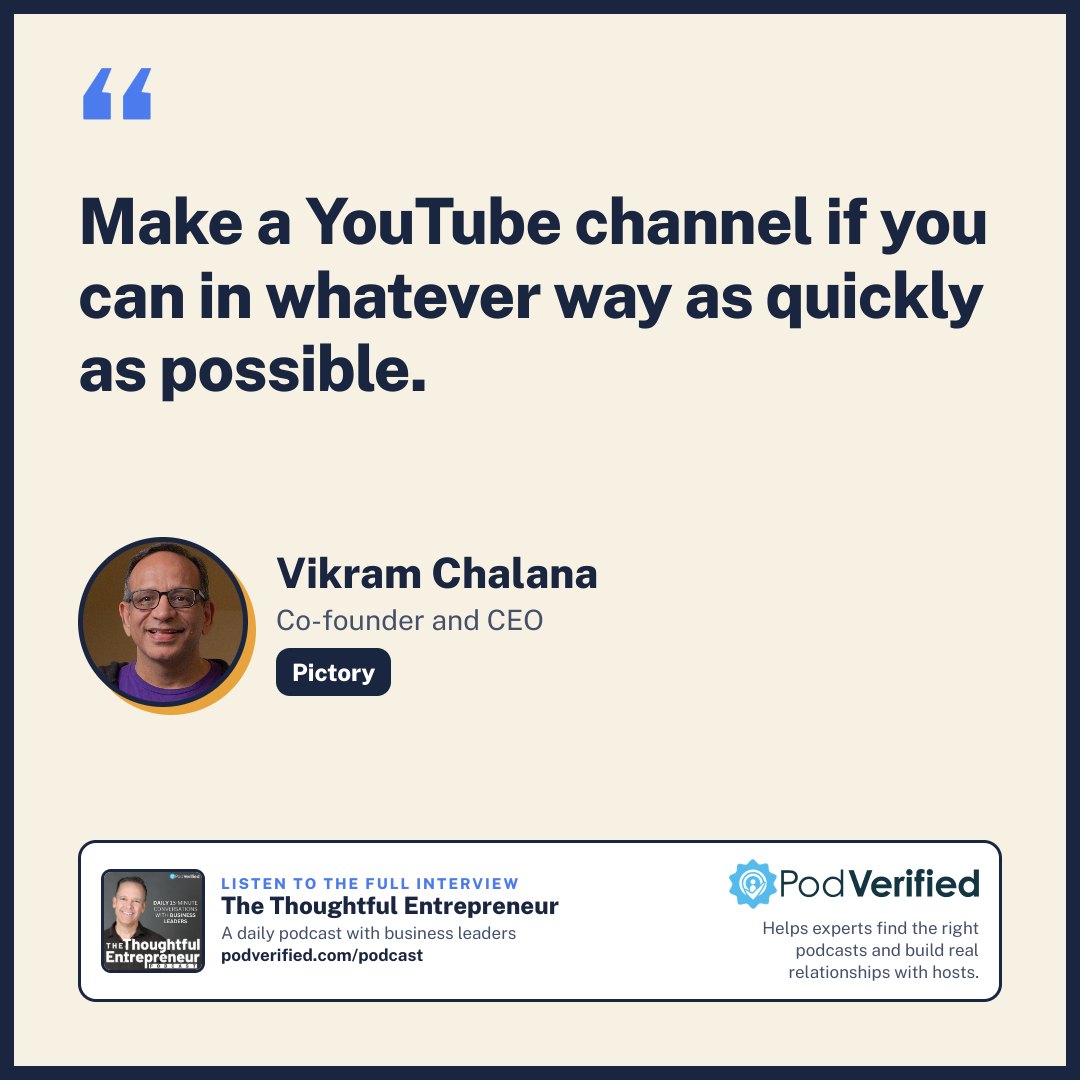
Vikram Chalana (17:13): So pictory.ai, that's a great place to start. And I'm personally on LinkedIn a lot, so connect with me on LinkedIn and we can talk about your AI, your video strategy, how you're thinking of videos. One very interesting recent fact that I came across, that I think your listeners would be very interested in hearing about: YouTube is the second biggest search engine. That's not a surprise. But the bigger surprise I found was that it is one of the top three indexed sources in almost all LLMs. So whether it's OpenAI ChatGPT, whether it's Claude, whether it's Perplexity, they all use YouTube as their source material. And so Reddit and YouTube, you have to be present there to be found on AEO and GEO and the new SEO world, if you will, search engines. Make a YouTube channel if you can in whatever way as quickly as possible. And AI tools can of course help in creating YouTube videos, but so can podcasts, and so can just getting yourself out there more. It's going to be indexed. You're going to be found on search engines and LLMs.
Josh Elledge (18:46): I love it. Vikram Chalana, founder, CEO of Pictory, found on the web at pictory.ai. We've got all the links in the show notes, including a link to your own YouTube channel. It's been really great. Vikram, thank you so much for joining us.
Vikram Chalana (19:08): Thank you, Josh. It's been a pleasure.