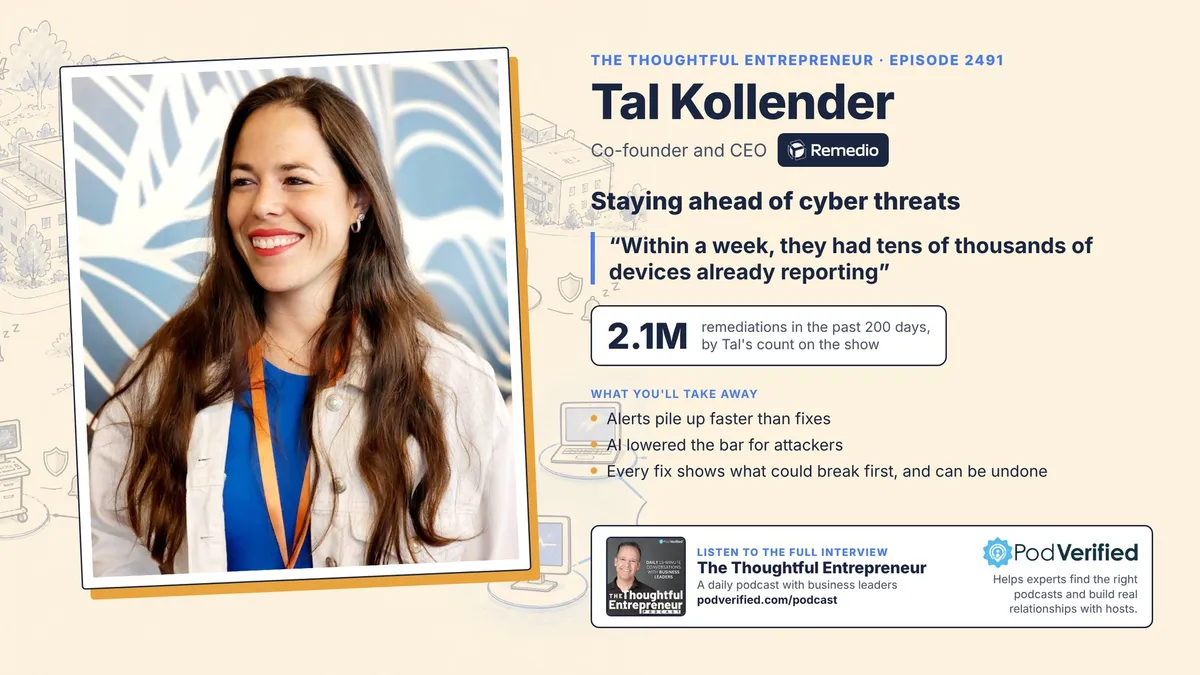
Staying Ahead of Cyber Threats Through Automated Remediation with Remedio's Tal Kollender
After a cyber attack, a large nonprofit healthcare organization called Remedio with an odd problem. Their endpoint detection and antivirus software had read everything the attacker did as normal behavior.
Within a week of rolling Remedio out, tens of thousands of their devices were reporting in. Tal Kollender, Remedio's co-founder and CEO, tells that story on this episode, along with why she says the problem has moved from finding vulnerabilities to closing them.
🎧 Listen to Tal's interview
Press play below. About 19 minutes.
Or listen in your favorite app:
Apple Podcasts Spotify YouTube Amazon Music iHeart Audible Pandora Castbox TuneIn
The Thoughtful Entrepreneur is a daily podcast with business leaders. Subscribe so you don't miss one.
In this episode
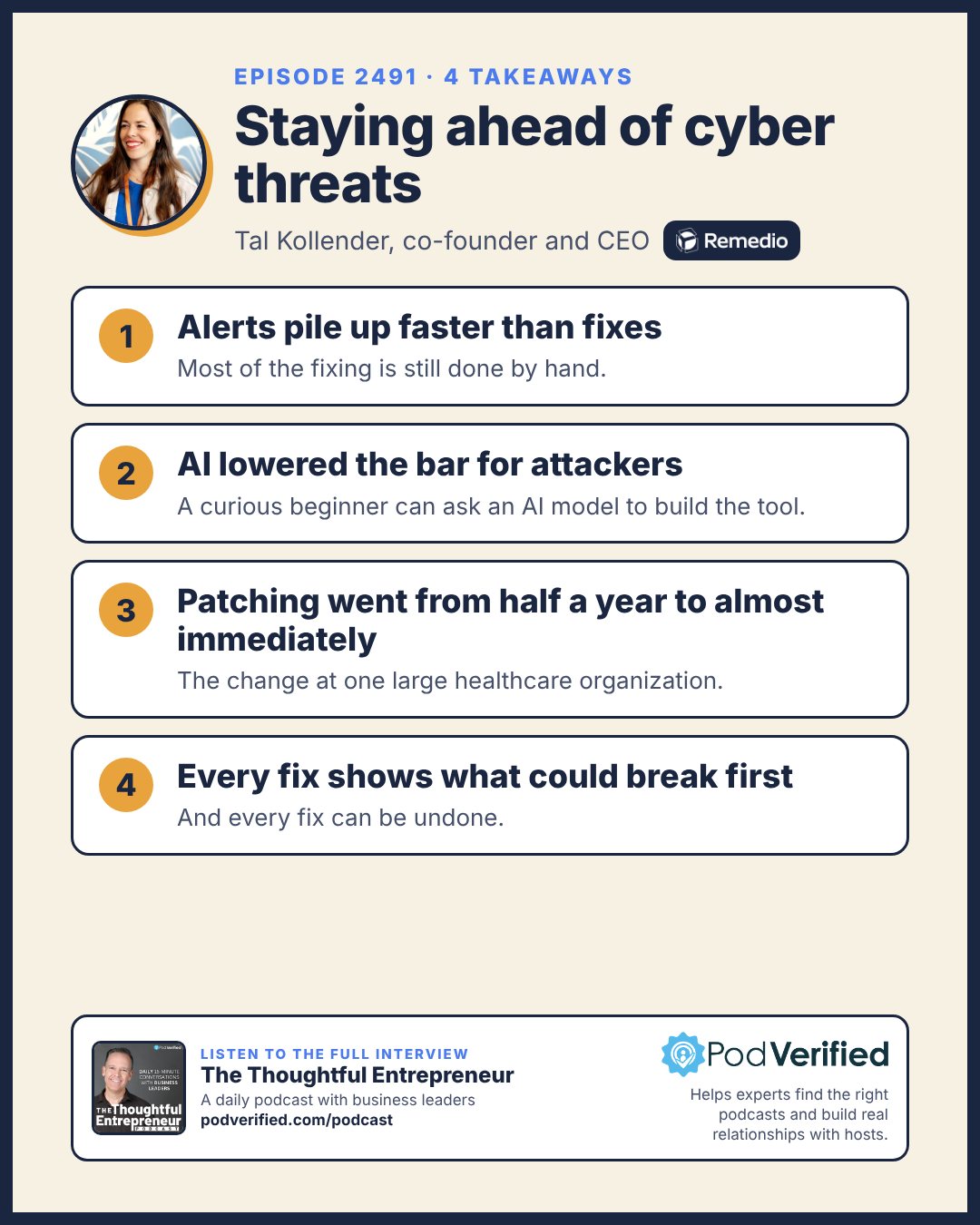
- Alerts pile up faster than fixes. Tal says teams get more alerts than they can handle, and the majority of the fixing is still done by hand.
- AI lowered the bar for attackers. A curious beginner can describe a situation to an AI model and get a tool built for it, Tal says.
- Patching went from half a year to almost immediately. That's the change at the healthcare organization, per Tal.
- Every fix has an undo button. Remedio shows what could break first, then lets you roll the change back.
What happened after the attack?
Tal didn't name the organization. She told Josh the call came right after the attack, and that everything the attacker did, including moving laterally across the network, looked normal to every tool they owned.
Once Remedio was running, they could see what it flagged as dangerous, lateral movement included, and they started acting on it. Because it's a hospital, Tal says, nobody wants a fix to disrupt something critical like an operating room. So each remediation shows an impact analysis first: click here, and this is what could break. Each one can also be reverted.
Remedio also turned up shadow AI, tools such as DeepSeek that people had installed even though they aren't enterprise ready. Tal says some open a backdoor. It found a password typed in clear text, too.
Then the numbers. The organization used to wait about half a year to apply Microsoft patches. Now it applies them almost immediately after release. A screenshot the customer sent Tal showed 2.1 million remediations in the past 200 days. At the time of recording, Tal said a full case study would follow.
Straight from the recording
Quotes are lightly edited for readability: filler words and stutters removed, nothing reordered. Times are approximate.

“They abuse something that is called configuration drift. Those configurations are just there by default or human error, but it's there and no one is fixing it.”
“They can even tell them the situation. And they can build for them the tool that will hack…”
“Within a week, they had tens of thousands of devices already reporting”
“We just did in the past 200 days 2.1 million remediations.”
Josh's plain-language version
Asked to explain it for people outside security, Josh put it this way:
“These are just cybersecurity vulnerabilities that are largely on the edge, right? So unpatched OSes, a browser plugin, you know, an AI agent that has maybe a little bit too much access.”
Tal agreed, and added that it's getting bigger and wider.
Questions answered
What is configuration drift?
Settings that sit at their defaults, or were set wrong by a person, and never get fixed. Tal says attackers abuse them once they're inside, and that they move laterally fast.
Why can't companies patch everything right away?
Tal gave several reasons. Some systems are too old to be patched at all. Vendors release fixes a little at a time, and Tal's rough guess was about 1% of a long list each month. And zero days can be exploited before any patch exists.
What do impact analysis and revert do?
Impact analysis shows what could break before you apply a fix, which matters when the network runs a hospital. Revert lets you undo the fix if something does break.
What is shadow AI?
Tools such as DeepSeek that people install even though they aren't ready for an enterprise. Tal says some of them open a backdoor, and Remedio shows you where they are.
How do you get started with Remedio?
Book a demo or contact the team at remedio.io. Tal says replies come within a few minutes, and she encourages a trial: close as many things as you want, then talk about whether to continue.
Questions to ask your own team this week
Drawn from the examples Tal gave, not from Remedio's marketing.
- How long do vendor patches sit before we apply them? Tal's healthcare client waited about half a year.
- Has anyone installed AI tools we haven't approved? That's what Tal means by shadow AI.
- If a fix breaks something, can we undo it? In a hospital, that question comes before the fix.
- Would our tools notice an attacker who looks like a normal user? That's what the healthcare organization says happened to them.
Away from the screen
Tal says people told her there are areas in the US where you shouldn't walk alone after 9 or 10 at night, so she got serious about Muay Thai. She used to know Krav Maga. She says it also helps mentally, because CEOs need somewhere to say everything with their hands and legs. She's learning guitar too, mostly Pink Floyd and Guns N' Roses. Josh plays bass, so they compared notes.
“Thank you for the work you're doing to keep the good guys safe.”
Episode details
| Guest | Tal Kollender |
|---|---|
| Role | Co-founder and CEO, Remedio |
| Website | remedio.io |
| Background | Former computer hacker who went on to build security products. Remedio was featured on Forbes' Next Billion Dollar Startups list, as Josh noted on the episode. |
| Topics | Remediation, configuration drift, patching and zero days, shadow AI, AI-assisted attacks, healthcare cybersecurity |
| Host | Josh Elledge |
| Episode | 2491, The Thoughtful Entrepreneur |
| Tal Kollender on LinkedIn | |
| Listen | Play it on this page, or on Apple Podcasts, Spotify, YouTube or Amazon Music |

We're always looking for great guests
Be our next guest on The Thoughtful Entrepreneur
We publish a new conversation every day, so we're always looking for leaders like Tal. The guests we love most are generous: real experience, a clear point of view, and something useful to give our listeners. Come ready to teach, and we'll make you look great doing it.
Not ready to apply yet? Get your free PodVerified Score to see how podcast hosts size you up. It takes two minutes.
Full transcript
Filler words and stutters removed. Company and guest names corrected where the automatic transcript misspelled them. Times are approximate.
Read the full transcript
Josh Elledge (00:00): With us right now, it's Tal Kollender. Tal, you are the co-founder and CEO of Remedio. You're found on the web at remedio.com [sic, remedio.io]. Which we have the link all set up, in our show notes for the episode. But Tal, it's great to have you.
Tal Kollender (00:25): Thank you so much for having me, Josh. Absolutely pleasure being here.
Josh Elledge (00:29): Yeah, before we talk about what you do with Remedio, what the platform is, you always love, you hearing from busy leaders, what they do for fun when they're not at work. And you've picked up a couple of hobbies recently, Muay Thai and guitar. so first, why Muay Thai? How did you find that?
Tal Kollender (00:50): So, Apparently when you, I mean, there are, more than I think areas in the US that you cannot walk, you know, by yourself and you cannot walk alone after, I don't know, 9, 10 PM. And when they said, oh, you know, like it's dangerous, you know, like you need to have someone or it's better for you to take an Uber. And I'm like, why? And then, oh, you know, you have some, you know, some people can run into you. And I said, okay, so I'll start, you know, being, you know, like learning some kind of... I mean, I used to know Krav Maga, but now I'm taking very seriously Muay Thai. That's really good, even for my soul.
Josh Elledge (01:36): Yeah, I mean, and it's just kind of a, you know, what I hear, right? It's just, it's a, it feels good knowing it, even if you never need it in a real life situation. Is that kind of what you're experiencing?
Tal Kollender (01:50): Yes, but also like, it helps also, you know, mentally with everything that you, that we go through, you know, like CEOs, et cetera, like it's important that, we will have this point of that we can finally, say everything, but, say everything, with your hands and with your legs.
Josh Elledge (02:10): And what have you been playing on guitar, by the way? So I absolutely love that. I picked up the bass a couple of years ago, and it's just so fun being able to play all the music of my youth and, you know, kind of background, just stuff that I love. But, what have you been doing on guitar?
Tal Kollender (02:30): wow. So I'm trying to do some, you know, like Pink Floyd and other, like some kind of, very, I don't know, like I would say bands that I used to love and they are, I still miss them and I do want to see them all, to hear them all. But yeah, it's, this and other as well. Like, it's Guns N' Roses and like other things, but that's my type for now.
Josh Elledge (02:56): I love it. I love it. Yeah, Pink Floyd is... I could play some Roger Waters. Roger Waters. It's, yeah, it's a lot of fun. So, yeah, in fact, I was just going through like Shine On You Crazy Diamond, which is like a 20-some minute song if you play the whole thing. And so it's... that's kind of a fun one to, you know, because it's... it just kind of comes in and out with some different things. So, well, very cool, Tal. Thank you so much for sharing. so Remedio was featured in Forbes' Next Billion Dollar Startups list. you want to share with me how you... what are they... what do they see? What is Remedio, and why is Remedio, potentially here, the next billion-dollar startup?
Tal Kollender (03:37): Maybe let's make it very simple. You know, for Remedio, what we do is remediation. And today with a world full of detection and things that are, you know, lots of alerts and things that you need to patch all the time or to close all the time or remediate all the time. That's why we are here. So just to show you end-to-end your everything about your attack surface within your devices and network. And not only that, we can only show you, but we can even close it and remediate. Everything from Config Drift, AI Govern, patching, application control, many things that will make your life I would say, that will make you, let's say, sleep well at night.
Josh Elledge (04:22): So just taking it back, even a step back, to make it even simpler. Imagine now we're in front of a room of 8th graders who are not in business for themselves. Do you... go ahead, let's go ahead and give that definition. first for folks that are wanting to make sure we're all singing on the same sheet of music here. Sure.
Tal Kollender (04:42): So today, every organization, and even if you have, you know, like, you know, small clinic of a few devices and everything today is done via computers, right? Laptops, et cetera. And of course, like the cloud things that you use for emails and for many other things. So Because, or thanks to the AI, I would say maybe the focus is now back to the devices, right? Like your device now is running, you run many many things with the AI, right? Like using Claude, using OpenAI and Codex and whatnot. Now, not only that, But because of what happened a few months ago [name unclear in the recording], et cetera, like you saw that there are a lot of vulnerabilities out there that are kind of revealed and being out there. But again, and of course, like now all of the big vendors, they just took it and they are now trying to keep up, you know, the pace and close them. But what is the problem? Some of the things that they got, they cannot even close, meaning they cannot even patch because they are too obsolete or cannot be supported anymore. Some of the things that they got, it's a very long list. They cannot really do everything at once. They release every month some, you know, some, I don't know, like some items from the list. Like, I don't know, maybe, maybe 1%. And that will take them a lot of time. And it's not getting any better because what they used to find was what they found a few months ago, Today the finding is even more drastic because you see more findings and more zero days, meaning things that can be exploited and can be exploited without any patch. So what we do is not only that we have the ability to speed up everything and close it, For the ones that are unclosable or unpatchable, we can do it already. And even the ones that the patch is being released, there are so many organizations that cannot really close everything so fast. So we come and help them not only patch it, but again, having the ability to show that each and every attack that you see in the market today, and even the ones that you don't know about, the attacker is just moving. Once they are in, they move laterally so fast. And they abuse something that is called configuration drift. Those configurations are just there by default or human error, but it's there and no one is fixing it. I mean, no one but your Remedio. So our own goal, our whole goal is to see it holistically from the patching, the one that everybody knows that they need to do like every month, or so. And the one thing or the main thing that people are not even aware that they exist, and even if they are aware, they don't know how to address it. Address it properly fast enough.
Josh Elledge (07:45): Yeah. So would it be fair to say that this is a... I mean, it's, you know, again, for folks that, you know, need to speak in layman's terms, lay terms here, these are just cybersecurity vulnerabilities that are largely on the edge, right? So unpatched OSes, a browser plugin, you know, an AI agent that has maybe a little bit too much access. It is that's what we're talking about.
Tal Kollender (08:17): Yes, and unfortunately it's getting bigger and wider and people, they just get too many alerts these days from so many systems or solutions that are telling them. And even if you get prioritized, you know, a prioritization from this system, there are still too many things to address. And you cannot really address it today because the main way to address The majority of the things is manually.
Josh Elledge (08:52): The concern over threats, I think, seems to be heightening because of AI. Can you kind of just again explain in layman's terms why it's going to be more important than ever before to make sure that vulnerabilities are well managed, particularly again in those edge user cases. Why do we need to button things up a little bit better in our organizations?
Tal Kollender (09:25): Sure, but for, you know, in order to answer that, I need to take you maybe, I don't know, 20, 25 years back. So when I was younger, I used to, I mean, I was a hacker, computer hacker. So I used to hack. into many things, and it started with video games and actually evolved into creating my own product. But everything back then was very manually, you know, you needed to learn everything, the bits and the bytes, and to know how, you know, like to get into things and to move laterally. And it was... that is why Back in the days, attacks used to take sometimes even years when you really needed to take something from the network and without people to see it. Or without obviously like the tools to see it. Today, the best thing, or what happened because, or thanks to the AI, is that even someone without any education and doesn't even know how to hack, but they are just curious enough, you know, of how to do it. They can ask Claude, they can ask Gemini, they can ask Codex, they can ask GPT how to, you know, like kind of the how to hack. But then not only that, they can ask them how to hack, They can even tell them the situation. And they can build for them the tool that will hack and will get into the whatever thing that they want. I mean, sometimes it works, sometimes it is, it is not. But again, the, there are a lot of, I mean, like the trend of successful attacks is getting higher and higher. And we all know that it's not only today countries versus countries. And then you have like, you know, the old attacking groups. Today you have so many, so many attackers that are just... what they do is they just love doing it even for fun, because they can. And it's even, you know, like I seen, I mean, like someone, you know, like, you know, individuals that they want to try just to, oh, let's see if I really, you know, nailed it. So that's basically what we, what we see recently. And unfortunately it became very easy.
Josh Elledge (11:41): So how does it work when we, when somebody implements Remedio.
Tal Kollender (11:47): So We have one of the, I believe the largest nonprofit healthcare, okay, maybe let me give you an example without mentioning their name, but, and they just texted me, I mean, I mean, they did, okay, let's say that they had a cyber attack. Unfortunately, they called us right after the cyber attack and they said, we need Remedio because that's exactly what the attacker did, and no one in the organization, including our most sophisticated EDR, could not even detect it. Actually, in fact, the EDR or the antivirus, I mean, for all days, they detected it as normal behavior. Everything that the attacker did, you know, moving laterally on the network, taking this and that, and more pieces, and then they implemented Remedio. They implemented it very fast. Within a week, they had tens of thousands of devices already reporting, and then they saw exactly what we flag as dangerous, as lateral movement, and they start... they started taking actions. Now, they... we... what we also add on top of that is that because it's a hospital, okay? So you need to take care that no one is going to, you know, be impacted because you don't want to, I don't know, like to ruin some I don't know, operation room or something, that, who knows, but critical. And that is why we also add on each and every remediation the impact analysis. So if you are going to click here, this is the impact, what will be broken if there is something, right? Like, if there isn't, then okay, it's a safe remediation. If there is something, we are telling you. So sometimes they wanted even to close the ones that you have potential impact. And, but for those things, they took extra caution because in Remedio we also add revert. Now, even with revert, so you can undo and roll it back. And then you know that even if you did something and there is any impact, now you are safe. But on top of that, now with the evolution of AI, we also discovered something that is called shadow AI because some people just enjoy installing some DeepSeek and some tooling that are not, I don't know if to say legit, but they are not enterprise ready and they should not be installed on enterprises. And some of them actually open a backdoor within the organization and they let an attacker to get in. So we show them all of these, including, you know, like someone who just entered clear text password so everyone can see the admin of the hospital, you know, like having, you know, like entering his password in clear text and to see how with Remedio now when there is Microsoft patching, they find finally, if up until recently they didn't patch and they waited, you know, for half a year. Now with Remedio, they do it almost immediately once the patch is released. Now that is maybe one of the best case studies that we have, and of course we will be able to share probably in a couple of weeks with everybody. But yeah, that's really nice to get this customer's feedback and of course, like, to see that they just sent me a picture, screenshots from the UI saying we just did in the past 200 days 2.1 million remediations.
Josh Elledge (15:03): Wow. And everything is automated, so they don't really... yeah. That's significant. We think about all of that vulnerability now that's handled. Okay, so remedio.io. To our friend that's listening, maybe they're already researching Remedio or they're looking for solutions. Where do they go from here?
Tal Kollender (15:27): So they go from, you know, book a demo, like contact us immediately, and our response time is pretty fast, I would say. Like it can take a few minutes after, like they will already get an email back. We encourage everyone, like again, like it's, you know, just even try it, have it, you know, for a trial, enjoy, just close as many things as you want. I mean, let's talk afterwards if in case you want to proceed or not, but we really want to help any organization that we can. We already, we are already helping hundreds of organizations in the world. And again, like to see the impact, the good impact that it makes, and it frees their time and it shows them them the, you know, like their life now, they can focus on other tasks instead of doing things in a manual way. That makes a lot of sense. And of course, like risk reduction and everything that's going on right now that everyone needs to justify the board, what's going on.
Josh Elledge (16:32): Yeah. Well, Tal Kollender, co-founder and CEO of Remedio. You're found on the web at remedio.io. Remedio.io. Tal, it's been a great conversation. Thank you so much for the conversation. Thank you for the work you're doing to keep the good guys safe. I appreciate you.
Tal Kollender (16:55): Thank you so much, Josh. Thank you.