What It Takes to Build a Podcast That Grows and Generates Revenue with BackBeat Media's Dave Hamilton
A few days before this recording, Dave Hamilton sat behind a drum kit in Portsmouth, New Hampshire, about to play John Bonham's parts in a Led Zeppelin and Heart tribute for about 600 people. Early in the set he felt himself going timid on a fill. He caught it, and every time it happened after that he played the biggest fill he could.
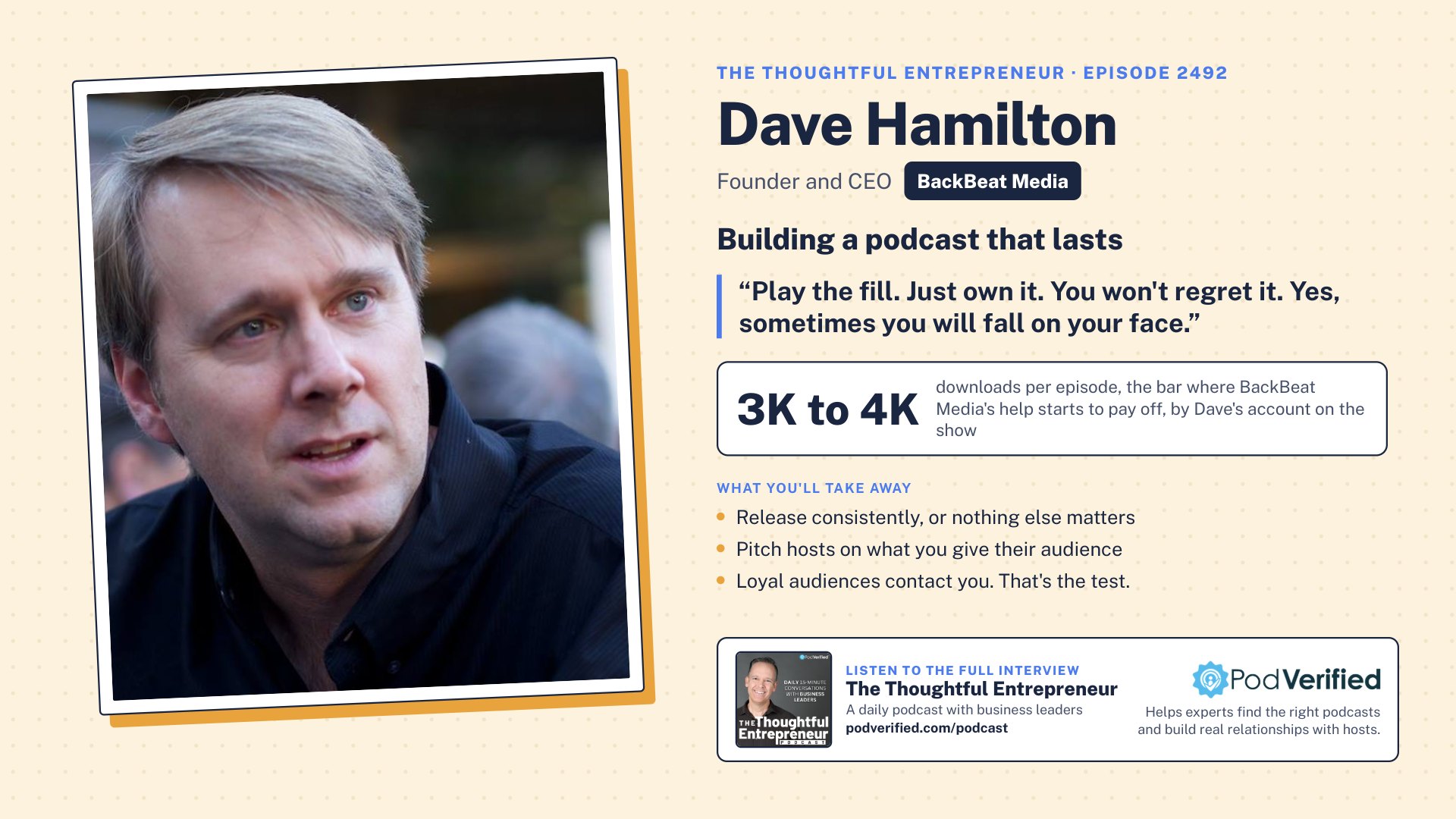
Dave is the founder and CEO of BackBeat Media, which sells sponsorships for independent podcasters, and he has co-hosted Mac Geek Gab since June 2005. He tells Josh what that night on stage taught him about business, why consistency comes before audio and content, how to be a guest hosts want back, and the one question BackBeat asks every podcaster.
🎧 Listen to Dave's interview
Press play below. About 20 minutes.
Or listen in your favorite app:
Apple Podcasts Spotify YouTube Amazon Music iHeart Audible Pandora Castbox TuneIn
The Thoughtful Entrepreneur is a daily podcast with business leaders. Subscribe so you don't miss one.
In this episode
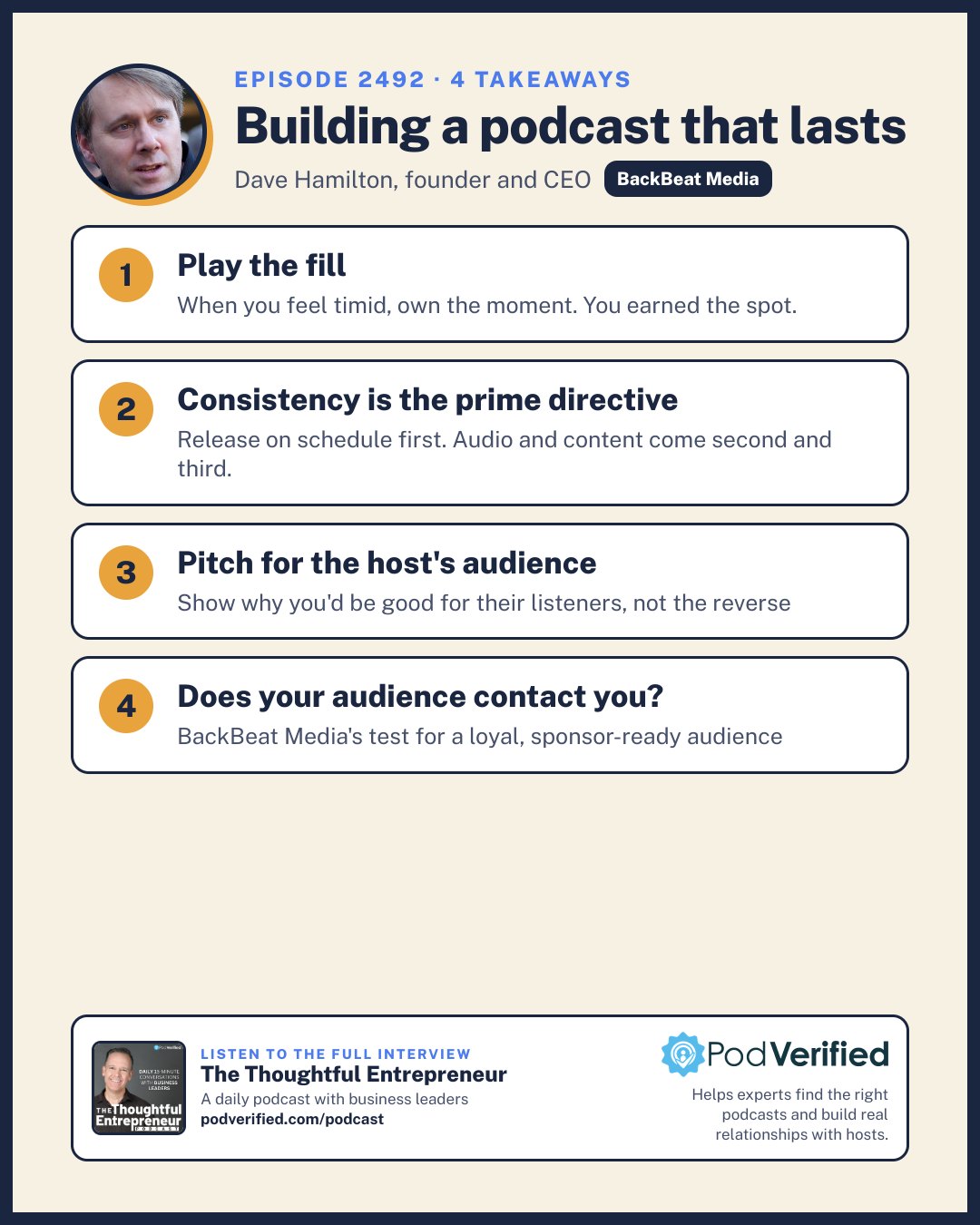
- Play the fill. Dave's name for owning the moment when imposter syndrome makes you want to hold back.
- Release consistently. Dave calls it the prime directive, ahead of audio quality and content quality.
- Be the guest hosts want. Pitch for the host's audience, skip one-word answers and have an arc for each story.
- Does your audience contact you? That's the question BackBeat Media asks every podcaster before it sells sponsorships for the show.
What does a Led Zeppelin fill have to do with business?
Two minutes before Dave's band took the stage, his bandmates were talking about how exposed they would be in front of that crowd. Dave agreed. He would be up on a drum riser playing John Bonham's parts, and he knew someone in the audience knew those parts better than he did.
So he framed it the way he needed to. For that night, that person was sitting in the audience and Dave was on stage. He had earned the spot. If someone chose not to enjoy the show because they thought they were better, Dave says, that was on them.
Then, early in the set, he felt timid about a fill. Timid is not a word anyone uses for Bonham or for Led Zeppelin, and Dave realized he was selling himself short and not giving the audience what it came for. From then on, any time he felt timid, he played a huge fill.
He turned it into a phrase for himself: play the fill, Dave. In business, he says, that timid feeling is probably some version of imposter syndrome. You created the opportunity that put you there. You may not be the only person who could be there or the best, but you are the person there at that moment.
Sometimes you will fall on your face, Dave says, and that's fine. On his podcast Business Brain, mistakes count as tuition. The mistake he says you can make over and over is not doing the thing at all.
Straight from the recording
Quotes are lightly edited for readability: filler words and stutters removed, nothing reordered. Times are approximate.
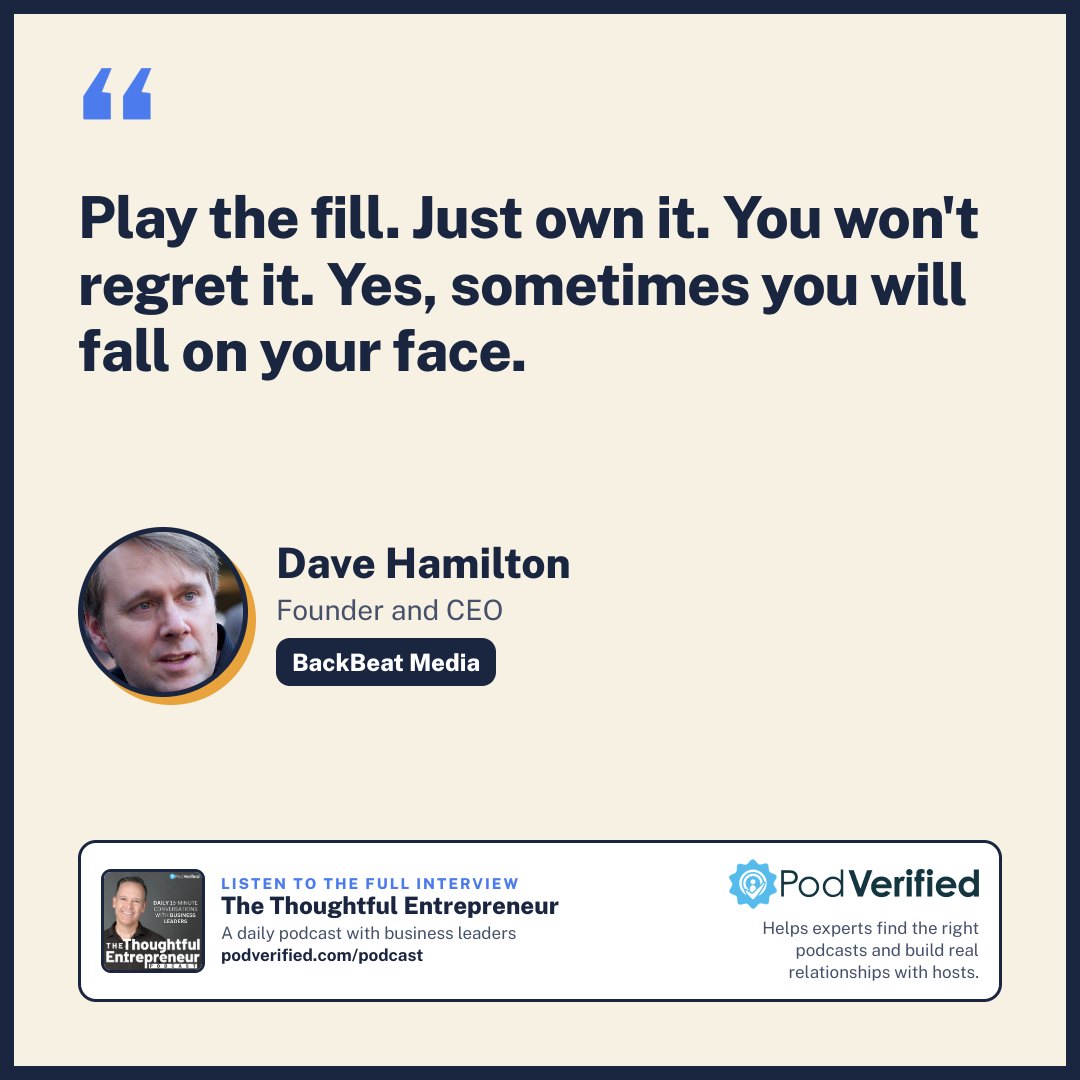
“So anytime I was feeling timid, I would just play some huge bombastic drum fill.”
“The world runs on a schedule. If Timmy listens to your show at noon on Tuesdays, well, if you haven't released a show, Timmy's gonna listen to somebody else at noon on Tuesday.”
“But then also sharing why they would be good for my audience, not why my audience would be good for them, right?”
“Because if your audience doesn't find a way to contact you, they are not the loyal audience that we are going to be able to help you monetize.”
Why Josh says nobody starts out good
Josh started converting his radio segments into a podcast in 2008, and when he launched the Savings Angel Show, around 2014 by his memory, he was afraid of being judged. What helped was going back to one of Pat Flynn's first five episodes, where Pat stumbles, restarts and leaves it in.
“Nobody was born good at this. You do the thing.”
Dave agreed and added the performer's view. A friend of his is one of the principals in The Outsiders on Broadway, doing eight shows a week, and Dave says nobody can be 100% of themselves every night. Some nights it will be 60% you, and the job is knowing how to get through the show with the tools that 60% brings.
Questions answered
What does it take to start a podcast today?
Dave's answer: first, start recording. Second, don't stop. He calls releasing consistently the prime directive of any podcast, ahead of audio quality and content quality, because no audience sticks with a show that doesn't come out on schedule.
How do you get booked as a guest on a podcast?
Dave says the pitches that work show the guest understands the show and explain why they would be good for the host's audience, not why the audience would be good for them. He can still tell when someone is faking being a fan, even with AI.
How do you become a great podcast guest?
Never give one-word answers, Dave says, and never answer a yes or no question with only yes or no unless that's clearly what the host wants. Have an arc in mind when you start a story so it lands somewhere. On his own shows, Dave tells guests they are the guest co-host for the episode.
What does BackBeat Media do?
Dave describes BackBeat Media as representing the sponsorships of a group of fiercely independent podcasters, himself included. The company handles booking, scheduling, managing and selling sponsorships, and the podcasters keep full control of their shows.
Which podcasts should contact BackBeat Media?
Dave says it works best for shows that already have an audience, and that 3,000 to 4,000 downloads per episode is about the bar where BackBeat adds value. If you think your show fits and you're under that, he says reach out anyway. Visit backbeatmedia.com to see the shows in the network.
Questions to ask your own team this week
Drawn from the examples Dave gave, not from BackBeat Media's marketing.
- Where are we playing it safe when we should play the fill? Dave's timid moment on stage was him selling himself short.
- Do we publish on a schedule our audience can count on? Dave puts consistency ahead of audio and content quality.
- When we pitch, do we lead with what we give the other side? Dave books guests who show why they'd be good for his audience.
- Does our audience contact us? BackBeat Media treats that as the sign of a loyal audience.
Away from the screen
Dave says he enjoys his work and believes in lifestyle businesses, but his other passion is drumming. He isn't sure his wife would call it a hobby, since it's more like another job. He also hosts a show for musicians called Gig Gab.
Josh, who picked up the bass a couple of years ago, asked where he plays. The answer was the Zeppelin and Heart tribute. Dave came off stage glowing, he says, and a few days later he was already bracing to watch the video for the one thing he knew he got wrong.
“I just played a Led Zeppelin and Heart tribute in front of about 600 people in Portsmouth, New Hampshire.”
Episode details
| Guest | Dave Hamilton |
|---|---|
| Role | Founder and CEO, BackBeat Media |
| Website | backbeatmedia.com |
| Background | Dave started podcasting in June 2005 with Mac Geek Gab, which he co-hosts and which is now more than 21 years old. He also hosts Gig Gab, a show for musicians, and is part of the podcast Business Brain. |
| Topics | Podcasting, consistency, imposter syndrome, performing, being a podcast guest, pitching podcasts, podcast sponsorships, podcast monetization, loyal audiences |
| Host | Josh Elledge |
| Episode | 2492, The Thoughtful Entrepreneur |
| Dave Hamilton on LinkedIn | |
| Listen | Play it on this page, or on Apple Podcasts, Spotify, YouTube or Amazon Music |
We're always looking for great guests
Be our next guest on The Thoughtful Entrepreneur
We publish a new conversation every day, so we're always looking for leaders like Dave. The guests we love most are generous: real experience, a clear point of view, and something useful to give our listeners. Come ready to teach, and we'll make you look great doing it.
Not ready to apply yet? Get your free PodVerified Score to see how podcast hosts size you up. It takes two minutes.
Full transcript
Filler words and stutters removed. Company and guest names corrected where the automatic transcript misspelled them. Times are approximate.
Read the full transcript
Josh Elledge (00:00): With us right now, legendary podcasting pioneer. It's Dave Hamilton. Dave, you are the CEO of BackBeat Media. You have been helping creators and publishers monetize podcasts for 20+ years. You're the host of Mac Geek Gab, which, Dave, how long have you been podcasting?
Dave Hamilton (00:20): I started podcasting in June of 2005, which makes Mac Geek Gab, and Mac Geek Gab was the first show that I did and we haven't stopped. So that makes that show 21+ years old. And thanks for having me.
Josh Elledge (00:34): Yeah, Dave, let me ask you this, because it's tradition before we get into it, even though I have so many questions about your podcasting experience. What do you do for fun when you're not at work?
Dave Hamilton (00:47): I mean, I enjoy my work. I know everybody says that, but I am someone who believes in the concept of lifestyle businesses. And I know in the entrepreneurship community, they can go both ways. There's people that love them, people that hate them. But I really do enjoy my work. I work to live. But I know that I'm gonna work a lot. And so I enjoy, not every aspect of my work, mind you, Josh, but a lot of it. And I work on things that I enjoy so that even the unenjoyable aspects have something to them. But I am also a...
Josh Elledge (01:25): Also a drummer, is what I'm looking for.
Dave Hamilton (01:27): Yeah, I'm a drummer too. Although I'm not sure my wife would agree that that's a hobby. It's another job, but that is something other than work that I do, and I absolutely enjoy that as well.
Josh Elledge (01:40): So do you perform on stage all the time?
Dave Hamilton (01:44): Oh yeah.
Josh Elledge (01:45): What are you drumming in front of people?
Dave Hamilton (01:48): So it's Saturday night, and I don't know when this will come out, but the days before we recorded this, I just played a Led Zeppelin and Heart tribute in front of about 600 people in Portsmouth, New Hampshire. And I am not one to usually boast, so this is a little atypical, but we crushed it. It went really, really well, and the audience loved it. We loved it. It was great.
Josh Elledge (02:13): Yeah, sheesh, to do John Bonham, my friend, that's...
Dave Hamilton (02:17): You know, I learned a business lesson on that stage. As we were walking out, literally 2 minutes before we took the stage, my bandmates and I were talking, and some of them were like, wow, there's a lot of people there, and we're pretty exposed up there. I'm like, we're super exposed. And then there's me sitting on top of a drum riser about to go play John Bonham drum parts, and here's the thing: I know that there is someone currently sitting in the audience, like over there, that knows these parts better than me. But the difference between me and them, and this is what I have to put into my head, this isn't egotistical, it's just how I need to frame it, the difference between me and them is that for tonight, they are sitting there and I'm sitting on stage. I've earned it. I've deserved it. It's all fine. And I hope they enjoy it. If they choose not to because they think they're better than me, they might be better than me, but if that negatively impacts their enjoyment, that's on them. And I hope everybody else there enjoys this. We gotta go out and crush it and own it, and we will. And we did. And there was a moment, it happened several times, but there was a moment early on that really is the business lesson that I will share here. I started feeling timid about a fill. Now, if you know anything about Led Zeppelin and John Bonham, timid is not a word you would use to describe him nor that band. And I realized, wait a minute, I can't be timid on this stage at all. I am selling myself short, and I am not delivering what the audience came to see. So anytime I was feeling timid, I would just play some huge bombastic drum fill. And there's a business lesson. There's a life lesson for this, but a business lesson too. And it's one that I've compartmentalized for myself as play the fill, Dave. When you are feeling timid, it's probably some version of imposter syndrome or whatever. But whatever scenario you're in, you deserve to be there. You've created the opportunity that got you there. Doesn't mean you're the only person that could be in that scenario. Doesn't mean you're necessarily the best person. You are the person at that moment. Play the fill. Just own it. You won't regret it. Yes, sometimes you will fall on your face. That's fine. You'll learn. We call mistakes tuition in my world. We have a podcast called Business Brain that's young. It's only 12 years old. And one of our mantras there is that our mistakes are our tuition. And one mistake you can make over and over again is not doing the thing. So do the thing. Play the fill.
Josh Elledge (04:57): You know, that is quite aspirational. For a would-be podcaster, would you mind talking about what it takes, do you think, for someone to podcast today?
Dave Hamilton (05:13): First, start recording. Second, don't stop. It's very easy to... In the early days, I don't know if we use the term pod fading anymore, but in the early days we talked about people that started and stopped because they found it wasn't their thing, and we called those the pod faders, right? There was no shame in it. You realize, like, this is a lot of work. And the most important thing for any podcast, and I will call this the prime directive, is that you must release consistently. That's the most important thing, and it's the only important thing. You'll notice I didn't talk about audio quality. That's super important. That's the number two thing. You'll notice that thus far I haven't talked about content quality. That's important. That's the number three thing. But neither of those second or third things are important if you're not releasing consistently, because you won't retain an audience no matter how good your audio or your content is if you're not releasing consistently. The world runs on a schedule. If Timmy listens to your show at noon on Tuesdays, well, if you haven't released a show, Timmy's gonna listen to somebody else at noon on Tuesday.
Josh Elledge (06:27): Yeah.
Dave Hamilton (06:27): And that's just how it is.
Josh Elledge (06:29): You know, in some ways too, your earlier advice of play the fill is applicable here as well, because podcasters who do the thing and are consistent at it generally don't have too big of a problem getting back up on the bike and doing it, as long as too long a time doesn't go by. But it's like this with anything that we have to do in business. We feel insecure. There's a degree of vulnerability, like you getting out on stage, you getting behind a microphone. I remember, Dave, before I started podcasting officially, I was taking my radio segments and converting them into a podcast back in 2008. Magically found my way onto Apple iTunes at the time. But I remember when I started my first episode of the Savings Angel Show, and I wanna say maybe this is around 2014 or thereabouts, I was so afraid. I was afraid of being judged. I was putting it out there, and people are gonna think I was some dummy or fake or whatever, right? And then I heard Pat Flynn, another OG in the podcast space. I listened to one of his first 5 episodes just for kicks. Like, okay, let me see what he was like when he started. And I recommend anyone, if you want to do YouTube stuff, go look at your favorite YouTubers and go look at their early stuff, and it's going to make you feel so good. So when I was listening to one of Pat's early episodes, I literally heard him talking, and then he restarts it, and he didn't edit it out.
Dave Hamilton (08:11): Oh, I love that.
Josh Elledge (08:12): And that was the moment I said, listen, we're all the same there. Nobody was born good at this. You do the thing. Arthur Schopenhauer: you do the thing, you have the power.
Dave Hamilton (08:26): Yes, and you just got to keep doing it. And you strive for perfection. At least I do. But I know that the beauty of it is that perfection is unattainable. Your definition of perfection might change, right? You might get somewhere, but they can't all be perfect. You will have segments that you think, wow, it couldn't have gone any better. Love that, that's great. You will have episodes where you feel that couldn't have gone any better, and that's great. But the next episode's not gonna be as good as that one. It's just how it works. And this is true of any kind of performance. You walk on stage, be it literally a stage or your podcasting stage, it's a performance no matter what. And you get to find out in the first few moments which version of me is showing up. I do a show for musicians too called Gig Gab. And I was interviewing a friend of mine who I've played music with here in New Hampshire, and he has gone on to be one of the principals in The Outsiders on Broadway. So performing at a very high level, which is freaking amazing. I love it for him. He works extremely hard. It's no surprise he has made it to Broadway. Super talented. And he is a student of his craft, but he knows that, they're doing 8 shows a week on Broadway. You are never going to expect to be 100% of you 8 times in a week, let alone 1,000 times over the 2 years that he's been doing this show. And so you need to know that, okay, some days it's going to be 60% me.
Dave Hamilton (10:15): And how do I navigate through a show when I realize in my head that I am on stage in front of 1,100 people on Broadway who love this musical and came to see it? How do I get out of my head? By accepting I know who 60% me is, and I know how to navigate this show with the tools that 60% me brings with him. And that's only something you can learn by experience. And so you have to do it, and fail and learn and all of those wonderful things.
Josh Elledge (10:50): And there certainly is a little bit of spotlight effect in there. For example, you playing drums probably know every little, like, ah, it's a little late coming into that.
Dave Hamilton (11:02): Oh yeah.
Josh Elledge (11:02): Honestly, 99% of the crowd doesn't know, and probably close to 100% don't care.
Dave Hamilton (11:08): That's it. Even the 1% that know, they also appreciate it, many, most of them. There's that one guy, screw that guy, but the rest of them.
Josh Elledge (11:17): Get out of here, buddy. You got a bad attitude.
Dave Hamilton (11:20): That's on you. Yes, exactly. Led Zeppelin wasn't perfect live. Nobody can say that they were always perfect live, and there's beauty in that, in the rough edges. I've got a friend of mine that I play with sometimes, and he's like, "Hey, you don't want to polish it too much. You want to leave a little bit of hair on it." There's beauty in those imperfections, and it makes it human too.
Dave Hamilton (11:48): That's live art, when it's not exactly the same every time. There's a minimum bar you want to hit depending on what you're doing, and that's fine and good. But no, it's never going to be perfect. I beat myself up for the things that I didn't get perfectly. Boy, howdy, do I! Already, I came off stage glowing after the Zeppelin thing, and now a few days later, I'm like, "I guess it's time to watch the video. I know I screwed this one thing up. How bad was it?" But that's fine. I'm going to use it to improve, not to beat myself up, even though I'm definitely beating myself up.
Josh Elledge (12:27): Dave, I do a lot of work at PodVerified, and I work as a fractional chief communications officer where I am working with people that have messages that they want to bring to the world. They're hoping to do so collaborating with content creators, including podcasters. And so I always try to make sure that they're able to perform so that they can get the results that they're after. And I'm hoping maybe you could share a few bits of wisdom that you would offer to folks that want to guest on podcasts, how to be a great guest, and how to be successful at it. I'm sure you're like me; you've done a gazillion interviews, and so you've seen the good, bad, and ugly. Trust me when I say it's not a high bar, in my opinion, to be very competent, to get at that 60% level. But would you mind maybe filling in some of those tips that you'd recommend?
Dave Hamilton (13:20): Well, the first thing is getting yourself booked on the show initially. The ones that work for me are the emails that make it clear that they understand the show. Now, with AI, people can fake that slightly better, but I can still tell immediately whether someone is actually a fan of the show or if they're like, the most recent thing you talked about, and here's this, and it's like, yeah, okay. But then also sharing why they would be good for my audience, not why my audience would be good for them, right? And like you said, this is not a high bar. Once you get on the show, be comfortable. Fake it until you make it. Never answer one-word answers. Do what I'm doing here. Make Josh stop you from talking. These are important things. You are there to help the host. Sometimes you're going to be there to fill space for the host. That's part of the gig, right? The other part is to be interesting and share anecdotes, and so try and have an arc in your head when you start to share something, so that it lands somewhere. You won't always. I'm not exactly sure where this one's going to land. But be conversational, listen, but also be ready to speak. And even if they ask you a yes or no question, never answer yes or no unless you're certain that's all they want from you, because it might be some kind of lightning round thing.
Josh Elledge (14:56): Those clips, by the way, of interviews that go badly, where the guest is like, yes. Oh, okay. I mean, now it's also incumbent on us to not ask yes/no questions, which is a trap I've gotten myself into. It's like, well, I stepped in that one, didn't I?
Dave Hamilton (15:13): We all do it. Yeah, we all do it. The goal, when I have a guest on my show, I tell them that they are the guest co-host for that episode. I encourage them to ask me questions. I want to put us on as equal footing as I can so that they understand that this is a conversation. And that's what I have found is most valuable for my listeners. It's also what I've engineered. And of course, with podcasting, people that don't like your show don't listen anymore. So it's a self-fulfilling prophecy. Define what you want and go.
Josh Elledge (15:47): What does BackBeat Media do? Your website is backbeatmedia.com. To those who have not been listening to podcasts for decades like I have, you may not know the name, but if you have... I was listening to, I'd say, macOS Ken when Ken started, oh, I don't know how long ago he started his show, but he was one of the first podcasts that I listened to every episode of for a while.
Dave Hamilton (16:14): Yeah, so BackBeat Media, the running joke, and it's true, is that here at BackBeat Media, we represent the sponsorships of a group of fiercely independent podcasters, of which I am one. And like I said, all of that is true. Podcasters that don't want to have to deal with booking and scheduling and managing and selling their own sponsorships work with a company like ours to do that part for them, while leaving them completely in control, completely free to manage and run their show the way they want to run their show. And we've found our niche with the fiercely independent podcasters. It makes things interesting. It creates headaches, because everybody wants to do something a little bit differently, but that's where the value is. Generally those fiercely independent podcasters have very loyal audiences, and that's a good thing for sponsors when the fit is right. And we work really hard, closely with our shows as well as with our sponsors, to make sure that we're putting the right sponsors on the right shows and actually getting the fit right, because that's where everybody wins, including the audience.
Josh Elledge (17:23): Dave, so for our friends that are listening, first off, who should connect? Obviously you have a bunch of shows, so you can go to backbeatmedia.com to see all the shows that are already part of your network, including yours. But who should be reaching out to potentially engage with you?
Dave Hamilton (17:46): If you've got a show. Generally speaking, it works best when you have an audience already. We certainly work with some podcasters that are developing an audience. That is not the norm. The norm is somebody with an audience. And we find that 3,000 to 4,000 downloads per episode is kind of that bar where what we bring to the table is something that's going to be valuable for you. But if you think you're the right show for us and you have less than that, reach out. I'm always happy to have a conversation. We all are here. We're a relatively small team, but we love to help podcasters. We can all learn from each other. It's great. If you've got a show that has a loyal audience, then we might be the right place for you. And I'll share something I probably shouldn't share, but I will. We ask a question of every podcaster that knocks on our door, or every podcaster whose door we knock on. The question is, how does your audience contact you? I am going to give you a secret. In terms of what we are actually looking to ask, we drop the first word. For those conversations, we care: does your audience contact you? Because if your audience doesn't find a way to contact you, they are not the loyal audience that we are going to be able to help you monetize. Doesn't mean you don't have an audience. It just means...
Josh Elledge (19:26): Yeah, Dave. Podcasting pioneer Dave Hamilton. I think that's your official title. CEO of BackBeat Media, host of Mac Geek Gab, which again, to our friend listening to us right now, in your podcast app, go search that up. Go see how many episodes Dave has done over the years. Remarkable, Dave. You're a legend. Thank you so much for sharing your time with us and sharing your insights.
Dave Hamilton (19:54): Josh, thanks for inviting me, and thanks for letting me do this. I really appreciate coming on your show.