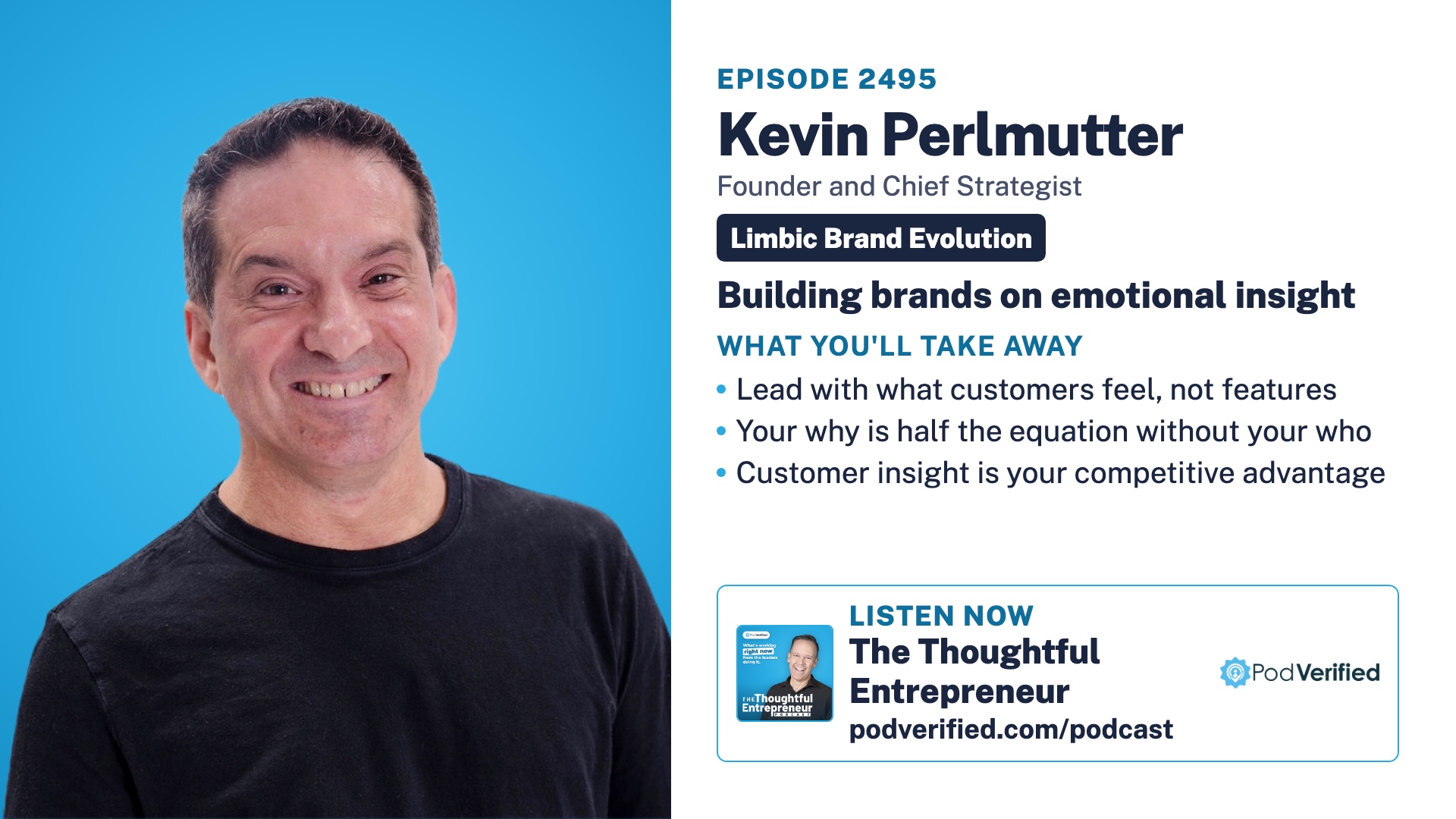
Why Emotional Insight Beats Feature Lists in Brand Strategy with Limbic Brand Evolution's Kevin Perlmutter
The Thoughtful Entrepreneur · Episode 2495
The short answer
How do you build a brand message that connects with customers emotionally?
Kevin Perlmutter, founder and chief strategist of Limbic Brand Evolution, says brands should start with what customers care about and want to feel, not features decided in a conference room. He mines customer conversations and reviews, then turns the common reasons people choose a brand into its core benefits. His view: customer insight is your greatest competitive advantage.
Key takeaways
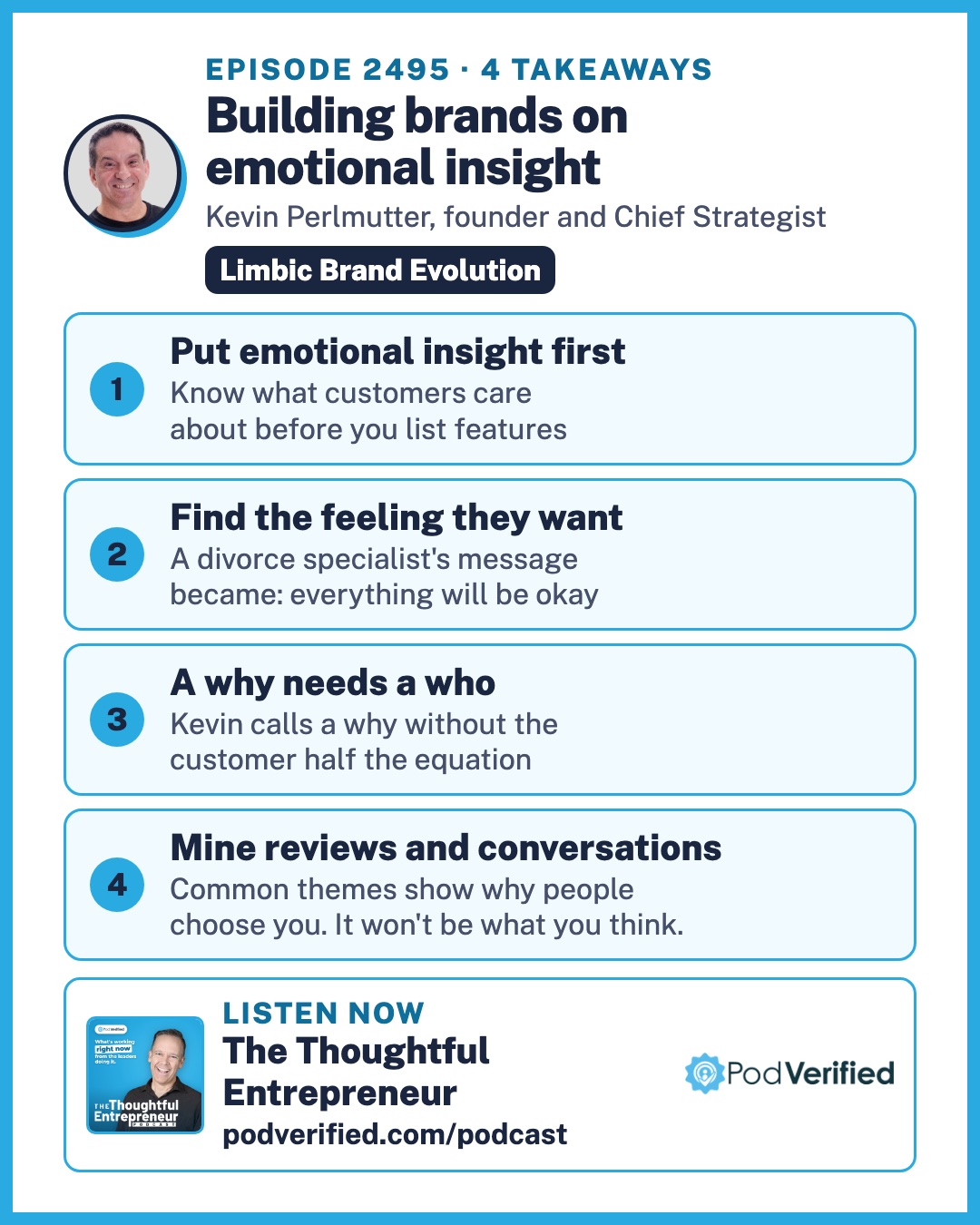
- Lead with emotional insight. Kevin wrote Brand Desire to put what customers feel at the center of how companies attract and keep them.
- Find what people want to feel. For a divorce specialist's clients, Kevin says, it came down to one line: everything will be okay.
- A why needs a who. Kevin calls "what's your why" half baked as a brand strategy framework when it ignores the customer.
- Ask your customers. Conversations and reviews show why people choose you, and Kevin says it won't be what you think.
A divorce specialist's clients were facing a home split in two, finances broken up and double the expenses. When Kevin Perlmutter studied what those clients wanted going in, the answer was simple: to know that at the end of the process, they would be okay. That became her brand message. Everything will be okay.
Kevin is the founder and chief strategist of Limbic Brand Evolution and the author of Brand Desire. He tells Josh why feature lists and "what's your why" fall short, where to find the emotional insight that does work, and why he thinks customer insight is a company's greatest competitive advantage.
🎧 Listen to Kevin's interview
Press play below. About 20 minutes.
Or listen in your favorite app:
Apple Podcasts Spotify YouTube Amazon Music iHeart Audible Pandora Castbox TuneIn
The Thoughtful Entrepreneur is a daily podcast with business leaders. Subscribe so you don't miss one.
Watch the clip
Kevin in 78 seconds
“So your customer insight is your greatest competitive advantage.”
A short video from the interview, with captions. Tap play. For the whole conversation, use the player above.
How did a divorce specialist end up promising that everything will be okay?
Josh opened with the example from Brand Desire that stuck with him: a divorce law firm whose marketing message became "everything will be okay." How, he asked, did Kevin get a room of attorneys to accept that?
It wasn't a room, Kevin says. The client, from his business's early days six or seven years ago, was one specialist who helps people through the legal and financial side of divorce. Kevin talked with her about how she helps people, then learned from her clients what they were thinking and feeling going in, and what they hoped to come out with.
What he heard was raw. Someone is leaving the home. Finances are being split. There are double the expenses. With that much uncertainty, Kevin says, what people wanted most was to know they would be okay at the end.
Once she understood that, it changed the entire way she put her brand out there. The goal became helping clients feel that way from the first contact. Kevin says he does the same work for a single professional or a global company with tens of thousands of employees: find out what people care about, then show the brand as an invitation to the feeling they want.
Straight from the recording
Quotes are lightly edited for readability: filler words and stutters removed, nothing reordered. Times are approximate.
“It puts emotional insight at the center of how companies attract and retain customers.”
“There's so much uncertainty that all they want to know is at the end of the process, they will be okay.”
“You're just continuing to talk about who you are and what you do, what you're passionate about.”
“If you can find enough information and find common themes for why people are choosing your brand, one, it's not going to be what you think. Two, it's going to be more emotional.”
What Josh heard from his own clients
Kevin's point landed close to home. Josh says his team learned some time ago that its ideal clients were mostly people in their 40s and up who are very good at what they do, and he shared what they told him, in their words.
“I always felt like at this stage of my life, I wouldn't have to work so hard for visibility or to make impact to audiences.”
Those clients also said they are generous, love serving and don't like yucky marketing. Josh says he had forgotten that in a lot of the language his team uses, and that he bought Kevin's book and plans to work through it with his team.
Questions answered
What is the book Brand Desire about?
Kevin wrote Brand Desire as a modern brand strategy playbook for company leaders, founders and brand leaders. It puts emotional insight at the center of how companies attract and retain customers, instead of proof points and feature lists.
What's wrong with starting with why?
Kevin says it may be a great leadership principle, but as a brand strategy framework it's half baked. Without knowing who your customer is, talking about your why is like talking about yourself all night at a bar without asking the other person a single question.
How do you find out what your customers care about?
Kevin points to customer conversations and reviews. Ask how they found you, what they would miss most if your brand disappeared, and what one reason they would give a friend for checking you out.
What do you do with customer insight once you have it?
Look for common themes in why people choose you, Kevin says, and turn them into the core benefits in your marketing. He says you'll find other people who want to experience those same feelings.
How can I learn more from Kevin Perlmutter?
Kevin suggests branddesirebook.com, the book page on the Limbic Brand Evolution website. From there you can reach his consulting practice, Limbic Sparks Brand Strategy, his How I Can Help page and his online course.
Questions to ask your own team this week
Drawn from the examples Kevin gave, not from Limbic Brand Evolution's marketing.
- What do our customers want to feel when they come to us? For the divorce specialist's clients, it was knowing they would be okay.
- Are we leading with features we chose in a conference room? Kevin says proof points matter less than what people care about.
- What would customers miss most if we disappeared? It's one of the questions Kevin suggests asking in conversations and reviews.
- Does our why say anything about our who? Kevin calls a why without the customer half the equation.
Away from the screen
Kevin builds furniture and has for decades. The bookshelf behind him on the call is one he made maybe two or three decades ago. This year he added side tables to match a headboard he built years back, then a bed frame over three or four days so he could get rid of the box spring.
His rule has been a new tool and a new skill on every job, and he says it parallels his career. A coffee table that might once have taken him a couple of months took five days this time. Josh, who gets the same calm from his yard and herb garden, asked if it's meditative. Kevin's answer was his afternoon coffee.
“I will be in my woodshop on a Saturday and I'll be working for hours and hours and I will emerge from my woodshop covered in sawdust at four o'clock and realize I forgot my two o'clock coffee.”
Episode details
| Guest | Kevin Perlmutter |
|---|---|
| Role | Founder and Chief Strategist, Limbic Brand Evolution |
| Website | limbicbrandevolution.com |
| Background | Kevin created Limbic Sparks Brand Strategy and launched Limbic Brand Evolution in 2019. His site lists more than 25 years helping brands evolve, including work with Interbrand, Made Music Studio, Publicis, McCann and Hampel Stefanides. His book is Brand Desire: Spark Customer Interest Using Emotional Insights. |
| Topics | Brand strategy, emotional insight, customer research, customer reviews, Start With Why, messaging, marketing, furniture building |
| Host | Josh Elledge |
| Episode | 2495, The Thoughtful Entrepreneur |
| Kevin Perlmutter on LinkedIn | |
| Listen | Play it on this page, or on Apple Podcasts, Spotify, YouTube or Amazon Music |

We're always looking for great guests
Be our next guest on The Thoughtful Entrepreneur
We publish a new conversation every day, so we're always looking for leaders like Kevin. The guests we love most are generous: real experience, a clear point of view, and something useful to give our listeners. Come ready to teach, and we'll make you look great doing it.
Not ready to apply yet? Get your free PodVerified Score to see how podcast hosts size you up. It takes two minutes.
Full transcript
Filler words and stutters removed. Company and guest names corrected where the automatic transcript misspelled them. Times are approximate.
Read the full transcript
Josh Elledge (00:00): With us right now, Kevin Perlmutter. Kevin, you are the chief brand strategist and founder of Limbic Brand Evolution, and you are the author of the book Brand Desire. I am so excited, Kevin, to speak with you about the work that you do. I think it is so critical. And I think it is such a huge gap that I see with a lot of founders. I look at a lot of founder websites when I do this podcast, obviously. And I think you nail a big, kind of, like I said, a gap big enough that I think we could drive a truck through. But we're going to talk about that in just a moment. Kevin, thank you for joining us.
Kevin Perlmutter (00:41): Thank you for having me. And I'm so appreciative that I'm here and for your enthusiasm for what we're about to talk about. Thank you.
Josh Elledge (00:47): For sure. Before we get into that, you know, one thing I love to talk with other leaders about is the things that they are enthusiastic about when they are not at work. I usually phrase it in the sense of, like, what are you geeking out on lately? And so I understand you've got a really fun hobby. Tell me about what you do.
Kevin Perlmutter (01:10): I build furniture. I've been building furniture for decades. I built this piece behind me, this bookshelf. I built this maybe two decades ago, maybe three. This is something I do all the time. In this past couple of months, I've built two pieces. I built a coffee table that's in this room that I'm in right now. And what else did I build? Oh, I built, over years, I built a bedroom set. So I built the headboard a few years back. And over the summer, early in the summer, I built these side tables that match. And a couple of weeks ago, over a three or four day period, I built a bed frame so I could get rid of the box spring and actually have a matching frame for the mattress. So one of the things that I love, love, love, love about this is just custom designing pieces for my home and finding things that my family will find useful. And we have creative conversations around utility and design. And I build custom pieces to spec, basically. And one of the things that I bring into it that is so in parallel with my career is a new tool and a new skill on every job. And I started that, I mean, I don't do it as much now because I have a lot of tools and a lot of skills, but I started that decades ago. And it makes it so much easier to do things when you bring in new tools and learn new skills. The next time you do a project, you've already got that banked and you can do that stuff easily and build onto something new. And you start collecting a lot of ways of doing things. And this coffee table that's in front of me here that you can't see might've taken me a couple of months, years and years ago. I built it over five days a couple of weeks ago.
Josh Elledge (02:54): Oh my gosh.
Kevin Perlmutter (02:55): Yeah.
Josh Elledge (02:56): Well, how cool is that?
Kevin Perlmutter (02:57): It's a lot of fun.
Josh Elledge (02:58): I guess it's like, you know, I can't imagine. What does your shop look like?
Kevin Perlmutter (03:01): How did my shop look like? You've been doing this long enough. I have a shop that has a lot of good tools in it. I've got a table saw. I've got a [unclear]. So I mean, I got all kinds of stuff. I got lots of toys. [unclear]
Josh Elledge (03:16): Yeah. And do you find, you know, I've talked with other people that do a lot of woodworking and furniture building, and it's meditative, you know, kind of like, you know, I'll do a lot of work out in the yard and the property and, you know, plants. I got an herb garden and stuff like that. And, you know, that's just my moment of Zen, you know, and I'm engaged in work, but it's not, you know, it's work for me. And I just, I feel afterwards, I feel like I just had like a, you know, like a 20 minute meditation session afterwards.
Kevin Perlmutter (03:48): Absolutely. This is how I know what you're saying is absolutely true. I'm a two time a day habit coffee drinker. I have coffee first thing in the morning and I have coffee at around two o'clock in the afternoon. And if I don't have my afternoon coffee, I start to feel it. I will be in my woodshop on a Saturday and I'll be working for hours and hours and I will emerge from my woodshop covered in sawdust at four o'clock and realize I forgot my two o'clock coffee. That's deep in a zone that's different from every other day.
Josh Elledge (04:22): I love it. Kevin, I'm so excited to talk to you about your book, Brand Desire. Now I will share. I think it flies in the face of a lot of conventional thought, particularly when we, well, we'll get into it. I'm just going to tease our audience here about something that we might think is kind of the Holy Grail of, you know, our values or how we define our businesses. And I think, you know, where we're going with that, but do you mind just kind of beginning, Kevin, with an overview of what Brand Desire is? And of course, you know, it's associated with the work that you do through Limbic Brand Evolution.
Kevin Perlmutter (05:00): Yep. I wrote Brand Desire to be a modern day brand strategy playbook for company leaders, founders, brand leaders. It puts emotional insight at the center of how companies attract and retain customers. And that does fly very much in the face of traditional approaches where emotional insight is not often considered or prioritized. There's a lot of things happening in traditional approaches that have been going on for a very long time that people have learned through school decades ago. People have learned through their mentors more recently that are rooted in approaches to advertising, marketing, and branding that predate the internet. And where it was all about proving to people with proof points and reasons to believe and unique selling propositions and actual language, language that takes you down the path of sitting in a conference room and thinking, how are we going to prove to people that they should be buying our stuff? What are the features that we should be talking about that we've designed because, you know, we think they're going to be compelling? Those are all important things to know, but what's equally or more important is understanding what people actually care about and desire in their own lives with or without your brand. And how can you find the relevant intersection between the two? So what I'm helping leaders solve is understanding more about their customers. What are their emotional motivations, the drivers of their decisions and behaviors, and what is it that they care about in their own world so that their brand is out there in a way that is reflective and personally relevant to the people they're trying to reach, not just what they decide in a conference room they should be selling.
Josh Elledge (06:48): One example that really stood out to me was you're working with a divorce law firm, and the shared emotional motivation came to, and get this, this is the marketing message now for a room of lawyers. And the emotional motivation was, this is their message to their audience: everything will be okay.
Kevin Perlmutter (07:14): Yes.
Josh Elledge (07:14): How did you get a room of attorneys to accept something that's…
Kevin Perlmutter (07:19): Well, I'll be honest with you, that's a client that goes back to some of the earlier days of my business, about six, seven years ago. And it wasn't a whole room full, to be honest with you. It was an individual specialist who focuses on working with people who are getting divorced and helping them through the legal and financial situation. But I spoke with this person about what she does and how she helps people. And I understood from her customers, the people, her clients, the people she works with, what it is they're thinking about going into the situation and how it is that they are feeling when they go in and what it is they're motivated to try and accomplish. And how can this professional invite people into a situation that will make them feel comfortable and that they want to be a part of? And everything that I'm doing with my clients, no matter what client, no matter whether it's a single person helping divorcees, or if it's a large global corporation with, you know, tens of thousands of employees and many times more customers, what I'm helping them do is understand what people care about and what motivates them, so they could present their brand in a way that has a benefit and invitation to what they've discovered people want to feel. And for this particular client that you mentioned, when they're going through the situation, they're faced with tremendous unknowns in addition to a heavy emotional toll. So raw in many cases. Someone is leaving the home. They're breaking up finances. They have double the expenses as opposed, you know, between them. There's so much uncertainty that all they want to know is at the end of the process, they will be okay. And when she understood that that was the emotional motivation that people were striving for, it changed the entire way she put her brand out there to help people feel that way from the beginning. Everything will be okay.
Josh Elledge (09:40): You push back on the Start With Why movement. Walk me through what you call who's your who, and why the why question sends brand leaders down the wrong path.
Kevin Perlmutter (09:54): Well, I think for your listeners, the majority of them are familiar with the what's your why question.
Josh Elledge (10:00): Oh yeah.
Kevin Perlmutter (10:01): It's very famous. It's been around for what, 15 or so years since the book came out. And it's taken hold in corporate America and especially with smaller companies, I think, because people hear that and they're like, that's so smart. It's brilliant. And the Golden Circle and all this wonderful stuff. And, you know, like if we just tell people what we're passionate about, what we're in the world to do, they're going to come running to us. And that's, it may be a great leadership principle to inspire people in your organization and inspire people maybe outside your organization, but as a brand strategy framework, it's half baked, because what's your why, in the absence of who's your who, it's half the equation. Imagine, Josh, you were at a bar. This never happens, I'm sure. You were at a bar and you were trying to meet someone and you started talking about, you know, PodVerified and what you do and what you're passionate about, and, you know, these wonderful interviews that you had and all this stuff you're talking about, but you haven't asked a single question to get to know the person. You haven't figured out how your conversation can both be about you, but also be personally relevant to the person who you're talking to. You're just continuing to talk about who you are and what you do, what you're passionate about. And meanwhile, the chance of an emotional connection is slipping away, and people are starting to get a little bit bored because this guy's just talking all about himself. So when companies enthusiastically embrace what's your why in the absence of understanding their customers, they're missing the mark. They're potentially overshooting what people need to hear about. And they're missing things that people would want to hear about to be inspired to learn more and inspired to go deeper in a conversation or a relationship.
Josh Elledge (12:05): Yeah. Fascinating. You know, and this tracks so much with a lot of, you know, I was recently, you know, kind of doing a deep dive on the spotlight effect, and, you know, there's that aspect of it. And, you know, everybody's the star of their own show. And, you know, I remember back in the day, you know, kind of this everyone's favorite radio station. What's in it for me. You know, WIIFM. This is really old school.
Kevin Perlmutter (12:33): Yep, yep, yep, yep.
Josh Elledge (12:34): And I'm like, yep, absolutely, 100%. And you know, it's amazing how often that, how easy it is to forget that. What's the pressure coming from most founders or marketers that we don't exercise that level of empathy for others?
Kevin Perlmutter (12:53): Yeah. And there's so many places to get the information. There's so many ways to get the information, and it's an often skipped step. Maybe it's seen as too time consuming. It's seen as just something that wouldn't be as valuable, because "we know our customers" is a common way of thinking. And the amount of insight you can get from customer conversations, customer reviews, understanding what people are going through, how they found you, why they found you, what would they miss the most if your brand disappeared? If they were to refer you to a friend or a business colleague, what would be the one reason why they would say, you got to check these guys out? What is their superpower? What do they do differently than other people who do exactly the same kind of work? Or what is the brand offer that's different than other brands that offer the same thing? And these questions can be asked very easily in a qualitative setting, or quantitatively, you can look at customer reviews to understand what people are saying. And here's the thing that I help people understand that they can apply to their work. If you can find enough information and find common themes for why people are choosing your brand, one, it's not going to be what you think. Two, it's going to be more emotional. The experience that they're having with you every single time, it's going to be the experience versus the features that you're prioritizing in your marketing. And then lastly, if you can aggregate those benefits that most people are feeling for why they choose you and turn them into your core benefits in your marketing, you're going to find other people who want to experience those same feelings and benefits. So your customer insight is your greatest competitive advantage. It'll turn your business, even if it's a commodity, even if it's a law firm working with people who are divorced, there are a dime a dozen out there, can turn your messaging into something so personally relevant that people feel like, I've got to work with this company.
Josh Elledge (15:12): Wow. I am so grateful our paths crossed. I am absolutely, I'm buying, I bought your book already.
Kevin Perlmutter (15:18): Thank you.
Josh Elledge (15:19): I am going to implement with my team, because this just absolutely tracks, you know, because we learned some time ago, you know, who our ideal client was, and it was a lot of people in their forties on up who are very good at what they do. And the sentiment was, you know, I feel like, or I always felt like at this stage of my life, I wouldn't have to work so hard for visibility or to make impact to audiences. And at this stage, it feels bad that it still feels like a little bit of an uphill battle. I'm really good at what I do. And I'm very, you know, this is what our clients are saying, I'm very generous. I love serving and I don't like yucky marketing. And so that's what we learned. And it's amazing to me that I've kind of forgotten that in some of, you know, a lot of the language that we use. So thank you. Kevin, I want other people to experience this same transformation in their business as well. So let's make sure that they have some great next steps that they can follow. Now, certainly your website, you know, to our friend that's listening, we have this all linked up. To our friend that's listening, go to branddesirebook.com. And Kevin, when they go there, do you mind sharing what they're going to see?
Kevin Perlmutter (16:34): Yeah, of course. Branddesirebook.com is a page on my company website. It's the page that features my book, Brand Desire, with information about what's inside, what you'll learn, where you can find it, the usual kinds of stuff. And then it also, of course, it's one page, so it links to other pages. It links to pages that talk about my consulting practice, Limbic Sparks Brand Strategy. There's a page that is called How I Can Help, and that includes a couple of other things. I've written a course that can be purchased, and, you know, it's a company website and you could find out all about me and the various ways that I can support businesses learning what I'm here to teach.
Josh Elledge (17:14): Kevin Perlmutter, your website is branddesirebook.com, which will take them to Limbic Brand Evolution, which is your website, of which you are the founder. Kevin, thank you so much for the work you're doing. Thank you so much for sharing your insights.
Kevin Perlmutter (17:31): Thank you for having me, Josh.