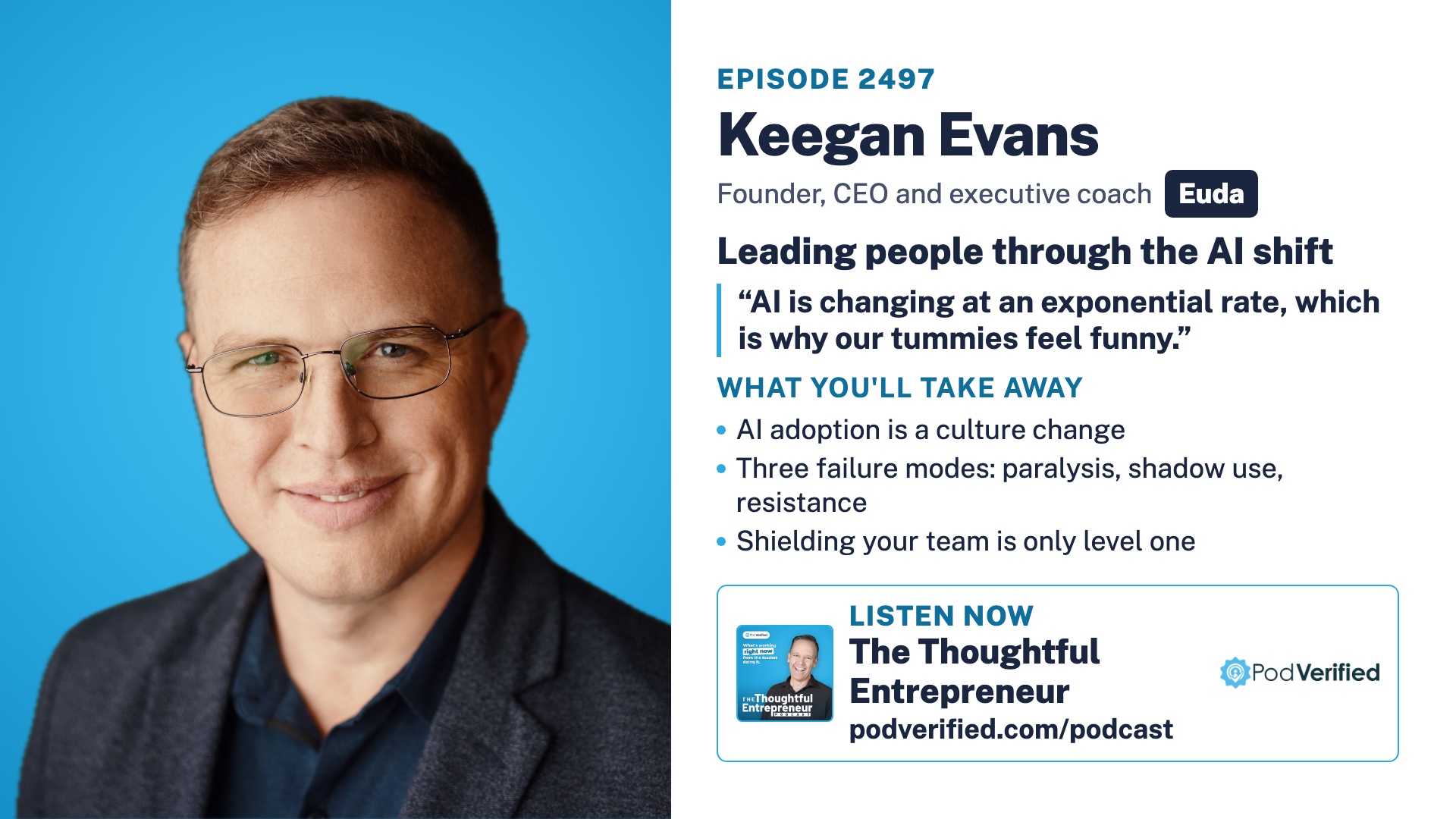
Building a Culture Where People Flourish in the Age of AI with Euda's Keegan Evans
The Thoughtful Entrepreneur · Episode 2497
The short answer
How should leaders help their teams adapt to AI?
Keegan Evans, founder and CEO of Euda, says bringing in AI is not a tool adoption but a cultural transformation. He sees it fail through paralysis, shadow use and resistance. His path through: ground the team in values and principles, meet people where they are with their fear of change, and give them space to name what scares them.
Key takeaways
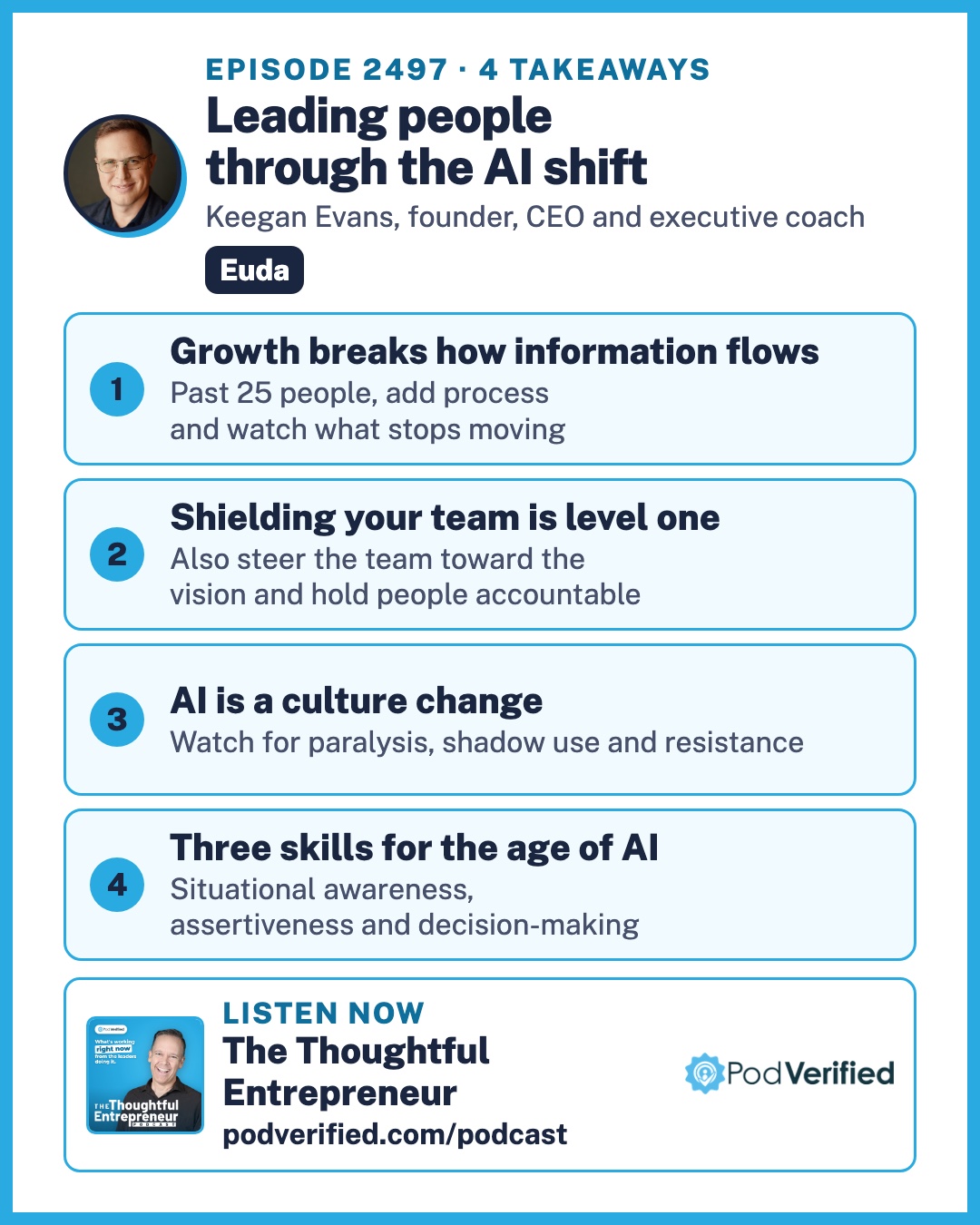
- Scaling breaks how information flows. Keegan says the jump from 25 people to 50, 75 or 100 calls for new processes and attention to what no longer flows on its own.
- Being your team's shield is only level one. Keegan says leaders also have to steer their team toward the larger vision and hold people accountable.
- AI is a culture change. Keegan sees three failure modes when organizations adopt it: paralysis, shadow use and resistance.
- Three skills for the age of AI. Keegan names situational awareness, assertiveness and decision-making, which he and Josh tie back to aviation.
When a company grows past its first 25 people and starts hitting 50, 75 or 100, Keegan Evans says how things work changes, and the founder no longer controls it. Information that used to flow on its own stops flowing. The first-time leaders he coaches, often in their late 20s or early 30s, feel it as overwhelm before they can name it.
Keegan is the founder and CEO of Euda and an executive coach. He flew H-46 helicopters in the Marine Corps, then worked in tech. He tells Josh why leaders get stuck as their team's shield, the three ways organizations get AI wrong, and the three skills he says leaders need now.
🎧 Listen to Keegan's interview
Press play below. About 18 minutes.
Or listen in your favorite app:
Apple Podcasts Spotify YouTube Amazon Music iHeart Audible Pandora Castbox TuneIn
The Thoughtful Entrepreneur is a daily podcast with business leaders. Subscribe so you don't miss one.
Watch the clip
Keegan in 84 seconds
“AI is changing at an exponential rate, which is why our tummies feel funny.”
A short video from the interview, with captions. Tap play. For the whole conversation, use the player above.
Why do leaders get stuck protecting their team?
Keegan has seen the same pattern since his time in the Marine Corps, and again in software and hardware teams. He calls the first stage of the leadership journey level one: understanding that your role is to be a shield for your team, protecting it so people can do their work.
The trouble, he says, is that too many people stop there. Their only job becomes protecting the team from the man. Sometimes a leader does have to be the shock absorber for random demands, weirdness or toxicity coming from above.
More often, Keegan says, the job is to advocate in two directions. You speak up for your team, and you also help line the team up with the organization's values, goals and direction and push it toward the larger vision.
That includes accountability. Keegan's view is that a leader can assume best intent and still hold people accountable at the same time, and he calls that a tricky balance to learn. It is the kind of skill he says can't come from a course or a single workshop. It takes practice and support, and it gets lonelier the higher you go.
Straight from the recording
Quotes are lightly edited for readability: filler words and stutters removed, nothing reordered. Times are approximate.
“I'm there for people at moments of change, transition, and growth, to help them get to where they want to go when what's gotten them where they are isn't going to get there.”
“You can simultaneously assume best intent and hold people accountable, which is a very tricky thing.”
“This is a cultural transformation. Solving this problem requires being intentional about your culture…”
“Exponential change is volcanoes, terrorism, and cancer. AI is changing at an exponential rate, which is why our tummies feel funny.”
Josh's advice: bring human judgment to the systems
Josh took Euda's AI Readiness Check on the website during the interview and says he scored 100%. He hears from founders who feel constantly behind on AI, and from some who buy a tool first and then figure out how to use it, which he calls backwards.
“Surround yourself with really, really smart AI implementers and AI leaders that know how to bring the judgment into the systems, the human judgment into the systems that you need to be running today.”
Keegan picked up that point in his last answer. The skills he says matter most for leaders now are situational awareness, or how closely your perception of reality matches reality; assertiveness, holding a point of view until the facts reasonably convince you otherwise; and decision-making, the ability to make decisions and own them as humans.
Questions answered
Why do companies struggle with AI adoption?
Keegan says the challenge is seeing AI as a cultural transformation, which takes intentional work on culture and values. He names three failure modes: paralysis, where there is a lot of talk and no action; shadow use, where people use personal AI accounts with no structure; and resistance to change.
What is shadow AI use and why does it matter?
Keegan describes shadow use as people using personal accounts on tools like Claude or ChatGPT on the side, without intentional structure. He says it risks leaking sensitive data, and the bigger problem is disconnected use across the company, so nobody gets the benefits.
What changes when a startup grows past 25 employees?
Keegan says that as a company moves from 25 people toward 50, 75 or 100, how things work changes and the founder loses control over it. Leaders need to put processes in place and watch which decisions and information no longer flow on their own.
What leadership skills matter most in the age of AI?
Keegan names three: situational awareness, assertiveness and decision-making. He says the list is distilled from aviation's crew resource management, the training used for high-performing teams in dynamic situations.
How do I reach Keegan Evans or check my company's AI readiness?
Go to euda.io and click the button for the AI Readiness Check, which Keegan says is about 10 questions. Euda also offers a more detailed AI Readiness Profile for whole organizations, and Keegan hosts the podcast Bet on People.
Questions to ask your own team this week
Drawn from the examples Keegan gave, not from Euda's marketing.
- Which information stopped flowing as we grew? Keegan says scaling past 25 people changes how decisions and information move.
- Are our managers only shielding their teams? Keegan calls that level one and says leaders also need to steer and hold people accountable.
- Where is AI being used in the shadows here? Keegan warns that personal accounts on the side can leak sensitive data.
- Do executives, managers and staff see our AI plans the same way? Euda's Readiness Profile looks for exactly that misalignment, Keegan says.
Away from the screen
Keegan flies and does improv for fun. On TV, he is rewatching New Girl for the humor and the characters. He reads nonfiction and fiction at the same time, and fiction is his release.
Right now that means the Dungeon Crawler Carl series, which Josh's wife was reading aloud to him in line at Halloween Horror Nights. Keegan says it surprised him: about once per book, the author lands a moment of character and resilience that has made him tear up.
“It is nerdy because you get crunchy Dungeons and Dragons style RPG stuff, but it has caught me by surprise…”
Episode details
| Guest | Keegan Evans |
|---|---|
| Role | Founder, CEO and executive coach, Euda |
| Website | euda.io |
| Background | Keegan flew H-46 transport helicopters in the Marine Corps and served as a series commander at the recruit depot before working in tech, including at Intuit. Euda's site says he flew over 150 missions across three tours in the Middle East. |
| Topics | Executive coaching, leadership, company culture, scaling a startup, AI adoption, shadow AI, change management, AI readiness, military veterans |
| Host | Josh Elledge |
| Episode | 2497, The Thoughtful Entrepreneur |
| Keegan Evans on LinkedIn | |
| Listen | Play it on this page, or on Apple Podcasts, Spotify, YouTube or Amazon Music |

We're always looking for great guests
Be our next guest on The Thoughtful Entrepreneur
We publish a new conversation every day, so we're always looking for leaders like Keegan. The guests we love most are generous: real experience, a clear point of view, and something useful to give our listeners. Come ready to teach, and we'll make you look great doing it.
Not ready to apply yet? Get your free PodVerified Score to see how podcast hosts size you up. It takes two minutes.
Full transcript
Filler words and stutters removed. Company and guest names corrected where the automatic transcript misspelled them. Times are approximate.
Read the full transcript
Josh Elledge (00:00): With us right now, it's Keegan Evans. Keegan, you are the CEO, you're an executive coach, and the founder of Euda. You're found on the web at euda.io. You are also a fellow podcaster, and your podcast is called Bet on People with Keegan Evans. We've got that linked up. And of course you can find all of that at your website, euda.io. And finally, Keegan, I gotta mention this anytime I get a fellow veteran business owner on. You are a fellow military veteran. Thank you so much for your service. You're in the Marine Corps, right?
Keegan Evans (00:32): Absolutely. Yep.
Josh Elledge (00:33): All right.
Keegan Evans (00:33): We're both Marine, I guess.
Josh Elledge (00:34): The Department of the Navy.
Keegan Evans (00:36): That's right. Yeah, that's right.
Josh Elledge (00:38): What was your job in the military, in the Marines?
Keegan Evans (00:41): My main job, I was an H-46 pilot. It's a transport helicopter, a little old, called the mini Chinook. Flew a lot of assault support, and then I had a series of other jobs, ground jobs, helping the squadron function. I also, at the end of my active time, led, was a series commander down at the recruit depot. So I was the first officer in charge of the drill instructors and the recruits, and really helping a lot in understanding how to [unclear] foundational transformation of people and organizational cultures with that intentional culture.
Josh Elledge (01:13): I know this because you and I were talking earlier, but that was quite formative to the services that you provide, which I'm going to get to in just a second. But I want to ask you, because I ask this of everybody, you know, I love hearing what leaders do when they are not at work, like the things that they're kind of passionate about, geeking out on movies, music, TV shows, games, you know, any of that stuff. What have you been into lately when you're not working?
Keegan Evans (01:36): Yeah, well, I love flying, flying as a hobby. I love doing improv as a hobby, but if you're asking the question what I'm really like geeking out on right now, on TV, I'm going through a rewatch of New Girl because it's just cathartic in humor and character. And I am on books. I like to read nonfiction and fiction at the same time. My fiction is my release. I got turned on to the Dungeon Crawler Carl series, and I'm down. I'm down.
Josh Elledge (02:00): My wife is reading it right now, and it's one of these. So she's an avid reader, which I think is hot. I think bookworms are, bookworm ladies are hot to me. My wife, specifically, excuse me. But she's reading Dungeon Crawler Carl right now. And so we're literally in line at Halloween Horror Nights. She brings her Kindle and it's got it loaded up on there. So we're just waiting in line, and you know, those lines are like an hour and a half long sometimes. But anyway, so she's behind me and all of a sudden she starts laughing out loud. And so I love it because she's reading all of these excerpts from the book. And it's like, this book is BS crazy. It's just bonkers. And did you hear that they're going to make it into a TV show?
Keegan Evans (02:46): I did. I'm very excited about that.
Josh Elledge (02:47): And it's with Seth MacFarlane's company. Oh, he's going to be perfect at that. That's his [unclear], and you know, all of that other stuff.
Keegan Evans (02:55): Yeah, yeah. Oh no. Yeah, it is bonkers. It is crazy. It is nerdy because you get crunchy Dungeons and Dragons style RPG stuff, but it has caught me by surprise because there's been probably one moment in each book that I've read so far where he hits with character-driven and real trauma-informed experience and resilience that I've teared up multiple times reading this series as well. And so, yeah, that's the current nerd obsession.
Josh Elledge (03:22): Amazing. Okay, we gotta get to, we gotta talk.
Keegan Evans (03:26): I know, we gotta talk about Euda.
Josh Elledge (03:27): And all right, so euda.io, tell me about the work that you do today.
Keegan Evans (03:31): Yeah, so we do executive coaching and some boutique consulting. I have a through line of my career from the military to tech to running this now in executive coaching, where intentional culture is what drives effectiveness. And the way that we achieve that is through decisions and actions, with a heavier weight on the leaders in organizations. And leadership itself is a journey and a skill. And so many companies or teams or organizations work on an assumption that for a high-performing individual contributor, the only path to progression is through management or leadership. But the skills aren't just something you could take a course on or do a workshop on. It's a learned and supported practice. Leadership is also incredibly lonely the further up you get, and especially in founding and executive teams. And so the support that I provide brings a toolkit across that broad career, aviation, Marine Corps, tech, and just general people, to be that support, to be that time where it's about reflection. It's about identifying the problems you're trying to solve, with someone who's been in a variety of situations that can be brought to bear and see the patterns that help you navigate. Whether it's ruthless prioritization of individual tasks you have to give that given week, or where your growth opportunities on leadership effectiveness are going to be, to be that more effective leader. The real short version, which maybe I should have started with, is I'm there for people at moments of change, transition, and growth, to help them get to where they want to go when what's gotten them where they are isn't going to get there.
Josh Elledge (05:01): Well, what does that usually take then when you're working with your client? Obviously, you know, an assessment, and I don't know if there are some patterns that you typically see with your clients coming through the door, but I'd be really curious about your take on that.
Keegan Evans (05:15): I love that. Yeah, there are assessments out there. I'm certified in the Leadership Circle Profile, which understands creative competencies and reactive tendencies. But so much of the work that we do is really about the person-to-person connection and mentorship. But more advanced than mentorship is the intentional coaching. Think just like a coach on a sports team, there to push you, there to make you a little bit uncomfortable, but to grow. The patterns that I see around that: I often work with folks in their late 20s, early 30s, founders, executive leaders who are in those kinds of roles for the first time. They have a good idea that they want to be better, that something's not quite fitting. They're getting overwhelmed. Maybe the company is scaling beyond the initial 25 people. When you start hitting 50, 75, 100 people, how things work just changes, and you don't have control over that. But often that can be missed, that that's a normal thing. You have to start implementing some sort of processes and understand how information is flowing, and what decisions and information is not flowing organically when it used to, and be intentional about that. Thinking about alignment at an individual leadership level. One of the patterns I almost always see, and I saw this all the way back to my time in the Marine Corps, and I see it through software development and hardware development and everything, is level one, we'll call it, of the leadership journey is understanding your role as a shield for your team and protecting your team so that they can do their work.
Josh Elledge (06:40): Wow.
Keegan Evans (06:41): I call that level one, though, because too many people get stuck there, where their only job is protecting their team. And to continue to grow and mature, the stuff that often needs help from someone like me to grow through is to recognize how to work that nuanced balance. It's not a binary of protecting your team from the man. It's about understanding the overall values, goals, and direction, and how to channel that and guide your team. Yes, there are some times where you have to be the capacitor and the shock absorber from the random stuff that may come down, or the weirdness or the toxicity. But more than likely, it's going to be where you're going to have to be both an advocate for your team and understanding that, but also an advocate for getting that in line and pushing them into that larger vision and where it needs to be. And also holding people accountable. You can simultaneously assume best intent and hold people accountable, which is a very tricky thing. So those are a couple of the early patterns that I often am looking for when I work with folks.
Josh Elledge (07:42): You know, and then you kind of roll in the impact that AI has on our organizations right now. I think a lot of the pressure that founders are feeling, you know, I talk with a lot of founders that feel like they're constantly behind. Or maybe they just don't know. Somebody might buy a tool, and I hear this, right? They start with a tool and kind of figure out how to use it, which is backwards. But I know that AI is a big part of, or at least it's definitely a discussion item when you're working with your clients. In fact, I'm on your website right now, and you've got an AI readiness check that you could do on your website, which I actually just went through. I think I scored 100%. And I saw where you kind of flipped the script a little bit there. I kind of, oh, wait a minute. But yeah, so tell me a little bit about, here we are, getting toward the end of 2026. Where are we with organizations and how AI is incorporated into them? Because you can really screw this up. And some people do, and hopefully we're learning from those lessons. But what is our new reality?
Keegan Evans (09:00): Yeah. So Euda's vision is human flourishing in the age of AI. And there's a couple of parts on why I chose those words intentionally. It's recognizing that we're at the beginning of a new age of humanity, much like the Bronze Age or the Information Age. The age of AI is a fundamental change of things. And you see the signs to justify this, not just in the concerns and worries and the hyperbole, but the Pope issued an encyclical around it, and he called it an epochal change. We're grounded, though, in the philosophy of human flourishing. And so it's not about how do we use AI and put AI into everything, but recognizing what AI does. And whenever we're in these kinds of changes, at an organization, a company, a team level, the challenge is recognizing that this is not a tool adoption. This is a cultural transformation. Solving this problem requires being intentional about your culture and thinking through what that means. Many times that actually means regrounding in what your values and principles are, and then taking a systematic approach and thinking, okay, where can we be intentional about this? Where I see organizations getting it wrong is, we see three kinds of primary failure modes. We see paralysis, where there's just too much change, don't know what to do, and just talking, but nothing's actually happening. We see shadow use, where there's a lack of intentional structure, intentional thought, intentional application of it. AI is out there for plenty of people to use. They can have personal accounts on Claude or ChatGPT or any of those and just start using it on their phones on the side. It's very hard to stop. And that has a problem of leakage of sensitive data, but a bigger problem of completely disconnected application and use for everyone. You're not getting the benefits out of it. And then the third failure mode is resistance. There's legitimate and grounded and logical resistance, and then there's just normal human resistance to change, especially when dealing with an exponential pace of change. We've evolved to consider linear change, life cycles and learning, as good. Exponential change is volcanoes, terrorism, and cancer. AI is changing at an exponential rate, which is why our tummies feel funny. The path through that is to ground in principles. And we have three principles that are on the website that we talk about. We ground all of our approach in supporting organizations and leaders with this in those principles of AI curiosity, amplification without abdication, and AI as a teammate. And then being intentional and meeting people where they are in terms of the fear and concern of change. So much value, and I learned this doing similar work during the pandemic, navigating back into offices when I was at Intuit, is about giving the space for empathy amongst the atomic-level teams, or rather people who work together, to share and understand their experiences and to name the things that they're afraid of and to see that they're not alone in that. That doesn't mean that everything is solved, but we feel less alone in focusing on the relationships. So what does it mean to be human in the age of AI? What does it mean to flourish in the age of AI? We're still answering those questions, but there's a lot of really good background thinking all the way back, throughout civilization, in terms of philosophy. And how we apply that is a lot of what we do. You mentioned the Readiness Check. We'd love to have folks come and take that Readiness Check. It's the front page of our website. It's about 10 questions. It's going to give you a little bit of an idea on where along the stages and path you are. We also developed a much more detailed AI Readiness Profile for entire organizations, to give a mapped instrumentation of what's lifting you up in your organization towards AI flourishing, what's dragging you and holding you back, and also where the balance and misalignment is. Because not only do we slice against these dimensions, but we look at the other common piece, where the executive leadership, non-executive managers, and individual contributors have very different experiences of what's happening and what's being decided and what's going on with it.
Josh Elledge (12:15): Keegan Evans, your podcast is called Bet on People. We've got that all linked up. So to our friend that's listening, if you want more of this, go ahead and subscribe to that. But let's get you over to euda.io, and click the button that says, Get your AI Readiness Check. And then, you know, if we had more time, I feel like... First off, I have a confession. The reason that this episode is shorter is because you and I found some common threads real quick. I'd love to have you, Keegan, sometime back in the future, because you have a lot of great stuff. But again, to our friend that's listening, please go follow Keegan. Surround yourself with really, really smart AI implementers and AI leaders that know how to bring the judgment into the systems, the human judgment into the systems that you need to be running today. Anything else, Keegan, for someone when they pull up your website?
Keegan Evans (14:18): Yeah, to your last point, the key skills of leadership and key skills of flourishing in the age of AI are three: situational awareness, how accurately your perception of reality mirrors reality; assertiveness, holding firm to a point of view until reasonably convinced otherwise by the facts; and decision-making, the ability to make decisions and own those as humans. And then I'll do a bonus plug for Bet on People, because our third season will be coming out, I think, a few months after this episode drops. And our focus is going to be on leadership in times where you haven't had control of the context in which you're leading, a lot like the transformation into the age of AI, but also looking back at previous times in our guests' experiences, whether it be the pandemic or financial crises or other things that they've had to navigate and lead teams through. So that'll be a big focus, directly to the piece that you're setting up.
Josh Elledge (15:07): I love it. Keegan Evans, again, your website, euda.io. E-U-D-A dot I-O. Keegan, it's been a great conversation. Thank you so much for joining us.
Keegan Evans (15:18): Thank you, Josh.