Healing From Business Betrayal and Building Trust Guardrails with Executive Intensives' Allyson Clemmons
The Thoughtful Entrepreneur · Episode 2498
The short answer
How do business owners recover from a business betrayal?
Allyson Clemmons, a licensed therapist and founder of Executive Intensives, says a business betrayal is an extremely stressful event that sets off a whole stress response in the body, and that response needs proper support. Coaching is great for strategy and leadership, Allyson says, but trauma needs trauma treatment because of how it affects the brain and the body.
Key takeaways
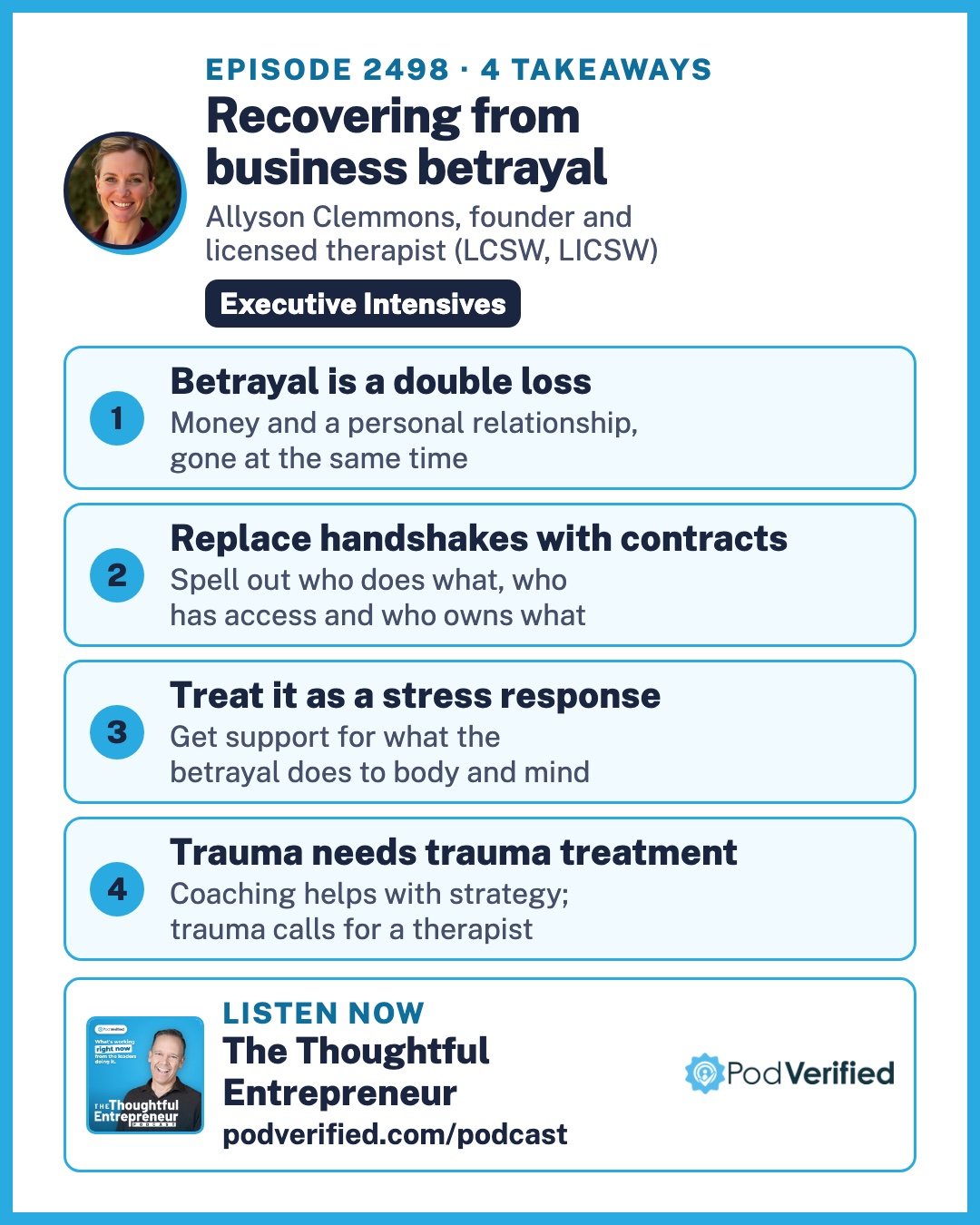
- Business betrayal is a double loss. Allyson says owners often lose money through theft, fraud or embezzlement and lose a personal relationship on top of it.
- Handshake deals left people exposed. Most of the owners Allyson interviewed had no contracts spelling out who does what, who has access to what and who owns what.
- Treat it as a stress response. Allyson says a business betrayal overlaps heavily with an affair in what it does to the body and mind.
- Coaching and trauma treatment do different jobs. Allyson, who has a coach, says trauma calls for trauma treatment such as Accelerated Resolution Therapy.
In 2026, Allyson Clemmons interviewed about two dozen business owners in the US and Canada who had been betrayed in business. Many blamed themselves for missing the red flags. Allyson keeps pointing back to the evidence they had: the person had been a friend for two decades, sat at their dinner table, and stood next to them at their wedding.
Allyson is a licensed therapist and the founder of Executive Intensives, which offers one-day intensive therapy for business leaders and entrepreneurs dealing with the damage left by a business betrayal. Allyson tells Josh why a betrayal by a business partner hurts as much as it does, what most of the business owners Allyson interviewed were missing beforehand, and why the recovery calls for trauma treatment.
🎧 Listen to Allyson's interview
Press play below. About 25 minutes.
Or listen in your favorite app:
Apple Podcasts Spotify YouTube Amazon Music iHeart Audible Pandora Castbox TuneIn
The Thoughtful Entrepreneur is a daily podcast with business leaders. Subscribe so you don't miss one.
Watch the clip
Allyson in 78 seconds
“We don't choose to be traumatized. We don't choose to be extremely stressed by something like a betrayal…”
A short video from the interview, with captions. Tap play. For the whole conversation, use the player above.
Why do betrayed founders blame themselves?
When Allyson asked business owners about their betrayals, a common thread was hindsight. They told Allyson they should have seen the signs. There were red flags and warning signs, they said.
Allyson sees it differently. The people who betrayed them had often been friends for two decades, partners, mentors or classmates. They had earned the owner's trust in every other part of life, so trusting them in business made sense. As Allyson puts it, it would make no sense to trust someone at your dinner table and at your wedding and then suddenly not trust that person at work.
What most of those owners lacked, Allyson says, was structure. Their agreements were handshake deals, with nothing concrete about who does what, who has access to what and who owns what. Trust felt even safer when an agency or a community had already vetted the other person.
Allyson stresses that the betrayals were not the owners' fault. The lack of guardrails left them exposed. Contracts and clear boundaries, set before going into business together, would have helped most of the people Allyson talked to.
Straight from the recording
Quotes are lightly edited for readability: filler words and stutters removed, nothing reordered. Times are approximate.
“You had so much evidence of why this person was trustworthy because they had been your friend for two decades.”
“I think contracts are really important. I think having these agreements and doing that before getting into business is really important…”
“It might be that, but it's not just that. It's a whole stress response that your body goes through.”
“I am a huge fan of coaching. Do not get me wrong.”
Josh's case for a licensed professional
Josh has been through business betrayal at least a couple of times in decades of business, and has felt the same way about institutions that let Josh down. Josh's advice to founders who feel weak or think they should tough it out alone: build a support system, from books and podcasts to a coach, mentor or advisor.
“I'm going to put a plug in for working with a licensed and competent mental health professional, just because I know from experience what that layers on.”
Allyson agreed. Coaching works well for strategy, behavior, implementation, leadership and confidence, Allyson says, but trauma changes the brain and the body, and nobody chooses that. Trauma calls for trauma treatment.
Questions answered
What is business betrayal?
Allyson describes it as a betrayal by someone you went into business with in some capacity, often a friend, partner or mentor. There may be financial theft, fraud or embezzlement, and the personal relationship is lost on top of that. Allyson says the effects reach far, leaving owners unsure whether they can collaborate, hire or partner again.
How can founders protect themselves from a business partner betrayal?
Allyson says most of the owners interviewed relied on handshake agreements. Allyson recommends contracts and clear agreements before going into business, spelling out who does what, who has access to what and who owns what, plus clear boundaries.
How do you recover emotionally after being betrayed by a business partner?
Allyson says the first step is acknowledging that it was a betrayal and an extremely stressful event, especially when it touches your livelihood, finances and bank accounts. Calling it a business lesson doesn't resolve what it does to your body, emotions and mind, so getting real support for that stress response matters.
What is institutional betrayal?
Josh described feeling the same way when institutions let Josh down, and Allyson named it institutional betrayal. Allyson, a therapist for 16 years, says it can be as damaging as a personal betrayal and happens all the time, even though most people don't have a word for it.
How do I reach Allyson Clemmons?
Go to executiveintensives.com, where Allyson has several articles on business betrayal. Allyson is also writing a PDF report of the findings from the 2026 interviews; join the email list on the site to get it when it's out.
Questions to ask your own team this week
Drawn from the examples Allyson gave, not from Executive Intensives' marketing.
- Which of our partnerships still run on a handshake? Allyson says most of the betrayed owners had no contract at all.
- Is it written down who owns what and who can access what? Allyson points to access, ownership and roles as the details owners lacked.
- Do we trust someone here only because an agency or community vetted them? Allyson says outside vetting made owners feel they didn't need guardrails.
- If a partner betrayed us, who would we call first? Allyson and Josh both say support, not toughing it out, is how owners recover.
Away from the screen
Allyson has lived in Mexico for the last two years. Allyson and Allyson's husband explore the country by motorcycle and follow live music and DJs around central Mexico.
On the way home from a recent show, they got a flat tire in a small village on Mexican Independence Day, with everything closed. People came out of the woodwork offering to help in English, Allyson says, and Allyson's Spanish has gotten better in two years, though the technical words for a flat tire are still tough.
“We actually just got back from a show last week and we had a flat tire on the way home.”
Episode details
| Guest | Allyson Clemmons |
|---|---|
| Role | Founder and licensed therapist (LCSW, LICSW), Executive Intensives |
| Website | executiveintensives.com |
| Background | Allyson has been a therapist for 16 years. Executive Intensives' site lists Allyson as LCSW and LICSW, offering one-day intensives online for clients in several states and in person in Mexico City, using Accelerated Resolution Therapy. |
| Topics | Business betrayal, business partnerships, contracts, boundaries, trust, institutional betrayal, betrayal trauma, founder mental health, Accelerated Resolution Therapy, coaching vs. therapy |
| Host | Josh Elledge |
| Episode | 2498, The Thoughtful Entrepreneur |
| Allyson Clemmons on LinkedIn | |
| Listen | Play it on this page, or on Apple Podcasts, Spotify, YouTube or Amazon Music |

We're always looking for great guests
Be our next guest on The Thoughtful Entrepreneur
We publish a new conversation every day, so we're always looking for leaders like Allyson. The guests we love most are generous: real experience, a clear point of view, and something useful to give our listeners. Come ready to teach, and we'll make you look great doing it.
Not ready to apply yet? Get your free PodVerified Score to see how podcast hosts size you up. It takes two minutes.
Full transcript
Filler words and stutters removed. Company and guest names corrected where the automatic transcript misspelled them. Times are approximate.
Read the full transcript
Josh Elledge (00:00): With us right now, it is Allyson Clemmons. Allyson, you are a licensed clinical social worker. You are a therapist by trade, and you are the founder of Executive Performance Optimization. Your website is executiveintensives.com. I love this, Allyson. I love the work you do. You do one-day intensive therapy for business leaders and entrepreneurs to resolve damage left by a business betrayal.
Allyson Clemmons (00:28): That's correct.
Josh Elledge (00:29): We're going to get into that in just a second. I don't think I forewarned you, but before we get into that, I always love talking with business leaders about what they do for fun when they're not at work. And so just kind of in your personal life, I don't know if you're into any hobbies right now, movies, music, TV shows, games, like anything that you're really geeking out on. What have you been up to lately outside of work?
Allyson Clemmons (00:53): Sure. So outside of work, most recently, so I've lived in Mexico for the last two years. And so my husband and I have been exploring Mexico on our motorcycle. And so that's been our most recent kind of like fun thing that we do. And we kind of follow like live music and DJs around the middle of the country. It's been really fun.
Josh Elledge (01:17): Oh, heck yeah. That would be amazing. And I would imagine, how long have you lived there?
Allyson Clemmons (01:23): Two years.
Josh Elledge (01:24): Two years. And I would imagine the culture is, it's gotta be really cool. So for an expat or for an American living in Mexico, what have you noticed, especially when you go to music festivals or concerts or shows or anything like that? How is it? I mean, I already love that as an American doing this stuff in America, going to these shows. Because it's kind of cool. It's like everybody just kind of comes together. We forget all the disunity elsewhere in our lives and in the world, and in that moment, we're all united. But Mexico, I have to imagine, would probably be even a level above.
Allyson Clemmons (02:00): Even more so. Yes. Yeah. People are so nice. They try to speak to us in English, which is really sweet. And of course I try to speak in my very broken Spanish. So often there's a language barrier, but people are really, really helpful. We actually just got back from a show last week and we had a flat tire on the way home. And so we had to stop in like this little Mexican village, and it was Independence Day in Mexico, so everything was closed and we were like stranded. But people kind of came out of the woodwork and they were like, I speak English, I can help you. It was really nice.
Josh Elledge (02:32): Oh my gosh. Yeah, that's awesome. Does your husband speak Spanish as well?
Allyson Clemmons (02:37): Nope.
Josh Elledge (02:42): Wow. Well, I would imagine the immersion over the past couple of years has been pretty helpful. Like when you go back to the States, people who now kind of hear your level of proficiency are like, whoa.
Allyson Clemmons (02:53): Yeah. It's definitely gotten better over the last couple of years. But especially talking about something like a flat tire, technical words and things like that, that part's tough.
Josh Elledge (03:04): Well, Allyson, I have to get to talk to you about business betrayal. And listen, to our friend that's listening right now, if you've been in business for any length of time, something's probably going to come up. I mean, people are people, and everyone's got their own things going on, and there's only really so much we can do to limit our exposure to situations where you have two different people with different points of view, different backgrounds. And I'll tell you, having been through this at least a couple of times in my decades of doing this, it sucks. It's really painful. It hurts. To me, it can be, depending on the situation, every bit as painful, if not more, than a personal betrayal, depending on kind of what went down. But I don't want to steal your thunder, Allyson. I'm just going to pull up a chair and maybe sit in the lotus position. Give us an overview of exactly the work you do, and let's kind of get into this topic of business betrayal.
Allyson Clemmons (04:19): Sure. So I have spent 2026 interviewing about two dozen business owners in the US and Canada, and I have not personally been through business betrayal. I've had my fair share of kind of toxic work environments or toxic bosses. But business betrayal, I found, is different because of exactly what you said. It's the personal relationship that you have with someone that you go into business with in some capacity. And then not only is there often a financial, maybe theft, or there's fraud or embezzlement, but then you also lose the personal relationship on top of that. And so that is ultimately what is so painful about this experience. And it really leaves business owners wondering if they can collaborate in the future, if they can hire, if they can partner. And so some bottlenecks are created, some opportunities are lost. I mean, the effects are really far-reaching.
Josh Elledge (05:23): So I'm sure that there are, I'm thinking of things that I've had to learn over the years, and you and I were talking about this beforehand. But particularly for those of us, I think, who are naturally pretty trusting, we look for the best in people. I think another risk factor is where we kind of operate with our boundaries, particularly when there are high degrees of familiarity, which is going to happen. I mean, it is normal to become friends with a lot of people that you work with. But there are some potential pitfalls in that. Do you want to kind of explain where you would take that topic?
Allyson Clemmons (06:15): Yeah. So I think that's exactly right. And I think what I've found in my interviews with these business owners is they sort of blame themselves. Like, in hindsight, I should have seen the signs. There were red flags. There were warning signs. But really, I always come back to: You had so much evidence of why this person was trustworthy because they had been your friend for two decades. They were a partner. They were a mentor. They were somebody that you went to school with and had a relationship with. So they had the business owner's trust in every context, every aspect of this person's life. And so to me, it makes a lot of sense that of course they're going to trust them in a business context too, because why wouldn't they? I mean, that wouldn't make any sense, to be like, this person is somebody that I've known and had at my dinner table and stood next to me at my wedding, and I'm all of a sudden not going to trust them in business. That wouldn't make any sense. So of course they did.
Josh Elledge (07:17): So what would you recommend, Allyson, as maybe best practice for boundary setting, and how does trust look? Is it like perestroika, right? Trust, but verify. Because you hope to do that. Like, I do that in my primary relationships. But I remember I had a mentor, and I don't know if this is good advice or not, but he said, hey, when it comes to the social stuff, after hours and after work, you're still the boss. And as much as you want to kind of let your guard down and really connect with people, he advised against it. And he said, you want your people definitely connecting with one another, but be careful of too much familiarity. What do you think of that?
Allyson Clemmons (08:21): I think that's fair. I think so. The reflections that I've come across when I've talked to these business owners are mostly about, prior to the business relationship, having agreements be like a handshake agreement. So they didn't have any kind of contracts. They didn't have any kind of concrete, tangible, this is what we're doing, who does what, and who has access to what, and who owns what. So I think contracts are really important. I think having these agreements and doing that before getting into business is really important, because a lot of the betrayals, unfortunately, it's not the fault of the business owner, but they were sort of vulnerable to them because they lacked any kind of guardrails. So I think if that had been in place... And again, I think it makes sense, because this person was trustworthy in every other context. So you would think, I don't really need a legal contract. I have no reason to distrust this person. Especially when there's an institution that's vetting them. So if you work for some type of agency, or you have a community around you and you're part of this community, I mean, there's a lot of layers to it. So definitely contracts, being really, really clear on boundaries. I think that would have helped most people that I've talked to. And then at the end of the day, after the betrayal has happened, like I said, most people are so hesitant about partnering again or about hiring or about collaborating in any way. And so really getting into treating the stress of that experience and getting some support, and then being able to scale your business at the end of the day.
Josh Elledge (10:17): Okay. So let's say, Allyson, the betrayal has happened. I would imagine a lot of times there are some business consequences on top of the personal consequences, and we might feel for a while disoriented. Like, I have business things I obviously need to take care of. I've got maybe some damage control. And again, I know that every situation can be kind of unique based on what went down and what happened. But how do we handle the emotional side of it? Because as a founder or as a leader, you still have to show up, probably, and you've got work to do. But meanwhile, it's almost like you went through a messy divorce or something, or you found out that your partner had been dishonest with you or had been cheating on you or whatever, right? Whatever the situation may be that led to that betrayal, it's hard. What are the first things that we can do to at least get some emotional stability in that moment?
Allyson Clemmons (11:31): So I think the first thing is acknowledging that it is a betrayal, and that there's a ton of overlap between business betrayal and romantic relationship betrayal, like an affair, right? Or infidelity. The overlap is huge. So even though the relationships could be different, the consequences, the stress, the bodily sensations that happen after a betrayal, those have a lot of overlap between the two situations. There's obvious differences, but I think the first thing is acknowledging this was an extremely stressful event, especially if it includes your livelihood, which for most people it does. It includes finances. It includes access to bank accounts. It includes passwords for really sensitive information, et cetera. So it's not just, oh, this is a business lesson. It might be that, but it's not just that. It's a whole stress response that your body goes through. And so getting the proper care and attention and support for that stress response is really important. And I've heard a lot of business owners, they make meaning out of the experience, as we all do when we have a stressful experience. So sometimes, though, they will say things like, oh, it just wasn't meant to be, or that person wasn't meant to come on the journey with me. That might be true, and I don't disagree with that, but that does not, let's say, resolve or adequately support the consequences of the betrayal in your body, in your emotions, in your mind, in your business. So really getting the support to treat it as a very, very stressful, potentially threatening event, threatening in the sense of my livelihood, my income, my savings, my whole business, potentially. I mean, I've talked to business owners who've had businesses stolen from them. So it's not a small, it's not small bones. It's a big deal.
Josh Elledge (13:41): Okay. And Allyson, please share what you do with your clients. This has been so helpful, and I feel like we're just kind of scratching the surface here. I think at the end of the day, I would imagine there is probably just stuff to process. Like I know, for me, when this has happened in my past, I'm just like, I need to talk with somebody to talk this out loud. Because right now, you're right, there's the, what did I do? How did I cause this? How could I have been so overly trusting? Or how could I have been a fool, or whatever, right? And unfortunately, there's just so many things that it's probably not fair to start pointing the finger too much at yourself, because if you're a good, honest person, the other person did something patently unethical. Look, having been through situations as well with institutions that have really let me down, this ain't my first rodeo. And I've noticed that those feelings are very similar.
Allyson Clemmons (14:58): Yes. Yeah. And there's a word for it. It's called institutional betrayal. I mean, these are real concepts. And I think that there's maybe a knowledge gap with the general public. And even as a licensed therapist, I've been a therapist for 16 years, and only in the last handful of years, maybe five, six years, have I really kind of wrapped my head around betrayal trauma and what that means outside of a romantic relationship and outside of a parent-child relationship. So when you're looking at an institution that betrays you, that can actually be just as damaging. And we see that actually all the time in real life. We just don't have a word for it. So having some understanding, kind of education around what betrayal is and how it affects a person, I think is really useful. And so I talk with my clients about that, and then I do a specific kind of trauma treatment. And I know trauma is a little bit of a four-letter word, right? Like, people are like, well, I didn't go to war, or I wasn't physically assaulted. But it's much more broad than that. So getting trauma treatment for a traumatic event is the proper type of treatment. And that can look like a lot of different things, depending on what kind of therapy you want to have or what kind of therapy your therapist does. But getting trauma treatment for a traumatic event is what helps people heal.
Josh Elledge (16:25): Yeah. I don't want to mince words. Are you a fan of EMDR for trauma?
Allyson Clemmons (16:30): I do something very similar to EMDR. It's called Accelerated Resolution Therapy. Same idea with eye movements. So very, very similar.
Josh Elledge (16:40): Right. I just want to say this, and I want to kind of close up and make sure we know where folks can go here and get access to more resources. I know you've got a great blog. You've got some great articles. I was actually kind of pulling one up, reading what you were writing, and I think this is really important stuff, if you are a founder, to maybe work out some of these beliefs and these thoughts ahead of time, so you're not trying to pick up the pieces when a bad situation, should it happen, comes up at some point. But Allyson, I want to share this before we get to that. And that is, to the founder who feels like they are somehow weak, or that they somehow need to buck it up, right? And deal with it yourself. You can, right? And that is one path. But what I would say, and I dare say a lot of really experienced business founders and leaders who have been in business for a couple of decades would say, please surround yourself with a support system. And that includes, obviously, reading, listening to podcasts, watching YouTube videos, things like that. That's all very, very good. You need the education. But it is so okay to call in a coach or a mentor or an advisor. But in this case, I think, Allyson, given that you have a background as a mental health professional... My wife is a licensed marriage and family therapist and sex therapist. Working with someone that has that sort of background, that sort of academic foundation, everything is going to be very evidence-based instead of some kind of cute coaching program or whatever, which is great. But again, I'm going to put a plug in for working with a licensed and competent mental health professional, just because I know from experience what that layers on. And you know that you have a standard that you can count on. And again, evidence-based, not, oh, this sounds really good on social media, so this is what I'm all about. It might sell, but that might not necessarily be the right approach. And also, I'm so sorry I'm going so long on this wind-up here for you. But one thing I'll just say with licensed professionals is it's a little bit of a different relationship, right? Where you have to advocate for the client and the client is leading, as opposed to in a coaching relationship. Sometimes it's like, well, I'm just going to tell you what to do, which I see, right? And that may or may not be appropriate. But therapists, I find, tend to ask a lot more questions and be a lot more prescriptive, as opposed to, oh, I'm just going to push my will, or this is how I do things. So I think that's also helpful, so that you know that you maintain that standard. Okay, enough Josh talk.
Allyson Clemmons (19:52): It's okay. No problem. I appreciate it. Yeah. So I would echo everything that you said. I am a huge fan of coaching. Do not get me wrong. I love coaching. I support coaching. I have a coach. I have done coaching in the past for other people. I get it. And I think that coaching is great for strategies, behaviors, implementation, leadership stuff, maybe confidence building. But when it comes to trauma, you need trauma treatment. And that's because of how it affects your brain and what it does to your body. That's not anything that we choose. We don't choose to be traumatized. We don't choose to be extremely stressed by something like a betrayal, but that's exactly what happens. And that's what the research shows.
Josh Elledge (20:41): Yeah. All right, Allyson, your website is executiveintensives.com. Share with us how you work with folks, what that looks like. And let's make sure, for someone who's like, yeah, I should probably take about 30 minutes and do some reading and learning about this topic, which I'd highly recommend.
Allyson Clemmons (20:59): Absolutely. Yep. So I've got several articles on my website that folks can read. And I'm working on a findings report that I'm going to put out as a PDF of all of the findings that I've had from these two dozen interviews this year. So that's going to come out in October. So if you want, you can opt into my email list on my website, and that will be sent when it's available.
Josh Elledge (21:26): All right. Again, your website, executiveintensives.com. Allyson, it's been a great, great, great conversation. Anything else that we missed? I want to make sure that our folks know exactly what to do next.
Allyson Clemmons (21:38): Nope. I think I've said everything. I mean, there's a lot I can say, but not for the 20 minutes.
Josh Elledge (21:45): Allyson, thank you so much for the work that you do. To our friend that's listening, normalize this. Again, it happens to the best of us. Obviously we don't know why people act the way that they do, but they do. We're all human, and so there are a lot of imperfections out there, and it manifests sometimes in some very, very painful ways. So, executiveintensives.com. Allyson Clemmons, thank you so much for joining us.
Allyson Clemmons (22:18): Thanks, Josh.