Raising Your Prices and Stepping Out of the Chief Everything Officer Role with Alaina Schwartz
The Thoughtful Entrepreneur · Episode 2501
The short answer
How can a service business owner earn more while working fewer hours?
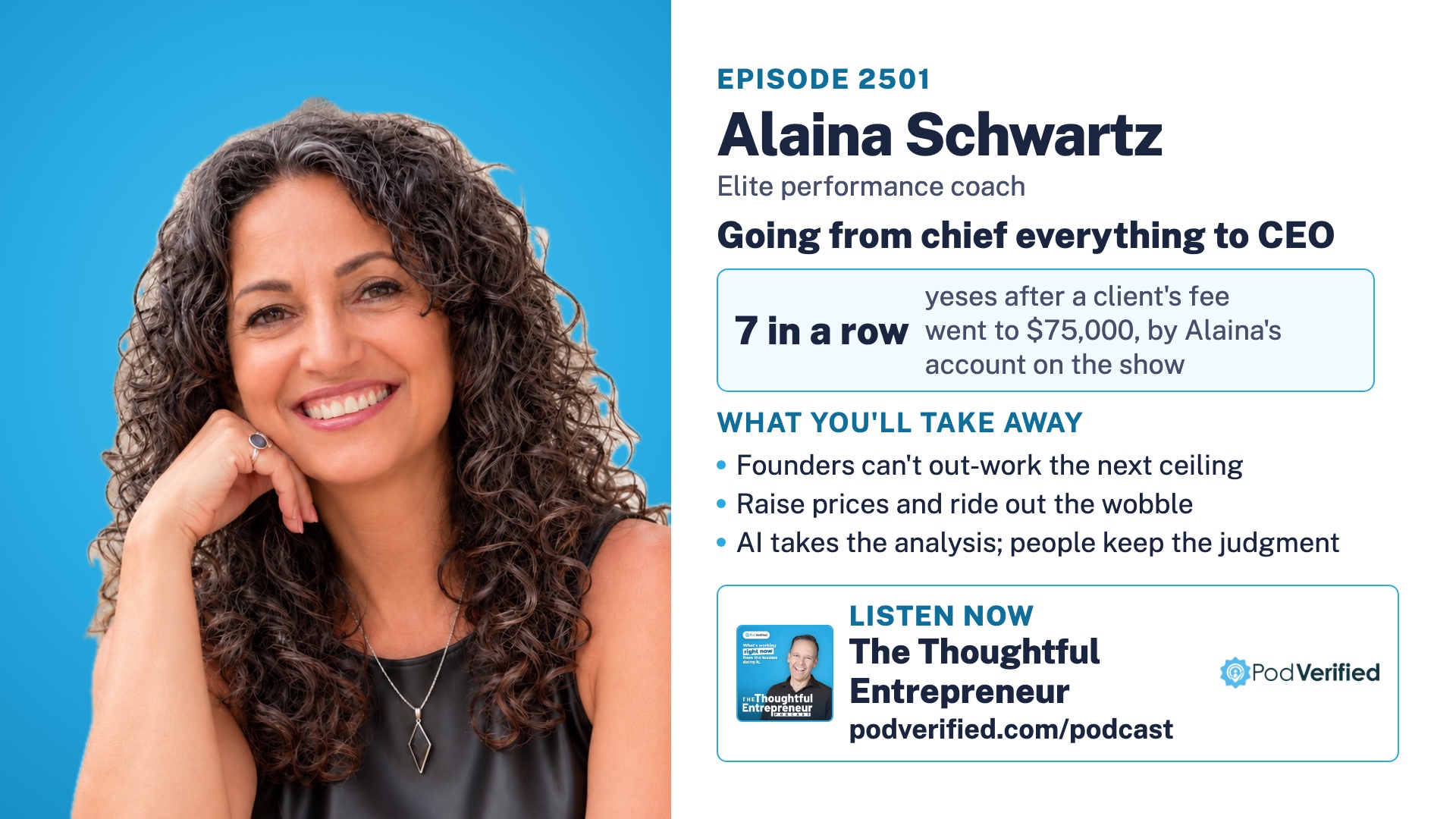
Alaina Schwartz, an elite performance coach, says many service business owners believe how hard they work decides how much they make, so they keep driving themselves. Alaina finds clients are often undercharging. One client, Bibi, raised fees to $75,000, got through a string of nos and what-ifs Alaina calls the wobble, then got seven yeses in a row.
Key takeaways
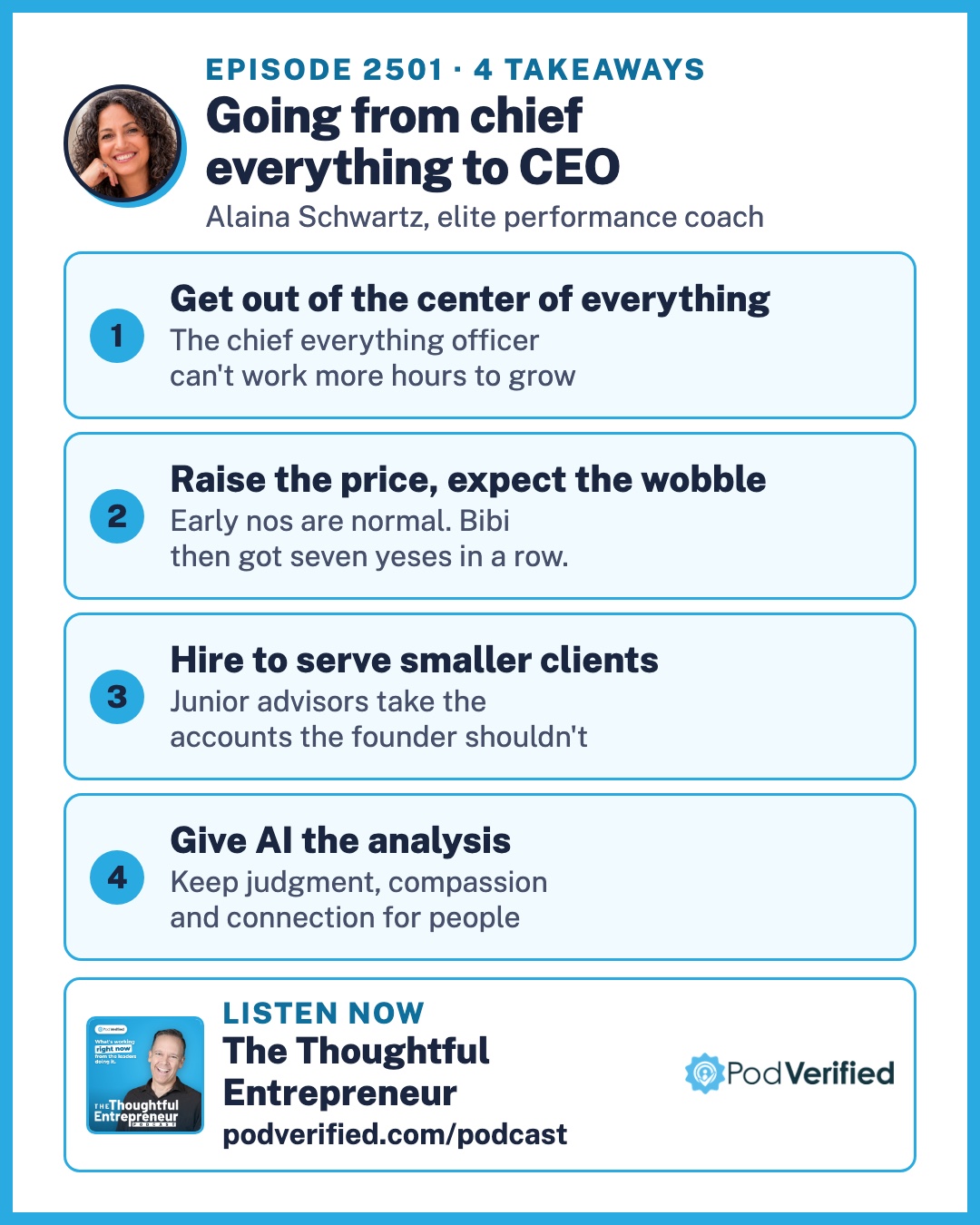
- The chief everything officer. Alaina's name for the founder who is still at the center of everything, however big the team gets.
- Raise the price, ride out the wobble. Alaina calls the run of nos and what-ifs after a price increase the wobble, and says clients get through it.
- Build a team to serve everyone. Alaina points to wealth managers who hand smaller accounts to junior advisors so nobody gets left behind.
- Let AI do the analysis. Alaina says AI handles data work so people can spend time on judgment, compassion and connection.
When Bibi first hired Alaina Schwartz, Bibi was working about 100 hours a week, charging $25,000 a year and hearing no at $35,000. Within three months, by Alaina's account, the fee went to $75,000. The first answers were more nos. Then came seven yeses in a row, which Alaina says would have taken 21 clients at the old rate.
Alaina is an elite performance coach who works with service business owners between multi-six and multi-seven figures. Back on The Thoughtful Entrepreneur about four years after a first visit, Alaina tells Josh why founders end up as the chief everything officer, how pricing and a team get them out, where AI fits and where it doesn't, and what a free 11-question diagnostic shows.
🎧 Listen to Alaina's interview
Press play below. About 23 minutes.
Or listen in your favorite app:
Apple Podcasts Spotify YouTube Amazon Music iHeart Audible Pandora Castbox TuneIn
The Thoughtful Entrepreneur is a daily podcast with business leaders. Subscribe so you don't miss one.
Watch the clip
Alaina in 73 seconds
“AI does not replace judgment. It does not replace human touch, right? It does not replace compassion.”
A short video from the interview, with captions. Tap play. For the whole conversation, use the player above.
What happens when a coach triples the price?
Alaina's first lever is what Alaina calls ascension: charging what the work is worth and working with the level of client you want. Bibi, a client, was working about 100 hours a week at $25,000 a year. The goal was over $100,000, but prospects were saying no at $35,000.
Alaina had Bibi make the first jump to $75,000 within three months. Like most of Alaina's clients, Bibi then went through what Alaina calls the wobble: a string of nos and objections, plus the inner what-ifs. What if my work isn't worth two to three times more? What if I miss my revenue numbers this month?
Once those were cleared, Alaina says, Bibi got seven yeses in a row. The clients changed too. Bibi moved from mid-level and C-suite people at multinationals to the C-suite of multi-billion-dollar multinationals, and now charges between $120,000 and $165,000 for the same work.
Josh pushed back for earlier-stage coaches who sell to small businesses. Alaina's answer was Nina, a coach making $15,000 to $20,000 a month on 10-hour days and selling a six-month program for $3,000. The price rose step by step to $9,000 for a four-week program, and Nina now has a waitlist.
The second lever was a team. Alaina helped Nina hire and lead one. By Alaina's account, Nina went to $70,000 months while working four hours a day.
Straight from the recording
Quotes are lightly edited for readability: filler words and stutters removed, nothing reordered. Times are approximate.

“So they're still at the center of everything regardless of how big their team is, right?”
“And once we cleared that, she got 7 yeses in a row, which would've been 21 clients at her old rate.”
“Because AI does not replace judgment. It does not replace human touch, right? It does not replace compassion.”
“And actually it's my form of lead generation is generosity in conversation because it comes back to me.”
Josh's warning about AI
Josh agreed with Alaina that AI can't replace human judgment, and added that a big share of a founder's day could likely be handed to systems if the right people set them up. Then Josh gave leaders a deadline of sorts.
“If you are not innovating at a breakneck speed right now with AI, I think that you are probably falling behind”
Josh said the point wasn't to scare anyone, only that leaders should give this work more of their time. Alaina agreed. For Alaina, the payoff is time back for coaching, conversations and networking, and Alaina says generosity in those conversations is how new business comes in.
Questions answered
What is a chief everything officer?
It's Alaina's term for founders who are so good at the work that they keep doing it themselves instead of explaining it to someone else. They stay at the center of everything no matter how big the team gets, and often work 50 to 80 hours a week or more.
Should a service business raise its prices?
Alaina's view is that the market always bears it. Alaina's clients often undercharge, and the work is raising prices, getting through the wobble of early nos, and moving up to the level of client they want.
How do you keep serving smaller clients after you raise prices?
Alaina points to wealth managers and financial advisors who hire junior advisors to work with lower-revenue clients. Everyone still gets served, and the founder stops spending time on low-value work. Josh's version: get flush with cash, then build other offers and hire people to run them.
Can AI replace a coach or a service team?
Alaina doesn't think so. AI handles Alaina's data analysis now, but Alaina says it can't replace judgment, human touch or compassion, which is what clients of service businesses pay for. When Alaina leaned into AI, Alaina's assistant ended up with more work, not less.
How do I get in touch with Alaina Schwartz?
Go to alainaschwartz.com and click the orange button to take the diagnostic. It's free, 11 multiple choice questions, and you can see results without giving an email. It shows which of three things is capping your time and revenue and what to work on first, and Alaina takes calls with founders who are a fit.
Questions to ask your own team this week
Drawn from the examples Alaina gave, not from Alaina's marketing.
- Where are we still routing everything through the founder? Alaina says the chief everything officer stays at the center no matter how big the team is.
- When did we last raise our prices? Bibi went from $25,000 a year to $75,000 within three months, by Alaina's account.
- Who could serve our smaller clients? Alaina's wealth manager clients hire junior advisors for lower-AUM accounts.
- Which of our analysis work could AI take over? Alaina no longer has people doing data analysis and spends the time on clients.
Away from the screen
Alaina has been walking the Camino de Santiago. Last year it was 165 miles in nine days on part of the Camino Francés, which Alaina admits was too intense. This year it was the Portuguese Trail, 90 miles in six days along the coast from Portugal into Spain, at a sweet spot of 15 to 17 miles a day.
Training meant rucking up hills with at least 15 pounds in the same backpack Alaina would carry on the trail, plus CrossFit. The surprise on the first trip was the calves, not the feet. Josh, who took up rucking with 40 pounds in January 2026, asked whether rucking is a military guy thing. Alaina's answer: it's for everybody.
“There's a huge difference between walking 4 miles and walking 18.”
Episode details
| Guest | Alaina Schwartz |
|---|---|
| Role | Elite performance coach |
| Website | alainaschwartz.com |
| Background | Alaina spent 18 years as an attorney in the music industry and was executive vice president of what alainaschwartz.com calls the largest independent music company in the world. Alaina has walked the Camino twice. |
| Topics | Founder workload, pricing, the wobble, delegation, building a team, junior advisors, AI in service businesses, lead generation through generosity, the Camino de Santiago, rucking |
| Host | Josh Elledge |
| Episode | 2501, The Thoughtful Entrepreneur |
| Alaina Schwartz on LinkedIn | |
| Listen | Play it on this page, or on Apple Podcasts, Spotify, YouTube or Amazon Music |

We're always looking for great guests
Be our next guest on The Thoughtful Entrepreneur
We publish a new conversation every day, so we're always looking for leaders like Alaina. The guests we love most are generous: real experience, a clear point of view, and something useful to give our listeners. Come ready to teach, and we'll make you look great doing it.
Not ready to apply yet? Get your free PodVerified Score to see how podcast hosts size you up. It takes two minutes.
Full transcript
Filler words and stutters removed. Company and guest names corrected where the automatic transcript misspelled them. Times are approximate.
Read the full transcript
Josh Elledge (00:00): With us right now, it's Alaina Schwartz. Alaina, it's so great to have you. You are an elite performance coach. You work with CEOs and you help them go from Chief Everything Officer, which I know so many of us feel like, to Chief Executive Officer, which is the proper role we should be aspiring for. But we're gonna get into that for sure. You're found on the web at alainaschwartz.com. Alaina, thank you so much for joining us.
Alaina Schwartz (00:30): It is such a delight to be here with you, Josh.
Josh Elledge (00:33): Yes, yes, yes. And I should also point out that I think you were on the show last time, maybe about 4 years ago. So it's great to have you back because what you talk about is incredibly important. We're going to get to that in just a second because I know there are a lot of CEOs that just feel pulled in all directions, worn thin. And as a result, there are definitely some consequences that we'd like to address. But before we get into that, Alaina, you know, always love hearing what executives and leaders do for fun when they are not at work. And I understand you do some fairly good treks, long-distance walking. Tell me about that.
Alaina Schwartz (01:16): Yeah. So I'm really into challenging my body. Like, as I've gotten older, I've wanted to ensure that I can continue to adventure and do the things that I love to do. And so that involves doing a bunch of things. But recently I've been into this long-distance walking and the Caminos. I don't know if you've ever heard of the Caminos. Camino de Santiago. There are 7 main trails and I've already done 2 of them. So last year I walked 165 miles in 9 days, which I admit is a little too intense. I didn't realize it was gonna be that intense. And this year I walked the Portuguese Trail. So I walked 90 miles in 6 days, which was super cool, walking from Portugal along the coast into Spain.
Josh Elledge (01:54): Yeah, 'cause you're getting close to 20 miles a day at that pace. That's a lot.
Alaina Schwartz (02:01): Yeah, it's 15 to 17 miles a day. I mean, it was more last year. It was a lot more last year, but like my sweet spot is 15 to 17 miles a day.
Josh Elledge (02:11): Yeah. So what does one need? Like, is it mostly flats, or are you going a lot of...
Alaina Schwartz (02:16): It depends on the trail. So the Portuguese Trail was mostly flat, and I did part of the Francés. I did a third of the Francés last year, and it was not flat at all. And so really training my body, like we were talking about this before, because I was rucking. I was walking up hills a lot with a minimum of 15 pounds on, rucking, preparing myself for carrying my pack, 'cause my pack was about 15 to 20 pounds. So that's what I did, but I was also doing other things to help my legs get into gear for climbing hills, like CrossFit. So I've been really into CrossFit.
Josh Elledge (02:54): Wow, I am inspired. I mention this from time to time, but this year in 2026, beginning of January, I got myself a ruck backpack. And I'm up to 40 pounds right now, and I'm probably just gonna stay there for the time being. I absolutely love it. I think it's about the easiest exercise, bang for the buck, what you get compared to the impact that it causes your body and potential for injury. You know, if you do it well and you're well fitted and stuff, it's just such a great core workout and it gives you a lot, in addition to obviously working out all those walking muscles and your cardiovascular. It doesn't have quite the impact that running does. As a former marathon runner, I could tell you that it's the norm. Like, even in the best of shape, I'm just going to get injured training for a marathon. It's a lot. And I shouldn't say it has to be that way, but that's kind of what my experience was. But rucking, it's just so low impact. And like I said, it gives you that farmer strength, you know, where you could just kind of like...
Alaina Schwartz (04:13): It does. It makes you very sturdy. Yeah, really very sturdy, which helps as we age in everyday life, you know. So that's a big part of it too. And I live very hilly, so I walk up a lot of hills, but I will say I was really surprised about this because I was walking 4 miles a day when I was preparing for it. This was for my first trip. I knew what to expect my second trip, my second Camino. But the first one, I thought, okay, I'm walking hills, I'm walking with weight on me, I'm preparing for it, and I thought this is going to be a piece of cake. There's a huge difference between walking 4 miles and walking 18. So it did not totally prepare me for that. But now I understand how to prepare my calves for it in a different way. Because everybody talks about their feet and watching all the blisters and everything, but it was actually my calves. So that was the thing that was making me want to really focus on more for my second Camino, and I nailed it. So I'm pretty psyched about that.
Josh Elledge (05:09): That's amazing. Well, thank you so much for inspiring us. And by the way, for other ladies out there who are like, oh, you know, walking, rucking, isn't that like a military guy kind of thing?
Alaina Schwartz (05:24): No, it's for everybody. You know, the thing is, walking is really healthy. Like you said, it's really low impact. And when we can add weight, we add resistance, which means we're getting so much more out of the actual time we're spending walking, which is like, I'm all about maximizing. It's what I do in business. It's what I do in my life. It's about maximizing results.
Josh Elledge (05:45): Between weighted vests and a ruck, I went with a ruck. It's a little easier on the lower back because it shifts a lot of the weight to your hips. And then with a ruck, it has a little bit of a pulling, where it kind of pulls your back into better alignment unless you're leaning forward too much. But I found that that was also really helpful for my posture, as opposed to a weighted vest. A weighted vest is just straight down.
Alaina Schwartz (06:15): That's just straight down weight. What I actually did was put 15-pound weights in the backpack that I was going to carry, so I could get accustomed to wearing it. So I used the backpack that I was actually going to use on the Camino and then just weighted it up and used that.
Josh Elledge (06:32): Well, very cool. Okay, Alaina, [unclear]. I love that. I love this topic. Let's talk about the superpowers, because I know you work with a lot of really great CEOs that are just stretched thin. Start by maybe giving us a little bit of a mini TED Talk here on the topic of how CEOs often find themselves in this position where they're doing way too much.
Alaina Schwartz (06:55): Yeah, yeah. You know, I was thinking about this as I was about to join this conversation. Everybody starts their own business, hopefully because of some passion, some purpose, right? To make something meaningful. And they think it's going to give them a level of flexibility over their previous corporate job. But then they end up in another J-O-B with them as a boss, right? So what ends up happening, 'cause I work with service-based business owners who are between multi-six and multi-seven figures, trying to get to the next level. They're so good at what they do, and they typically think they're better at everybody else at doing these particular things, that it's just easier for them to do it themselves rather than have to explain it over and over again to somebody else. So they're still at the center of everything regardless of how big their team is, right? That's what I call the chief everything officer. They're still doing way too much in their businesses, and they believe that there's a direct correlation. There's a direct, I would say, causation between how hard they work and how much they make. So they keep driving themselves more. But if you're working 50 to 80 hours a week, sometimes even 100 hours a week, you really can't work anymore. So then how do you get to the next level without it coming at some sacrifice or additional sacrifice? And that's what I help them, get out of that cycle so they can 2 to 5x their revenue, but work 20 to 30 hours a week less in the process.
Josh Elledge (08:26): Okay, well, how do we get there? Where do we start?
Alaina Schwartz (08:30): Where do we start? Okay, well, there's actually 3 things. I'll give you a couple of examples. So when clients come to me, they're often undercharging and they're not working with the level of client they want. I call that ascension. So like my client Bibi, when she first came to me, she was working about 100 hours a week, actually, which is pretty crazy. She was charging $25,000 a year for her services and she wanted to be charging over $100K, but she was getting nos at $35,000. The first bump I had her do was at $75,000. Within the first 3 months, we raised her fees to $75,000. And like most of my clients, she got a string of nos and objections because they go through what I call the wobble, all the yeah buts and what ifs. What if my work isn't worth 2 to 3 times more? What if I don't hit my revenue numbers this month? Like all the yeah buts and what ifs. There's tons of them. And once we cleared that, she got 7 yeses in a row, which would've been 21 clients at her old rate. And she completely up-leveled her client because now she's charging considerably more. So she went from working with mid-level and C-suite of multinationals to working with C-suite of multi-billion-dollar multinationals. And now she charges between $120,000 and $165,000 for the same exact work.
Josh Elledge (09:43): Right. Yeah, so those are some big numbers. And I suspect that there are maybe some earlier stage coaches and they're like, well, that's not even in the realm of possibility right now, or my target client is not multinational corporations, I'm working with SMBs. And I've heard that advice, you know, oh yeah, charge more, charge more, charge more. Maybe. I mean, the market may or may not bear it. So how do you...
Alaina Schwartz (10:18): In my experience, the market always bears it, because, like, I'll give you another example. My client Nina was working 10-hour days, was making about $15,000 to $20,000 a month when we first started working together. And she was charging $3,000 for a 6-month program. She also happens to be a coach, but she was charging $3,000 for a 6-month program. And we continued to elevate. And within a short period of time, she was charging $9,000 for a 4-week program. Now she's full. She has a waitlist of people, right? So we can look at that and go, okay, well, will the market bear it? That may not be as dramatic of numbers as Bibi did, but it was able to take her to $70K months. And that's 4 hours a day, because I also helped her hire a team, which is my leverage component of really understanding how to lead your team effectively so that you can get out of the center of everything. And she did that, and she went to working 4 hours a day in the process of elevating from $15,000 to $20,000 a month to $70,000 a month.
Josh Elledge (11:22): Yeah. I mean, and Alaina, there could be some people that are like, well, gosh, I like being able to keep my prices accessible for a certain segment of the population. But I guess what I would argue is, if that's not getting you to the cash flow that you need, that's a problem. It's great that you wanna do charity and you wanna do good for good people. One possible solution is, hey, listen, get flush with cash and then create other products and services so that you can better meet the needs of those people, and maybe hire some other people to run that so that you don't have to do that work. That's a pretty solid plan.
Alaina Schwartz (12:05): Like, it is a solid plan.
Josh Elledge (12:06): Yeah, people can do that.
Alaina Schwartz (12:07): Yeah. As a matter of fact, I work with a lot of wealth managers and financial advisors, and that's typically what they do, because when they start working with higher net worth people, they don't necessarily want to leave people who aren't high net worth behind, but that's not where they should be spending their expertise. So they hire junior advisors, right? And those junior advisors then work with those lower revenue, lower AUM clients. And then they're able to fulfill everybody they wanna service, but they're not spending their time on low-value work.
Josh Elledge (12:39): Yeah. So what about, Alaina, I love all this. I wonder if there's someone listening who's like, okay, well, this sounds great. I'm motivated. I'm just gonna use AI to try to do all this. And again, great. Love the energy. But Alaina, could you maybe talk about where AI does fit in this and why you would still wanna make sure you've got that human leadership and judgment along with you, based on what you do?
Alaina Schwartz (13:08): Yeah, yeah. I love this conversation 'cause you and I have been geeking out with AI with each other lately, and I am so into AI and it's allowed me to do so many things in my business, expand in ways that I wouldn't have. And it's funny, when I first really started getting into it, my assistant said to me, so am I gonna be out of a job? And I was like, no, you're gonna have more work. And that's exactly what's happened. She says a lot more work now. Because AI does not replace judgment. It does not replace human touch, right? It does not replace compassion. And so when we are talking about service-based businesses, what people are paying for is that level of connection. And AI can't create that level of connection. It can do a lot of the things that I don't believe humans should be doing anymore. And so it can free you up to focus and free your team up to focus on those higher value things that we all should be spending time as humans doing. Like, I don't do data analysis anymore. AI does that for me, and it's awesome 'cause it gives me very accurate data analysis that allows me to decide where I wanna go in my business. But I don't have humans doing that anymore, right? But then it allows me as a human to do the things that I love to do, to coach more people, to have more conversations with people, to network more. High value for me is networking and being of service to others. How can I be generous with others and give with others? And actually it's my form of lead generation is generosity in conversation because it comes back to me. AI can't do that, right? So I'm not concerned with AI replacing me or the people I work with at all. It's just allowing us to do our jobs better.
Josh Elledge (14:51): Yeah, yeah. You know, part of the shift that you were talking about, going from chief everything officer to truly doing what nobody else can do, and what AI cannot do. My suspicion is that there probably is a really big chunk of the things that you do every day that, if you're working with some really smart people that understand systems and processes and what the technology allows us to do, it could be shocking just how much time you can free up from your schedule and from your team members' schedules so that you can apply that human capital into the things that we really, really need human connection for. We need personal human communications and presence and judgment. And it's knowing that difference, I think, that is really critical. And then being able to take advantage of where the technology is moving. And I'll just say this, Alaina, 'cause I know you're a fan of this as well, and I don't want anyone to feel too much pressure from this, but I would say as of when we're recording this here, we're getting toward the end of 2026. If you are not innovating at a breakneck speed right now with AI, I think that you are probably falling behind, because there are other people who are, and you will not be able to compete with them.
Alaina Schwartz (16:17): Right. I totally agree with that.
Josh Elledge (16:18): And again, I don't say that to be scary, but I do say that it's probably worth a little bit more of your time, leaders, to spend time focusing on this work. And Alaina, I know you've got a really great diagnostic. It's free. You can just go, and you don't have to opt in or anything on the front end. You can just go ahead and take the diagnostic. Do you mind sharing exactly what that is and why that's gonna be really valuable?
Alaina Schwartz (16:48): Yeah, yeah. I've discovered there's usually 3 things that are holding leaders back, that are holding what I would say founders or CEOs back. And what the diagnostic does is it tells you which of the 3 is the biggest for you right now and what to action first to move through it. So it will help you. It's very specific. It will help you determine which is capping your time and your revenue, what you should do first, and how to actually go about doing it. And as Josh mentioned, it is free, and you can get the results without having to even give me your email. And then if you choose to, there's very specific and detailed results that come on the back end of that.
Josh Elledge (17:29): Yeah, that is at alainaschwartz.com. You'll see an orange button that says take the diagnostic. There's a quick little video that gives you an introduction, exactly what to expect. And then you just go through it. Currently, as of when we're talking right now, it's just 11 multiple choice questions. And it's definitely some stuff I think would be really helpful for someone to go through, to get your brain engaged in this direction. And then I would imagine, Alaina, if someone is maybe at that caliber where you could potentially help them personally, then you probably grab calls with people. Is that it?
Alaina Schwartz (18:16): Absolutely, absolutely. And, you know, again, in the spirit of generosity, for me it's just about brainstorming or seeing how I can add value. It's never a strings attached kind of conversation. It's like, what can I do to add value to help you move forward in your business? And it'll be a fun conversation.
Josh Elledge (18:34): I love it. I love it. Alaina Schwartz, again, your website, alainaschwartz.com. We've got that all linked up. Again, you're helping CEOs go from chief everything officers to chief executive officers, truly allowing them to step into the role that they probably got into business to get to at the beginning.
Alaina Schwartz (18:57): Absolutely.
Josh Elledge (18:57): So, you know, again, if you're finding yourself kind of showing up to what feels like a job, and especially if there's a lot of tasks that you just don't enjoy doing, that stuff has a cumulative tax. And if you aren't at that kind of energy level that you need to be, because you're the founder, you need to be out spearheading growth and meeting people and inspiring impact and change out there. But like I said, if you just don't enjoy some of your work, or Monday morning comes up and you're like, I got a case of the Mondays, I don't want to be here. That's normal. I mean, that happens, but that might be an indication that there might be some opportunities to refine what your day-to-day looks like. Alaina Schwartz, this has been a great conversation. Again, your website, alainaschwartz.com. Take the diagnostic tool so you can start to get clarity. Alaina, thank you so much for joining us.
Alaina Schwartz (20:03): Thank you so much, Josh. Really appreciate it.