Cutting the Biggest Bill Business Owners Pay Every Year with Fides Wealth's Sohrab Mazlomian
The Thoughtful Entrepreneur · Episode 2502
The short answer
How can successful business owners reduce their tax bill?
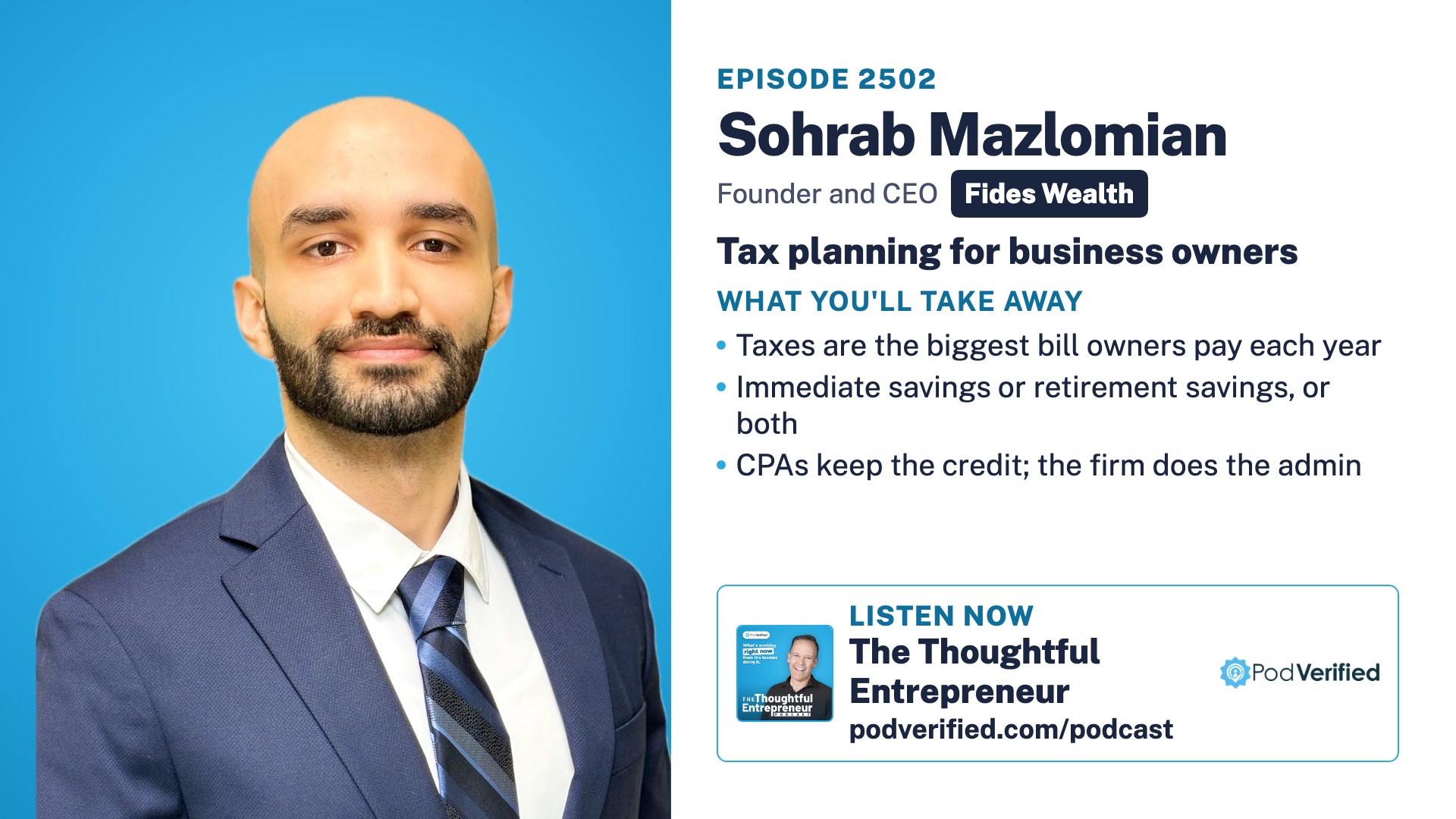
Sohrab Mazlomian, founder and CEO of Fides Wealth, says taxes are the most expensive bill successful professionals and business owners pay every year, and the bill grows with success. Sohrab's advice: once you earn above-average income, ask your financial advisor, CPA, wealth manager or estate planning lawyer to explore the options, then decide whether you're planning short-term or long-term.
Key takeaways
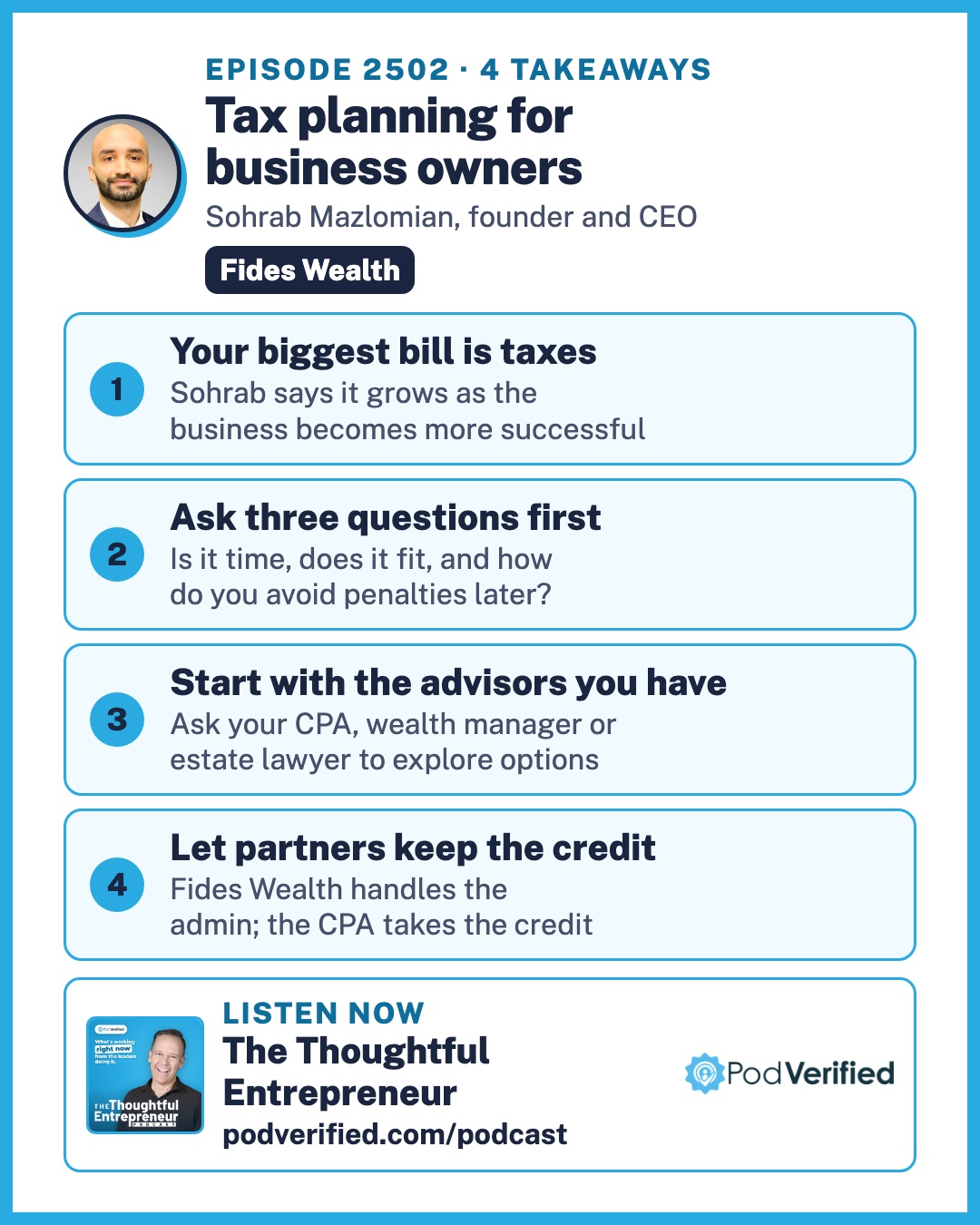
- Taxes are the biggest bill. Sohrab says the bill rises as a practice or business becomes more successful.
- Immediate or retirement savings. Sohrab's firm sorts tax planning into those two groups and can work on either or both.
- Three questions first. Is it a good time, does it fit this person's situation, and how do you set it up to avoid penalties later?
- Partners keep the credit. Sohrab says Fides Wealth lets CPAs and advisors take the credit while the firm handles the administrative work.
Sohrab Mazlomian opens with a question for every successful professional and business owner: what is the most expensive bill you pay every single year? Sohrab's answer is taxes, and the bill grows as the business does. Sohrab admits to not looking forward to tax season either.
Sohrab, who lives in Orlando like Josh, is the founder and CEO of Fides Wealth. On the show, Sohrab tells Josh how the firm sorts tax planning into immediate savings and retirement savings, the three questions it asks before planning anything, how it works with CPAs and wealth managers without taking their clients, and which kinds of earners it serves. This is general discussion from the episode, not tax or investment advice for your situation.
🎧 Listen to Sohrab's interview
Press play below. About 18 minutes.
Or listen in your favorite app:
Apple Podcasts Spotify YouTube Amazon Music iHeart Audible Pandora Castbox TuneIn
The Thoughtful Entrepreneur is a daily podcast with business leaders. Subscribe so you don't miss one.
Watch the clip
Sohrab in 82 seconds
“However, it is important to explore all possibilities to reduce your tax obligations as much as possible.”
A short video from the interview, with captions. Tap play. For the whole conversation, use the player above.
How does a tax strategist work with your CPA?
Josh asked how Fides Wealth fits in when a client already has a fractional CFO, a CPA or a wealth manager. Sohrab says wealth managers and CPAs are two of the best professionals the firm has worked with, and that CPAs handle the taxes, deductions and filings.
Sohrab's firm comes in to introduce a few options the consultant can bring to the client. Fides Wealth is introduced as the consultant's partner, the consultant takes the credit for the plan, and the firm handles the administrative work.
Sohrab is open about why that matters. Professionals are wary of working together because they worry someone will come in and sweep their clients. So the first job is making the consultant comfortable. Only after that trust is set does the firm look at the client's profile to see whether a strategy is even possible.
Before any plan, Sohrab says, the firm asks three things. Is this a good time to start planning for deductions? Usually, Sohrab says, the answer is yes. Does it fit this person's position and situation, since a strategy may not be right at that moment? And only then: how do you put it in motion so it doesn't bring penalties years down the line?
Straight from the recording
Quotes are lightly edited for readability: filler words and stutters removed, nothing reordered. Times are approximate.
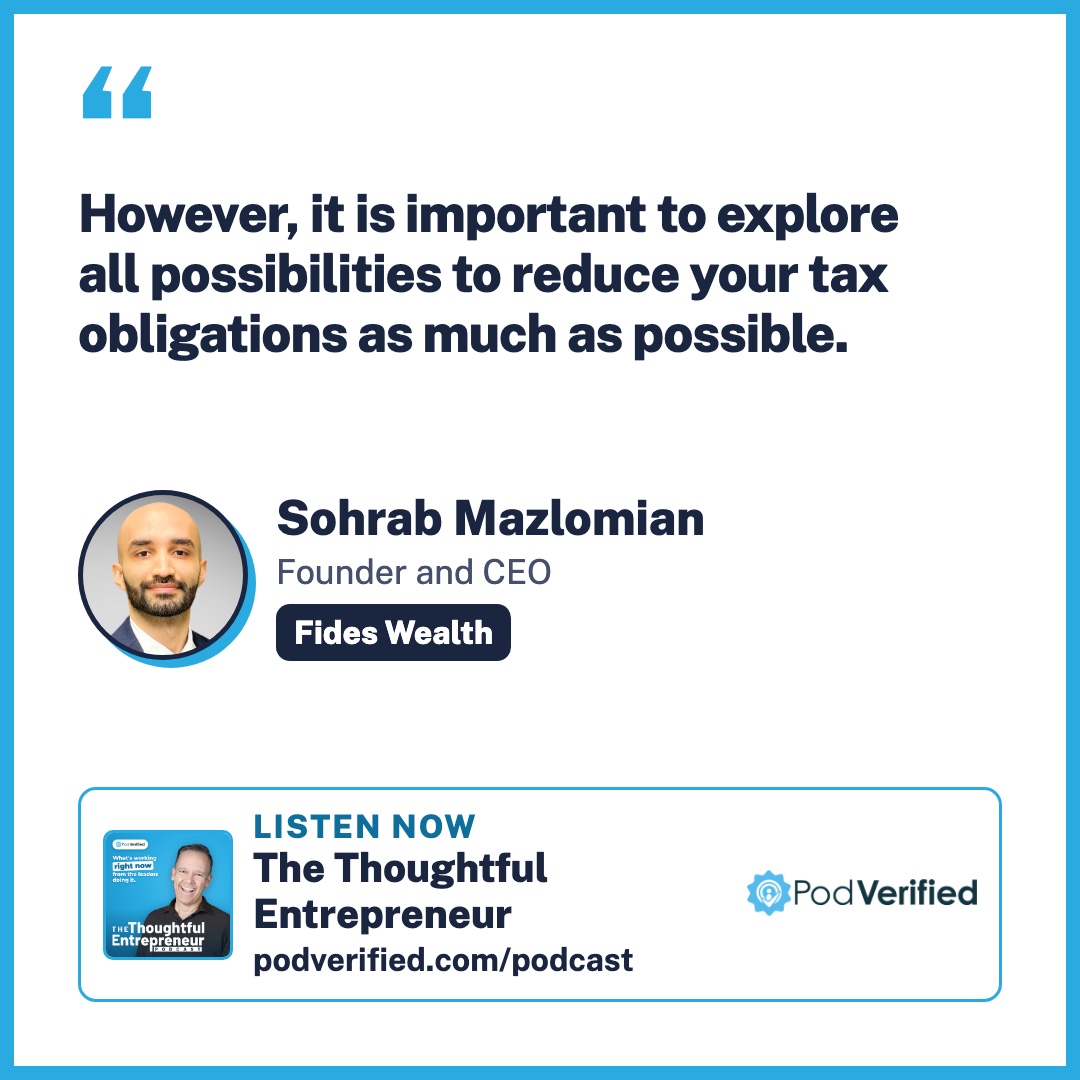
“Individually, everyone has to pay their taxes, and as a business owner or a professional grows their practice, become more successful, they will naturally be subjected to larger taxes.”
“Now, of course, we offer this to them in a way that they can introduce us to them as their partner, and we allow them to take the credit for the plans that we offer while we handle all the administrative work.”
“We are afraid somebody might come in and sweep our clients.”
“One is never lose money. The second rule is remember rule number one.”
Josh's warning for new money
Before the tax talk started, Josh set it up with a line for owners whose income has started to climb.
“And if you are new money, you better surround yourself with smart people.”
Josh added that the default ain't too friendly. Later, Josh told Sohrab that a lot of founders want someone like Sohrab in their corner, and asked when a business owner should start asking questions. Sohrab's first step for anyone earning above-average income was to go ask a financial advisor, CPA, wealth manager or estate planning lawyer to explore the options.
Questions answered
When should a business owner start tax planning?
Sohrab says it starts once you earn larger than average income, whether on a 1099 or a W-2 while working for yourself. Sohrab's suggestion is to ask your financial advisor, CPA, wealth manager or estate planning lawyer to explore options, and to decide whether you're planning short term or long term. Sohrab names a 35% or higher income tax rate as a sign to think about it.
Who does Fides Wealth work with?
Sohrab says the firm mostly serves business owners and partners in professional service, medical, financial and construction businesses. It also works with individuals earning well on 1099 or side income, such as a physician working at a hospital or a realtor who had a successful year.
What is a cash balance pension plan?
Sohrab describes it as the tool Fides Wealth uses for immediate tax savings, holding the taxable portion of income in the plan, and compares it to a Roth-type 401(k) with a high contribution ceiling. The figures Sohrab gives on the show, such as savings up to six figures and a 40% upfront deduction, are Sohrab's own and depend on each person's situation. Check any plan with your own CPA or advisor.
How do CPAs and wealth managers partner with Fides Wealth?
Sohrab says the firm introduces a few options the consultant can bring to clients, presents itself as the consultant's partner, and lets the consultant take the credit while Fides Wealth handles the administrative work. A meeting with the client comes only after the consultant is comfortable and the client's profile looks like a fit.
How do I reach Sohrab Mazlomian?
Go to fides-wealth.com and click Media. That page has the calculator and other free tools Sohrab gives away, built for people who heard Sohrab on a podcast.
Questions to ask your own team this week
Drawn from the examples Sohrab gave, not from Fides Wealth's marketing.
- Do we know what our biggest bill is each year? Sohrab says for successful owners and professionals, it's taxes.
- Have we asked our CPA about this year's options? Sohrab's first step is asking the advisors you already have to explore opportunities.
- Are we planning for this year, or for retirement? Sohrab sorts tax planning into immediate savings and retirement savings.
- When we bring in a partner, who gets the credit? Sohrab's model lets the referring consultant keep it.
Away from the screen
A lot of people in finance play golf, Sohrab says, but Sohrab can't play golf for long. The pick is motorcycles, dirt biking most of all. Sohrab's dad lives in Gainesville, Florida, owns a dirt bike, and the two take it to a track out of town that mixes natural trail with a real track.
Sohrab's dad is the pro of the pair, always winning, and likes to brag about younger days. Sohrab's tip for beginners who want to stay in one piece: don't start with dirt biking. Start with a Ninja 500.
“How fast? I mean, it's not so much about the speed, it's more mostly about the bumps, how you handle that, how you land on your bike.”
Episode details
| Guest | Sohrab Mazlomian |
|---|---|
| Role | Founder and CEO, Fides Wealth |
| Website | fides-wealth.com |
| Background | Sohrab is the founder and CEO of Fides Wealth. The firm says it partners with advisory firms that specialize in plan design, actuarial compliance and account management for qualified retirement plans. |
| Topics | Tax planning, immediate tax savings, retirement tax savings, cash balance pension plans, CPAs, wealth managers, referral partnerships, 1099 and W-2 earners, dirt biking |
| Host | Josh Elledge |
| Episode | 2502, The Thoughtful Entrepreneur |
| Sohrab Mazlomian on LinkedIn | |
| Listen | Play it on this page, or on Apple Podcasts, Spotify, YouTube or Amazon Music |

We're always looking for great guests
Be our next guest on The Thoughtful Entrepreneur
We publish a new conversation every day, so we're always looking for leaders like Sohrab. The guests we love most are generous: real experience, a clear point of view, and something useful to give our listeners. Come ready to teach, and we'll make you look great doing it.
Not ready to apply yet? Get your free PodVerified Score to see how podcast hosts size you up. It takes two minutes.
Full transcript
Filler words and stutters removed. Company and guest names corrected where the automatic transcript misspelled them. Times are approximate.
Read the full transcript
Josh Elledge (00:00): With us right now, it's Sohrab Mazlomian. We're going to call you Mazlo. And Mazlo, you're local here in Orlando. It's great to have you on the show. You are the founder and CEO of Fides Wealth. You're on the web at fides-wealth.com. And well, Mazlo, it's great to have you.
Sohrab Mazlomian (00:23): Thank you so much, Josh. Yes, ironically, I didn't know you were here in Orlando, but we connected and we thought it was been the best opportunity for 2 local guys to come together. So thank you so much for having me.
Josh Elledge (00:37): Yeah, yeah. And before we get going talking about, because, you know, we're going to be talking about, listen, you start to get up to some certain income levels in business. And if you are new money, you better surround yourself with smart people. I'll just say that, because the default ain't too friendly. We're going to get into that a little bit. One thing I love to do, Sohrab, is, as I always have guests talk about when they're not at work, what they do for fun or what they're geeking out on. So what have you been nerding out on lately?
Sohrab Mazlomian (01:14): Oh, lately or forever? Because I can go either way.
Josh Elledge (01:18): Yeah. What are your hobbies or whatever? Something that you enjoy doing.
Sohrab Mazlomian (01:24): A forever hobby is great. Well, I imagine a lot of people in the finance and financial planning advisor, they're usually playing golf. I cannot really play golf for that long. I usually like a little bit of riding motorcycle. Dirt biking, especially. You know, my dad has a dirt bike. Him and I take it to the track sometimes. And of course, he's a pro at the dirt biking, so he's always just beating me in that. But yeah, motorcycles, and that's what I usually do on the off time. And aside from that, I mean, let me see.
Josh Elledge (02:11): No, no, no, that's okay. Motorcycles. So when you say a dirt bike, you're obviously all off-road. Where do you go locally?
Sohrab Mazlomian (02:22): So my dad is usually in Gainesville. He lives in Gainesville, Florida, and we go to a track out of town. So it's a little bit not off trail.
Josh Elledge (02:35): So you're going on actual tracks?
Sohrab Mazlomian (02:38): It's natural track intertwined with, you know, a real track. Yeah, we usually go out in the nature, and we usually kick it together and having a good time.
Josh Elledge (02:57): Yeah, you get to do a lot of exploring. So how fast do you typically go up to?
Sohrab Mazlomian (03:04): How fast? I mean, it's not so much about the speed, it's more mostly about the bumps, how you handle that, how you land on your bike. Yeah, my dad of course is a lot older, but he likes to brag about his younger days. Evel Knievel, man.
Josh Elledge (03:25): Oh, that's great. That's awesome. Well, cool. What's your number one tip for a new motorcycle, dirt bike person to keep from getting injured?
Sohrab Mazlomian (03:40): Well, don't start with dirt biking, that's for sure. So just start with a, you know, Ninja 500, probably.
Josh Elledge (03:52): Yeah, that's a good way to go. Nice, nice. All right, well, Mazlo, we brought you on to talk about tax savings. You mind giving us a thumbnail sketch of why this is an important subject for leaders to be paying attention to?
Sohrab Mazlomian (04:13): Well, before we get into that, I'm sure everybody should ask themselves, what is the most expensive bill every individual, particularly those who are successful professionals or business owners, usually pay every single year? It is their taxes, right? Individually, everyone has to pay their taxes, and as a business owner or a professional grows their practice, become more successful, they will naturally be subjected to larger taxes. And that is the time to... It's not a subject a lot of people want to deal with, me included. I myself am not looking forward to tax season every year. However, it is important to explore all possibilities to reduce your tax obligations as much as possible. Now, there are 2 ways that we like to categorize this. One is immediate income savings or retirement tax savings. So when it comes to the immediate and retirement, we can deal with either or both of them.
Josh Elledge (05:40): No, are you talking about like right now? Let's talk about immediate.
Sohrab Mazlomian (05:44): Immediately. Okay. We often find ourselves working with other professionals. Wealth managers and CPAs are 2 of the best professionals that we've worked with. Of course, CPAs, their job is to deal with taxes, tax deductions and filings. And what we typically do is we look at an individual and we try to categorize this. We look at 3 things. One is, is it even a good time for them to start getting tax deductions, to plan for it? Usually the answer is yes. Second thing is, how does it exactly work for them at every single position and situation they're in? Perhaps the tax saving plannings that we're bringing to the table may not be a good fit for them at that particular time. And once we have those 2 confirmed, that they're good to go, then we move to the 3rd phase, which is planning it and putting it in motion in a way that it will not be subjected to any sort of penalties years down the line.
Josh Elledge (07:04): Yeah, I don't want to pay that much taxes. So if there were 3 kind of buckets that you would say, listen, if you're not talking to someone about this, this or this, you need to get on the horn and at least learn about this and figure out if you are a good candidate to maximize your tax savings, what might be those 2, 3 areas that you could think of?
Sohrab Mazlomian (07:35): Well, first, once you are in a position that you are earning larger than average income, whether as a professional, if you are a 1099, or if you're a W-2 and you're working for yourself, go and ask your financial advisor or your CPA or your wealth manager, estate planning lawyer, to really explore several opportunities. And then decide whether if you're planning short-term or long-term. Let's say if you're subjected to 35% or more in your income taxes, then you should definitely thinking about saving as much of it as you can. We typically offer something that is suited to every individual and their business, that it can get them tax savings up to 6 figures or more immediately. Now, that is the money that they can use to whether put that immediately into work for their business, call it working capital, or into their retirement savings, or just simply keep it away from Uncle Sam.
Josh Elledge (08:54): Yeah. And so you end up partnering with a lot of folks, and I know that there are a lot of folks who work with clients, a lot of fractional CFOs I've had the opportunity to work with, a lot of other people that are helping with different aspects of financial strategy. How do you interface with those folks? And how might you actually be a valuable resource for someone that is servicing their clients in that way?
Sohrab Mazlomian (09:29): That is an excellent question. If any of the financial professionals or accountants are listening to this, the best way we can work together is, first of all, we come in and we merely introduce a few options that the consultants can bring to their clients. Now, of course, we offer this to them in a way that they can introduce us to them as their partner, and we allow them to take the credit for the plans that we offer while we handle all the administrative work. So I know it is a pessimistic thing for people to work together, because we are a little bit on the fence. We are afraid somebody might come in and sweep our clients. So we want to make sure that the consultants that we work with are at ease as possible when we're discussing alternative options. Now, after that trust is established, we look at the client's profile, if it's even possible to implement some of these strategies for the clients. If the answer is yes, we'll set up a meeting and we'll go from there.
Josh Elledge (10:45): Yeah. Well, Mazlo, you're a pretty stoic guy, and, I'll just say, you and I have visited over the past month or so, we've gotten to know each other, but you're the kind of person that I think a lot of founders want to have in their corner. For clients themselves, what might be the point financially where they're like, yeah, they definitely need to grab a call with you or somebody and start just asking questions and brainstorming with people? Is there a certain financial level where it's like, yeah, you definitely grab some time with me? Because I know at your website, it's fides-wealth.com, F-I-D-E-S dash wealth dot com, and that's where you'll see a link so that you can take a look. You have a calculator there and some other tools and resources that you just give away so people can start to learn about this. But who should be visiting your website, and who should be playing around with the tools and calculators that you provide?
Sohrab Mazlomian (11:57): Well, allow me to just make one small correction. So it's fides-wealth.com/media for those who have been listening to this podcast episode.
Josh Elledge (12:09): Or you could just click on media, and the link is up above as well.
Sohrab Mazlomian (12:12): So yeah, thank you. And yeah, so the individuals that we serve are typically business owners themselves, whether if you own the whole business or you're a partner at a business. And the businesses can vary, whether if it's a professional service firm, medical, financial, etc. We help with those. Most of the time it falls into that category, construction businesses, etc. Or you can be an individual who earns substantially from their 1099 income. If you have a side income that generates higher than average income for you, that's something we can work with as well. If you're a physician working at a hospital, if you are a realtor who had a successful year, we can definitely look at some options that would reduce your taxes as much as possible. Now, when it comes to immediate tax savings, we hold the taxable portion of your income into a cash balance pension plan, which you can think of it as a Roth-type 401(k), that you could contribute pretty much almost an unlimited amount of contribution, that you will receive a 40% tax deduction upfront that you usually don't get with another qualified plan. So once that happens, you will receive your deductions, and we can have options to continue to fund this plan or exit it at any time that you like, at no cost.
Josh Elledge (14:15): Well, Sohrab, again, your website, fides-wealth.com. You can click on media, it's right there. And then you use that as a resource for people that hear you on podcasts and see you on stages, and as you're collaborating and creating content on YouTube and so forth, you send everybody there. So, well, wonderful. Again, F-I-D-E-S-wealth.com. Mazlo, thank you so much for the great conversation. Any parting words or any final thoughts before we sign off?
Sohrab Mazlomian (14:48): What do you have in mind?
Josh Elledge (14:49): Oh, that's up to you, to our friend that's been listening.
Sohrab Mazlomian (15:00): Well, I think it was Warren Buffett himself that said it, 2 rules of money. One is never lose money. The second rule is remember rule number one. And of course, a lot of investors, a lot of prudent investors have taken that to heart, but it applies the same with business owners when it comes to at least to their financial plannings.
Josh Elledge (15:27): Awesome. All right, Sohrab Mazlomian, again, your website, fides-wealth.com. Sohrab, aka Mazlo, thank you so much for joining us.
Sohrab Mazlomian (15:35): Thank you so much, Josh. It was an honor.