
Getting Better AI Results by Writing Down How Your Business Works with Bidview Marketing's Cameron LiButti
The Thoughtful Entrepreneur · Episode 2503
The short answer
How do you get better results from AI in your business?
Cameron LiButti, founder of Bidview Marketing, says better AI results come from building context. AI is built to give the most average answer to the most people, Cameron says, so write down the rules of your business, what each role does and how you want it done, in folders the AI can read.
Key takeaways
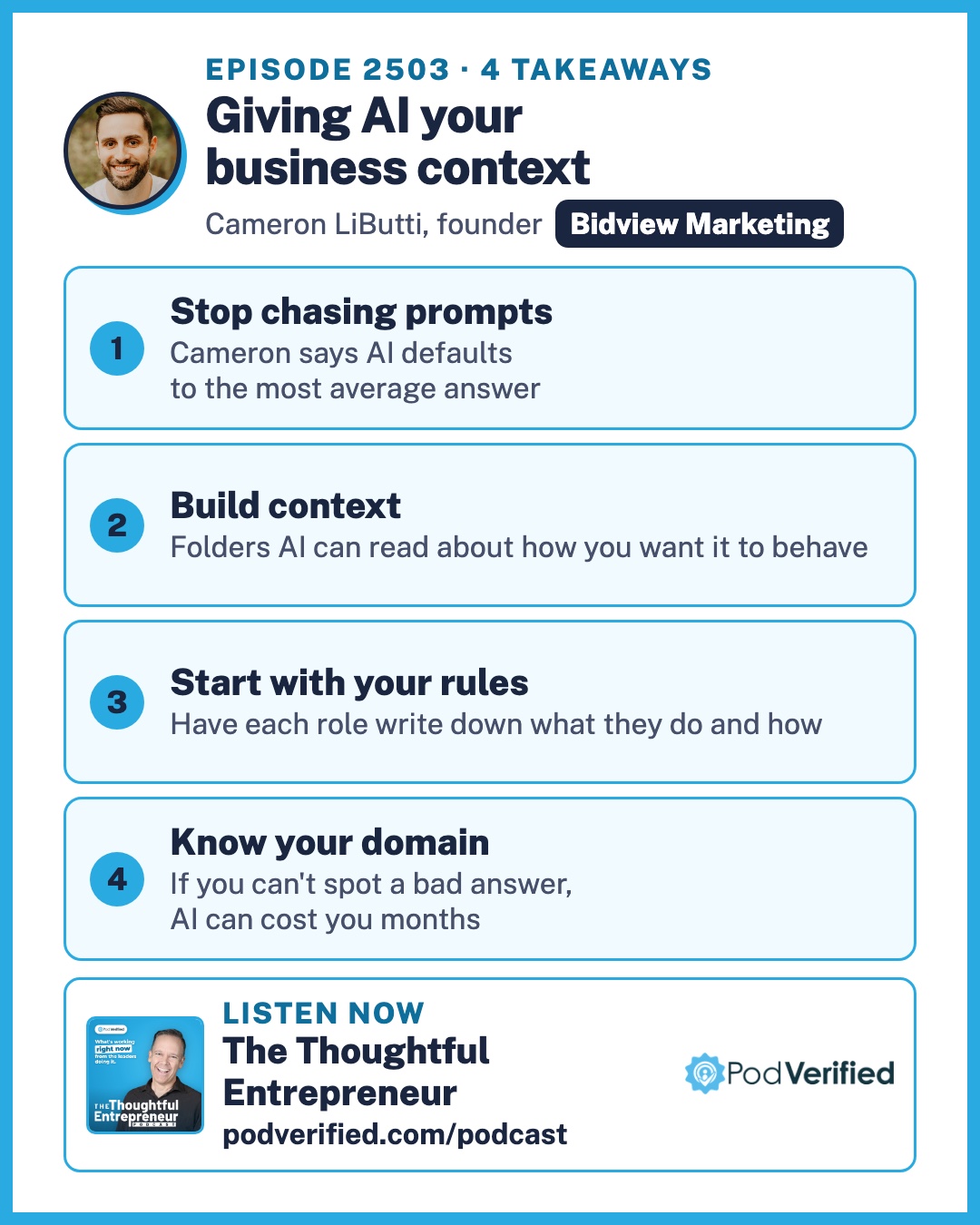
- Prompting won't fix average answers. Cameron says AI is built to give the most average answer to the most people.
- Context is folders AI can read. Cameron writes down the rules of the business and how he wants the AI to behave.
- Three people build the foundation. Cameron names an operations person, a developer and the person who knows the service.
- Shipping slop costs trust. Josh warns that consumers notice AI slop, and Cameron saw a car dealer's ad built around that.
At a networking event a couple of months ago, Cameron LiButti sat through a presentation on how to prompt AI. His reaction: why are we still talking about prompting? Cameron says AI is built to give the most average answer to the most people, and a better prompt won't change that. What changes it is context, written down.
Cameron is the founder of Bidview Marketing, a marketing agency in the northern Chicago suburbs. On the show, he tells Josh why he starts every client from revenue, how he and his senior developer built their own AI harness, the three people every company needs to build an AI foundation, and why a car dealer's ad made fun of AI slop.
🎧 Listen to Cameron's interview
Press play below. About 25 minutes.
Or listen in your favorite app:
Apple Podcasts Spotify YouTube Amazon Music iHeart Audible Pandora Castbox TuneIn
The Thoughtful Entrepreneur is a daily podcast with business leaders. Subscribe so you don't miss one.
Why does AI keep giving you average answers?
Cameron's view is that prompting is a useful skill, like knowing to tell Claude not to write mannered prose, but most people pick that up by using the tools. The bigger problem, he says, is that the AI companies have every reason to make answers the most average for the most people, because that is where the most people find value.
So when people ask Cameron how he gets different results, his answer is that he builds context. People assume he has some magic setup. He says context is a bunch of folders the AI can read that tell it how you want it to behave.
It starts with the rules of your business. Who provides the service? What does the operations person do? Cameron says if you can get those people to write down what they do and how they want it done, the AI will perform far better than you expect. When someone complains that AI hallucinates, he says, it's because they are prompting into the void.
Bidview built this into its own harness. Cameron compares a harness to the Codex app or the Claude desktop app, and says he and his senior developer wrote their own so the company could do data analytics the way he used to do it by hand for five clients, now for a hundred. By Cameron's account, Bidview went from a 100% service-based company last year to an AI-enabled one.
Straight from the recording
Quotes are lightly edited for readability: filler words and stutters removed, nothing reordered. Times are approximate.
“Because to your point, if you just use AI, it's in their best interest to make it the most average for the most people, right?”
“Context is just a bunch of folders that AI can read the way you want it to behave.”
“You have to have the operations person, which I think is the most difficult right now, because operations people don't tend to be technology-native people.”
“And so my philosophy was, well, if you can do marketing to generate more revenue, then let's do it. If you can't, I don't feel comfortable doing that with you.”
Josh's take: build the goose
Josh told agency owners, consultants and coaches listening to take notes. Clients will want the judgment of people who have done the work for decades, he said, plus the AI to do it without the old labor-heavy model.
“You can keep on paying for golden eggs your whole life, or you could just build the goose.”
Josh added a warning from his own use of AI. In areas where he knows the work well, he sometimes sees it suggest a stupid idea with full confidence, and someone who didn't know better could waste six months and a lot of budget on it.
Questions answered
How do you get better results from AI in your business?
Cameron LiButti says to build context instead of chasing better prompts. Write down the rules of your business, what each role does and how you want it done, and keep it in folders the AI can read. He says the AI will then perform far better than you think it can.
What does a company need to build an AI foundation?
Cameron says three people, or three departments in a bigger company: the operations person, the developer who can build the AI system, and the person who knows the service. He calls the operations person the hardest piece right now, because operations people don't tend to be technology-native.
How is AI changing marketing agencies?
Cameron sees the market splitting. Companies that want account managers, strategists and someone to take responsibility will keep paying for custom service, while others will pay much less for a machine that does the work, and he says the middle is getting hollowed out.
Is AI-generated advertising risky for a brand?
Josh says consumers do not like AI slop, and shipping it can lose customers and create bad sentiment. Cameron described a local car dealer ad that opened with intentional AI slop, then switched to real people answering the phone.
How can I reach Cameron LiButti?
Cameron points people to LinkedIn, where he posts his two podcasts: one with a real estate agent friend in Nevada about networking and digital marketing, and a monthly one with a CMO about how big brands solve problems. Bidview Marketing is at bidviewmarketing.com, and Cameron says talking about solving problems is his favorite thing.
Questions to ask your own team this week
Drawn from the examples Cameron gave, not from Bidview Marketing's marketing.
- Have we written down the rules of our business? Cameron says AI context starts there, not with a better prompt.
- Has each role written down what it does and how? Cameron starts with the person providing the service and the operations person.
- Who on our team can spot a bad AI answer? Josh says without domain knowledge, a confident wrong answer can cost six months.
- Would a customer think our last post was AI slop? Josh warns that shipping slop can lose customers and create bad sentiment.
Away from the screen
Cameron coaches football for his 10-year-old and 8-year-old sons, and when he isn't working, he is watching game film. His film sessions with the boys run 15 to 20 minutes: 10 plays, five good and five bad, plus a look at the other team's fast guy and quarterback. Coaches in the league share film freely.
Cameron told parents on day one that the team is there for the boys' development, not for winning at any cost. His goal was 16 plays for the season; by the last game the team had 36 installed, with a 9-year-old quarterback calling audibles. Before Cameron started coaching, his dad, who had coached him, reminded him that his own first team won zero games and he remembered only loving it.
“You don't remember your wins and losses. You remember how much you loved that game.”
Episode details
| Guest | Cameron LiButti |
|---|---|
| Role | Founder, Bidview Marketing |
| Website | bidviewmarketing.com |
| Background | Cameron is the founder of Bidview Marketing, a marketing agency in the northern Chicago suburbs that plans marketing back from revenue. Before marketing, he was an engineer designing mechanical systems for high-rises in Chicago. |
| Topics | AI context, prompting, AI harnesses, marketing agencies, revenue-first marketing, AI slop in advertising, youth football coaching |
| Host | Josh Elledge |
| Episode | 2503, The Thoughtful Entrepreneur |
| Cameron LiButti on LinkedIn | |
| Listen | Play it on this page, or on Apple Podcasts, Spotify, YouTube or Amazon Music |

We're always looking for great guests
Be our next guest on The Thoughtful Entrepreneur
We publish a new conversation every day, so we're always looking for leaders like Cameron. The guests we love most are generous: real experience, a clear point of view, and something useful to give our listeners. Come ready to teach, and we'll make you look great doing it.
Not ready to apply yet? Get your free PodVerified Score to see how podcast hosts size you up. It takes two minutes.
Full transcript
Filler words and stutters removed. Company and guest names corrected where the automatic transcript misspelled them. Times are approximate.
Read the full transcript
Josh Elledge (00:00): With us right now, Cameron LiButti. Cameron, you are the founder of Bidview Marketing. You're in the northern Chicago suburbs. And again, your website, bidviewmarketing.com. Cameron, it's great to have you.
Cameron LiButti (00:13): Thanks, Josh. Thanks for having me on.
Josh Elledge (00:15): Yeah, absolutely. And before we get going, kind of talking about the work that you do and who you serve, you always love hearing from leaders what they do for fun when they're not at work. And what keeps you busy right now?
Cameron LiButti (00:27): It's the football field. If I am not working, I am watching film, which is an insane thing to say for 10- and 8-year-olds. We're reviewing film of our games and of our competitors and then coaching. But I love it. And my wife jokes. People always thank me for coaching, and she laughs. She goes, he's out here for himself.
Josh Elledge (00:51): He loves this so much. Don't thank him. He doesn't need that on his ego. So, OK, wait a minute. So you're watching film of 8- and 10-year-olds. What are you looking for? What do you see in the film that maybe you don't catch in real time?
Cameron LiButti (01:07): So there's no rule. Like when I was a little kid, you had to run like a 6-2, for those football minds. Like you had to run this defense. You couldn't blitz. Offense was limited. Now football's football. If you want to blitz all 11, go ahead. Then it's on the offense to figure out how to stop it. So for example, we played a team two weeks ago. They ran an 8-man front. My kids had never seen that. So we practiced all week. How do you deal with this? How do you solve this problem? And then last week they ran this wide 5-3, and again, explaining to 10-year-olds, this is how you solve this problem in real time. And so it gives you a chance, the week of, to explain to them how we're going to work against this. And all the coaches in our league share film freely back and forth. So it's about helping the boys develop as they get older. You don't send scouts out. You email the other coach: can I have your game from last week? Sure. And you switch.
Josh Elledge (02:07): Wow. Cool.
Cameron LiButti (02:07): So yeah, it's pretty cool. I thought it was crazy a couple of years ago when I started, but film session with the boys is like 15, 20 minutes. My goal is to show 10 plays, five good, five bad. And then basically at this age, the boys love to know what the other team looks like. What are their colors? What do they look like? And then you point out every team's two guys, right? This is their fast guy. This is their quarterback. And you watch that for 90 seconds and that satisfies the boys. Then it's on the coaches to develop a plan and strategy and help them execute. But it's very limited at this age. That is what we do.
Josh Elledge (02:48): Yeah. I mean, that's amazing that you're going into those skills, which they're going to be doing in high school if they play high school. They're going to be looking at the other teams and figuring out what the game plan is ahead of time, no doubt. Aside from that, I wanted to ask you, what would you say, of you personally, are the other skills outside of football that you hope to impart in these boys?
Cameron LiButti (03:17): Well, I told the parents on day one, we're all business owners. We like to win, and certainly in the town I live, winning is important, but I'm not trying to do what it takes. Like if I wanted to win every game, I could do things that would be not...
Josh Elledge (03:36): Nefarious. Cheating.
Cameron LiButti (03:38): No, not cheating. But yes, I could put the same six kids on offense and defense all game. We're not doing that. We're here for the development of children. Listen, I have strong beliefs that for a little boy, there's not many places as great as a football field to learn teamwork and hard work. And so I want them to know at the end of the season that they can do something hard. All these kids have played sports. Very few of them have done something this difficult, right? The physical nature of football. And the other part: my two boys, they're the sons of a coach. We're always in my house talking about football. It's on the TV. And a lot of these kids don't have that. And the mental aspect of football is really hard. My wife is always commenting. She's like, man, you really put a lot, not pressure, but how much can you achieve? So our playbook, my goal for the season was 16 plays. [unclear] And I told the parents, we will go as far as they want to go or they're capable of going. We're up, this last game, we had 36 plays installed. So three more formations. We're calling audibles. I have a 9-year-old quarterback calling audibles. These are things I wasn't planning to do, but if the boys show that they have the capacity to do it, I'll teach them. And so at the end of the season, I want them to all want to come back next year. I want them to be excited about it. All of the feedback from the parents has been, they joke, I don't know what you do on the football field, but I've never seen my son come home with so much energy and excitement. So like I said, winning is nice, but we're not going to do it in a way that is negative to the boys.
Josh Elledge (05:21): So yeah, Cameron, I think folks listening to our conversation right now, if they've got kids anywhere near 8 to 10 and live anywhere near Chicago or Libertyville, wherever, they're going to be, how do we get this guy signed? How do we get this guy as a coach for our team? So very, very cool. Thank you so much. I mean, how many core memories you're creating that they will likely remember, we hope, for the rest of their lives. Or at least it'll come up: I remember when Coach told me about this, and I kept that as a habit. So you're right. It's so much more than sports and winning the game. It's creating character.
Cameron LiButti (06:03): My dad gave me the best advice. So he coached me. And he asked me before I started, this was two seasons ago, he said, how many games did you win your first season? I was 7. So I was like, I don't remember. I just remember loving it. He goes, OK, don't forget that. You won zero games that first season. So that was his message. You don't remember your wins and losses. You remember how much you loved that game. He goes, I bet you don't remember until you got to high school football what your wins and losses were. And I said, no, you're right. And he goes, so just remember that. They'll remember how you make them feel. And it's true. We've lost some games, and half an hour later, you look over and they're eating popsicles and having fun.
Josh Elledge (06:43): Love it. Cameron, thank you so much for that. I really appreciate you indulging me. And again, very, very cool. I'm so delighted for those young boys that you're able to mentor at this time. So let's talk about your work at Bidview. Your marketing agency focuses pretty specifically on revenue, which I think, as a potential client, I like to hear. Because obviously I'm looking for a positive ROI and not to make a dumb decision. And so rather than focus on, you know, there are metrics that are all very important, but at the end of the day, it's the bottom line. Do you mind sharing your philosophy and then talk specifically about who Bidview is?
Cameron LiButti (07:31): Yeah. So marketing was an accident. People like to tease me that I say that, but it's true. I was an engineer. So in Chicago, I was designing mechanical systems for high-rises. And so the idea that you don't know the defined numerical outcome, that's the only way I was trained. If I was going into a building downtown and they said, hey, our boilers are 80 years old, we need new boilers. OK. I would do the math to figure out how much heat that building needed. And then I would work back from there and design a new system. Obviously technology 80 years on is going to be different. So we have to redesign and refit the appropriate technology. And I can get into how I got into marketing, but when I started the company, I would say, why are you making these marketing decisions? How do they support your revenue? Well, I don't know. Marketing is something I'm supposed to do. I spend 10% of my revenue on marketing. And that's how this goes. Why? That was me as an engineer. Why do you spend any money? And the business owners kind of froze. I mean, I was not a salesperson. I was an engineer. I was like, I'll help you solve a problem, but why? And I have to convince myself to work with people, which sounds insane, but I turn people away when I'm like, I don't see it. I don't get it. Your business doesn't make sense. I don't understand how you're going to make money, or you're in a bad market. And so my philosophy was, well, if you can do marketing to generate more revenue, then let's do it. If you can't, I don't feel comfortable doing that with you. So it always starts from, if they'll share revenue numbers, or they'll at least share leads or data with me, we'll work our way back and we'll build, I call it like a marketing engineer program, where this makes sense. So for some, we work with a lot of doctors. So some doctors will say, this is what I do. I'm like, you have hospital systems around here. You can do all of the AI visibility or SEO that you want. You're never going to beat a hospital. So our channels might be paid ads, or we have to solve that. And someone will say, well, I know what you do in Chicago for this person. Well, you don't live in Chicago. Your business isn't in Chicago. So the philosophy was always: start with what the end goal was, which should be increasing revenue, and work our way back from there.
Josh Elledge (09:57): So, looking at some of the content that you're talking about right now, obviously I think we need to talk about how AI is impacting your work right now. If you compare where you're coming in with clients today versus maybe a couple of years ago, where is AI affecting, when you're coming in, and maybe you see the implementation of AI or not? I'm curious particularly about that side of it. What are you seeing?
Cameron LiButti (10:38): That's a big question for someone who used to be an engineer. So I'll pace it out real quick, and then you poke me where you want to hear more. So I started doing machine learning on my own in 2015, before any of those AI papers were released, the famous AI papers released in 2017, '18. So I was early to GPT, which was GPT-2 in 2019. And then I watched that progress here until, I think the moment was last December with the Opus release. And this year has been completely different. So I'll start from last December, because I think that's the most relevant to where we are today. You kind of have two, you know, everything's diverging, and everything that exists in the middle is kind of dissolving. So you'll have the real custom solutions where you want the account managers, the project managers, the strategists, the consultants, and that will continue to be, because those companies want somebody to take responsibility. We do really well in that area, and that's the way we're pushing. And then you have, I would call it the budget, the Costco might be the wrong analogy, but you want the machine to do the work. So you have a company like myself build a machine and you enter into it. The cost is much cheaper. Maybe you were spending a couple thousand dollars a month, and now you can spend a couple hundred and it'll take you through that. But I'm seeing it diverge, and I'm seeing the middle get hollowed out. Me and my senior developer built, we call it the harness. We built our own harness. So for those who are familiar with AI, you can think of the Codex app or the OpenAI app as a harness, or the Claude desktop app as a harness. We essentially built and wrote our own, which gave our company the ability to do data analytics the way I would do data analytics. So the way I used to do it when I was by myself for five clients, how do we do that for a hundred? And so that's what our harness has done. And this is interesting. I've explained this to a handful of developers. There's three pieces to the AI that I am seeing. You have to have three people. You have to have the operations person, which I think is the most difficult right now, because operations people don't tend to be technology-native people. And then you have to have the developer, the person capable of developing the AI system. And then you have to have the person who knows the service. And you have to get all three of those people, or departments, depending on how big your company is, to work together to build this AI foundation. And luckily, at Bidview, it's me and one other person, outside of the operations. He doesn't know operations, but he knows the other two pieces. And then I was able to teach myself the development piece, but obviously I know the service and the operations piece. And that's how we have grown this. We build the plane as we're flying. So we went from being a 100% service-based company last year to certainly an AI-enabled company.
Josh Elledge (13:54): Yeah.
Cameron LiButti (13:54): I don't talk about this when I'm onboarding clients. They don't care, right? They care about the outcomes that you can provide.
Josh Elledge (13:59): That's totally right. Exactly.
Cameron LiButti (14:01): In this scenario, when we're talking to other business owners and entrepreneurs, what does that look like? That's how I'm doing it. I've talked to some people, a former go-to-market person from Google, and showed him, I think this is kind of where the future is. How do you integrate these systems?
Josh Elledge (14:18): One hundred percent. Listen, other agency owners, consultants, coaches listening right now, I hope you're taking notes. The really smart, wise folks that have been doing this for decades, they know their stuff. They bring the judgment, and then they can also bring in the harness, because there's no reason today to do things inefficiently and hire an agency that's going to be doing things the old-school, labor-intensive, really expensive, really slow way. It's going to be really hard if that's your agency model to stay in business, I would say especially next year. Because Cameron, what you just described, you bring the wisdom, the judgment, the experience and the harness and the AI technology. So that is the model, no question about it. It's so funny listening to you. That's exactly how we've evolved. We build internal PR systems. You can keep on paying for golden eggs your whole life, or you could just build the goose. AI, if done well. And this is my second point I want to get to, because you made a really good post about this: doing it with just AI. I think there's a lot of business owners that realize this, right? They know that the potential is there, but they know the default, or even if you really try to work with your own AI. I know that there's areas that I have a lot of high domain competence, and when I talk with my AI, there are times where I'm like, that is a really stupid idea. And if you gave that advice to someone who doesn't know better, they are going to waste six months and a lot of budget and a lot of opportunity, because that's a dumb idea. And I'm certain that there's times that you are talking with AI and you're like, that's a really dumb marketing program, my friend. And I feel badly, because there's a lot of business owners, well-meaning, trying to use technology, and the technology comes across as confident no matter what it is. So if you want to do this well and master a particular area of your business, like marketing, which is critical.
Cameron LiButti (16:52): Critical. I was at a networking event a couple months ago and somebody was giving a presentation, and it was about, how do you prompt? And I'm like, why are we still talking about prompting? Listen, prompting is a valuable skill, knowing to tell Claude to not use mannered prose. Like, yes, you should know to do that. But most of us kind of pick that up using these tools. The thing that I am trying to influence my team and anybody I talk to is it's about building context. Because to your point, if you just use AI, it's in their best interest to make it the most average for the most people, right? Then the most people find the most value and they use it. And so people are like, well, how do you get different results? It's like, I build context, and everyone thinks I have some magic thing. Context is just a bunch of folders that AI can read the way you want it to behave. Obviously we've developed actual applications into our system, but it starts with what are the rules of your business? And that goes back to, who's the person providing the service? What is the operations person? Like if you can get them to write down what it is that you do and how you want to do it, the AI will perform a hundred times better than you think it can. So every time someone goes, ah, it hallucinates, or it does this, it's because you're just prompting into the void.
Josh Elledge (18:11): That's it. That's a skill problem if your AI is hallucinating. Or if, like in your post, you have AI do some design thing for you, and then you ship it and you don't know better, or you think that it's good enough. It's no different, in my opinion, than people that are pushing out marketing slop and visual slop on social media. And let me tell you, if you work with consumers, they are really not going to like that. You will actively lose customers and create bad sentiment if you ship slop today.
Cameron LiButti (18:55): Yep. I was watching Monday Night Football last night, and there's a local auto dealership, and their whole position, they used the first 15 seconds as intentionally AI slop to say, you don't get this at, they were positioning against it. They're like, you come in and talk to real people. Real people answer the phone. They intentionally mismatched the voice to the woman. You could tell immediately. It was like, what, are they really putting out an ad? This is terrible. And you kind of got hooked into it, and then it switched: no, we're real. You call. They were anchoring against AI slop. So that was pretty cool to see.
Josh Elledge (19:35): Well, yeah, again, look up some statistics on what consumer sentiment is around slop. And be very careful, to my fellow founders, with your reputation, or what your team is doing on your behalf when you're not really aware of what's getting shipped and what's going out on social or what's being communicated. So Cameron, it's been a great conversation. Your website, bidviewmarketing.com. Do you have just a couple more minutes to share a bit, to our friend that's been listening? I don't know if you have any resources that you'd recommend, or what you'd recommend if people want to learn more about you, or maybe they're not quite ready for a call. Where do they go? What do they do?
Cameron LiButti (20:18): So LinkedIn. I should be better about posting, but I do a lot of podcasts now. So if I'm a guest on a podcast, and then I am also hosting two podcasts now. One is, so obviously I do digital marketing. My very successful friend in Nevada, one of the biggest real estate agents in Nevada, his whole world is networking, right? So that conversation is about the difference between networking for success and then running digital marketing for success. And then another podcast that I do, you can see that on LinkedIn as well, with a CMO. I do know a lot about the CMO world, but I am an agency founder. For me, it's about providing these services, doing the actual work. She is fantastic. And we sit down once a month, we pick a topic, and we break it down. So this past one was about Lifetime. Looking at big brands, how they solve their problems and how they do a lot. People think, oh, they have all the money. And one of the things we talk about is, how do they actually do stuff for free? How do they make people fall in love with their services and their brand? And so those are the two podcasts that I do myself, and that all gets posted to LinkedIn. And if you ever do want to talk about solving problems, that is hands down my favorite thing.
Josh Elledge (21:37): Excellent. Cameron LiButti, again, your website, bidviewmarketing.com. We've got a link to that. Of course, we've got a link to your LinkedIn, where folks can find all the content you share. Listen, if there's one thing I could recommend to founders, it's talk with a lot of smart people that really know what's possible with AI. I feel like it's probably one of the better uses of your business development or research time. I mean, we're only limited at this point by our imagination and experience. And Cameron, someone like you has been obsessing on this and building your own harnesses and systems. If you're trying to DIY this, or trying to figure it out yourself, you're really starting at a disadvantage. So again, surround yourself with smart, smart, smart people. Always a good adage. But yeah, Cameron LiButti, you're one of those people. Again, your website, bidviewmarketing.com. Cameron, thank you so much for the conversation.
Cameron LiButti (22:41): Thanks, Josh. I appreciate it.